


Arrow supports .lumen in scaling production of Its glasses for the blind

Arrow Electronics is collaborating with Romanian startup .lumen to scale intelligent guide glasses designed to replicate the key functions of a guide dog.

.lumen’s Glasses for the Blind replicate the essential functions of a guide dog by combining artificial intelligence (AI), six integrated cameras, and real-time haptic feedback on a single wearable headset. The glasses continuously scan and understand the environment in real time, detecting obstacles, identifying safe paths, and guiding the user with gentle directional vibrations.

The entire navigation system runs locally on the device, making it fully independent from the cloud. This architecture delivers ultra-low latency, which is essential for safe, reliable navigation in fast-changing environments such as crowded streets or unfamiliar indoor spaces.

.lumen exhibited on Jan. 5-9, 2026, at CES, Las Vegas, where they were named a CES Innovation Awards 2026 Honouree in the Accessibility and Longevity category, and also won the CTA Foundation’s 2026 Pitch Competition.

Arrow is providing engineering and supply chain services to enable .lumen to scale its production efficiently. This includes identifying, sourcing, and integrating the lengthy list of electronic components required, such as processors, cameras, sensors, and connectors. Arrow is also supporting .lumen with inventory reliability, cost control, and improved performance of the complex wearable technology.

By supporting the development of this technology, Arrow is expanding on its existing work in Semi-Autonomous Mobility (SAM), which uses intelligent technology to provide greater independence to people with physical disabilities. An example of Arrow’s previous work in this area is the Arrow SAM Car, the series of advanced cars that can be controlled by a quadriplegic race driver with support from an AI model and electronics developed by Arrow engineers.

“We are helping to create a device which will eventually make life better for millions of people,” said Vitali Damasevich, Arrow’s regional director of engineering in Eastern Europe. “At Arrow, we are committed to supporting the .lumen team to help ensure this breakthrough technology can be reliably and efficiently manufactured so it can get into the hands of those who need it most.”

“Growing up in a family where everyone but me had a disability, I realised how much technology can help people with disabilities, but also how rarely it’s built for people with disabilities. I founded .lumen to solve this,” said Cornel Amariei, founder & CEO of .lumen.

“The Glasses for the Blind use .lumen’s proprietary Pedestrian Autonomous Driving AI technology. It does everything a self-driving car does, but on the pedestrian side. The best part is this technology doesn’t need any infrastructure change.”

.lumen is currently taking orders for the device, which aims to provide users with unprecedented mobility and freedom. Future software updates include features such as “Take Me,” which is designed to integrate with mapping services and extend navigation capabilities beyond obstacle avoidance.

arrow.com

> Read More

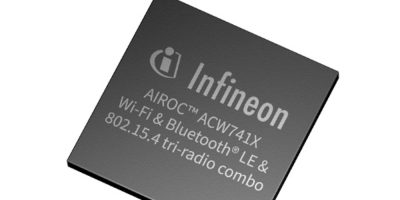
Infineon introduces the industry’s first Wi-Fi 7 IoT 20 MHz tri-radio device optimised for IoT

To support continued growth of connected devices in home, industrial and commercial markets, Infineon has introduced the AIROC ACW741x, a new product family that integrates a tri-radio with Wi-Fi 7, Bluetooth LE 6.0 with Channel Sounding, and IEEE 802.15.4 Thread, with Matter ecosystem support in a single device. This product family introduces the industry’s first 20 MHz Wi-Fi 7 device for IoT, provides Wi-Fi 7 Multi-Link for IoT for enhanced robustness in congested environments and has the industry’s lowest Wi-Fi connected standby power.

With the IoT connectivity market projected to reach 30 billion devices by 2030 [1], IoT device manufacturers continue to demand reliable, energy-efficient and cost-effective solutions. The Wi-Fi Alliance is introducing the 20 MHz device category for Wi-Fi 7 aimed at addressing the needs of the broader IoT ecosystem, and the AIROC ACW741x is the industry’s first product to support 20 MHz-only channels, with optimised radio performance and ultra-low power consumption.

As Wi‑Fi–connected IoT devices proliferate across homes and commercial environments, spectrum congestion and interference increasingly undermine wireless connectivity and performance. With Wi‑Fi 7 Multi‑Link for IoT, the ACW741x boosts link reliability with Adaptive Band Switching to mitigate congestion and interference. By maintaining concurrent links across 2.4, 5, and 6 GHz, Wi‑Fi 7 Multi‑Link for IoT delivers a more consistent, always‑connected experience for applications such as security cameras, video doorbells, alarm systems, medical devices, and HVAC systems.

The Infineon ACW741x product family has an optimised 20 MHz design to achieve the industry’s lowest power consumption, and is ideal for battery-operated applications such as security cameras, door locks, and thermostats that require ultra-low Wi-Fi connected standby power. Compared to other IoT Wi-Fi products on the market, the ACW741x offers up to 15x lower standby power consumption, which delivers significantly longer battery life.

The ACW741x also integrates wireless sensing capabilities, which adds contextual awareness to smart IoT devices to create differentiated offerings such as home automation and personalisation. Wi-Fi Channel State Information (CSI) 802.11bf enables enhanced Wi-Fi sensing with intelligence sharing between same-network devices, whereas Channel Sounding delivers accurate, secure, low-power ranging with centimeter-level accuracy.

Combining extensive on-chip integration—including transmit/receive switches, power amplifiers, low-noise amplifiers, power management, and a low-power oscillator—with a QFN package that enables low-cost two-layer PCB designs, the ACW741x provides a cost-efficient migration path to Wi‑Fi 7.

https://www.infineon.com/promo/acw741x.

> Read More

Digid announces its nanoscale temperature and force sensors are ready for mass deployment

Digid has announced that its patented printed electronics fabrication technology has been fully qualified for volume production of temperature and force sensors as small as 1µm long.

Digid sensors are believed to be the world’s smallest – and are set to become even smaller: Digid’s technology roadmap forecasts future production of sensors that are just 10nm long.

This nanoscale sensing technology provides the key that will unlock the potential of multiple emerging markets, including physical AI and humanoid robots. In robotics, for instance, Moravec’s paradox – that robots struggle with tasks which humans find easy, such as handling a delicate wine glass – has persisted in part because robot hands lack the billions of nerve endings on a human finger.

Now Digid offers the opportunity for machines to mimic human sensory capabilities: its nanoscale printed sensors can be applied to surfaces such as a robot’s shell in arrays of up to 16 x 16 sensors.
Other applications for Digid sensors include:
Force sensing on the blade of a scalpel in robotic surgical equipment
Temperature sensing on the tip of a temperature probe used in minimally invasive surgery
Temperature sensors embedded inside battery cells, for safety and performance monitoring
Biosensors for detecting biological objects such as viruses, or the chemical markers of drugs in the bloodstream

Dr Konstantin Kloppstech, Chief Technology Officer of Digid, said: ‘With the start of mass production of Digid sensors, the opportunities to embed sensing on almost any surface or in almost any device have become limitless. Our sensor is so small that it cannot be seen with the naked eye. Now it is up to the imaginations of design engineers to dream of uses for sensing where sensing has never before been possible.’

For each design project, Digid supplies a custom sensor and sensor assembly backed by hardware and software integration support. The sensor provides either a voltage or resistance measurement output via an I2C interface. Digid signal processing software converts the raw measurement outputs to useful temperature or force data.

digid.com

> Read More

Bosch Sensortec launches BMI5 motion sensor platform at CES

At CES 2026, Bosch Sensortec introduces the BMI5 platform, a new generation of inertial sensors designed to provide consistent, high-precision performance across multiple device classes. Built on a shared hardware foundation and adapted through intelligent software, the platform launches with three variants – BMI560, BMI563 and BMI570.

At the core of the BMI5 platform is Bosch’s latest MEMS architecture, which defies thermo-mechanical stress effects, provides ultra-low noise, vibration robustness and twice the full-scale range of the previous generation. A latency of below 0.5 ms, combined with a time increment of approximately 0.6 µs and a timing resolution of 1 ns, ensures responsive and reliable motion tracking in highly dynamic environments. A compact industry-standard LGA package further simplifies integration. A programmable Edge-AI classification engine supports always-on functionality by analysing motion patterns directly on the sensor, reducing system power consumption and accelerating customer-specific use cases.

The BMI560 is optimised for XR headsets and glasses, where low noise, low latency and precise time synchronisation enable natural head motion, frame prediction and intuitive 3D interaction. For smartphones and action cameras, its advanced OIS+ performance helps capture stable, high-quality footage even in dynamic environments.

The BMI563 combines an extended Full Scale Range (FSR) with the platform’s vibration robustness, supporting Simultaneous Localisation and Mapping (SLAM), high-dynamic XR motion tracking and motion-based automatic scene tagging in action cameras. Its design ensures reliable data acquisition under demanding robotic motion profiles.

The BMI570 provides dependable activity tracking, advanced gesture recognition and accurate head-orientation data for spatial audio. Its robustness under dynamic sports and everyday movements makes it a strong fit for next-generation wearables and hearables.

Across all variants, the BMI5 platform meets Bosch Sensortec’s highest ecological standards to date, combining technical performance with responsible innovation. This unified architecture enables device makers to streamline development across product lines, while supporting future edge-AI and ML-enabled enhancements.

www.bosch-sensortec.com

> Read More

About Smart Cities

This news story is brought to you by smartcitieselectronics.com, the specialist site dedicated to delivering information about what’s new in the Smart City Electronics industry, with daily news updates, new products and industry news. To stay up-to-date, register to receive our weekly newsletters and keep yourself informed on the latest technology news and new products from around the globe. Simply click this link to register here: Smart Cities Registration