

POLYN Technology announces first silicon-implemented NASP chip

POLYN Technology has announced the successful manufacturing and testing of the world’s first silicon-proven implementation of its unique NASP (Neuromorphic Analog Signal Processing) technology.

The NASP platform employs trained neural networks in the analog domain to perform AI inference with much lower power consumption than conventional digital neural processors.

NASP chips with AI cores process sensor signals in their native analog form in microseconds, using microwatt-level power and eliminating all overhead associated with digital operations. This is ideal for always-on edge devices. Application-specific NASP chips can be designed for a diverse range of edge AI applications, including audio, vibration, wearable, robotics, industrial, and automotive sensing.

NASP technology and POLYN’ design tools automatically convert trained digital neural network models into ultra-low-power analog neuromorphic cores ready for manufacturing in standard CMOS processes. The testing confirmed the chip’s parameters strictly match its model.

This first chip contains a VAD core for real-time voice activity detection. It marks the first step toward a new level of voice processing offered by POLYN. It will be followed by other cores POLYN is developing for speaker recognition and voice extraction, enhancing home appliances, critical communications headsets, and other voice-controlled devices.

Customers developing products with ultra-low power voice control can apply online for the NASP VAD chip evaluation kit.

POLYN’s NASP technology and design tools give semiconductor and AI developers a new way to quickly implement neural networks directly in analog silicon. It offers process-agnostic design across 40–90 nm CMOS nodes and automatic conversion from digital ML models.

POLYN is preparing evaluation kits for early adopters and extending the implementation of its NASP product families for automotive, critical communication, and wearable applications.
polyn.ai

> Read More

Connect smart meters, trackers, and sensors with NB IoT Click from Mikroe

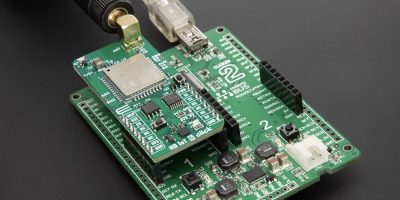
NB IoT 6 Click is a compact add-on development board that provides reliable narrowband IoT connectivity for embedded applications. This new Click board from Mikroe, is created around the BC65, a high-performance multi-band NB-IoT module from Quectel with ultra-low power consumption and which is compliant with 3GPP Release 13 and Release 14 standards.
Comments Nebojsa Matic, CEO of Mikroe: “This new Click board enables enable designers to prove that they can connect smart meters, asset trackers, and sensors over long distances, then begin full product development immediately without having to learn new tools or pay for expensive development kits.”

Other applications include smart parking, wearables, smart city solutions, agriculture, environmental monitoring and home appliances that requires wide-area coverage and stable communication.

A new member of Mikroe’s 1900-strong mikroBUS -enabled Click board family, NB IoT 6 Click operates across a wide frequency range from approximately 700MHz to 2.2GHz, supporting LTE bands B1, B3, B5, B8, B20, and B28 with a transmission power of 23dBm ±2dB and a receiving sensitivity of –114dBm. Alongside the main UART interface with hardware flow control, it integrates auxiliary and debug UARTs, a general-purpose 10-bit ADC channel, a SIM card holder, a network status LED, and an SMA LTE antenna connector.

NB IoT 6 Click is fully compatible with the mikroBUS socket and can be used on any host system supporting the mikroBUS standard. It comes with the mikroSDK open-source libraries, offering flexibility for evaluation and customisation.  Click boards enable design engineers to change peripherals easily, cutting months off development time. To enable hundreds of Click board to be connected to the microcontroller or microprocessor, the mikroBUS uniform connection interface allows designers to connect any Click board to a main board instantly.

www.mikroe.com

> Read More

u-blox launches firmware-upgradeable meter-level GNSS for enhanced IoT performance

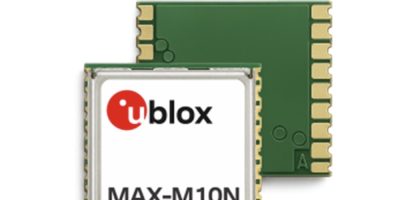
u-blox has announced the launch of the UBX-M10150-KB chip and the MAX-M10N module – the first M10-platform GNSS hardware designed with firmware upgradeability. Both products run the new SPG 5.30 firmware, introducing Low Energy Accurate Positioning (LEAP) – a mode that reduces power consumption by up to 50 percent while maintaining superior positioning accuracy. Designed for battery-powered devices, the new chip offers ultra-low power consumption of just 8 mW in continuous tracking. The new products are ideally suited for vehicle, people, and pet tracking, as well as livestock monitoring and wearable applications.

The UBX-M10150-KB and MAX-M10N extend the capabilities of the M10 family beyond previous ROM-based products. With SPG 5.30, they offer a set of new technical features: LEAP replaces cyclic tracking mode to achieve significant energy savings including external LNA power cycling, and RTCM corrections input supports positioning accuracy down to the sub-meter level. In addition, the firmware adds data logging and geo-fencing functions, enabling more autonomous tracking and monitoring directly on the device.

Both products include lifetime access to AssistNow Predictive Orbits and Live Orbits, which accelerate start-up times and improve positioning performance when using small antennas or operating in weak-signal environments. The EVK-M102 evaluation kit and u-centre 2 software are available to simplify the design-in phase for developers.

www.u-blox.com

> Read More

Rutronik adds SoC from Nordic for advanced Bluetooth LE and Matter applications

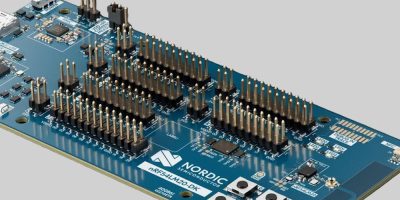
With the nRF54LM20A, Rutronik is expanding its SoC portfolio with the latest component from Nordic Semiconductor’s nRF54L series. This flexible wireless SoC combines an ultra-low-power 2.4 GHz radio with 128 MHz Arm Cortex-M33 processor, extensive peripherals and scalable memory configurations. Thanks to integrated high-speed USB, extended memory (2 MB NVM, 512 KB RAM) and modern security functions, the nRF54LM20A enables energy-efficient designs for future-oriented applications such as wearables, gaming peripherals or smart home solutions. The nRF54LM20A SoC and the matching nRF54LM20-DK are available for pre-order. The official sales launch is planned for Q1 / 2026.

The nRF54LM20A complements the nRF54L series and impresses with even more performance and flexibility. Proprietary technologies such as low-leakage RAM and advanced multi-protocol radio design significantly reduce power consumption – a key advantage for developers looking to reduce battery size or extend battery life.

To support cost optimisation and flexibility in the design cycle, the SoCs are available in memory and package configurations with up to 66 GPIOs including pin-to-pin options.

The associated development kit (nRF54LM20-DK) provides a complete functional overview on one board. It is supported by the nRF Connect SDK and tools and enables a quick start. Free training courses from the Nordic Developer Academy round off the offer for developers.

www.rutronik24.com

> Read More

About Smart Cities

This news story is brought to you by smartcitieselectronics.com, the specialist site dedicated to delivering information about what’s new in the Smart City Electronics industry, with daily news updates, new products and industry news. To stay up-to-date, register to receive our weekly newsletters and keep yourself informed on the latest technology news and new products from around the globe. Simply click this link to register here: Smart Cities Registration