
Infineon expands CoolGaN family to deliver up to 82 percent footprint reduction

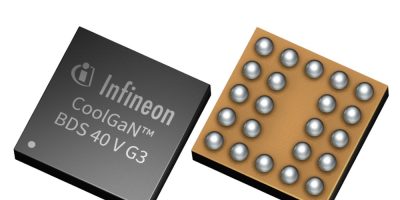
Infineon has expanded its CoolGaN BDS 40 V G3 bidirectional switch (BDS) family with two new devices, the IGK048B041S and IGK120B041S. The new additions reduce PCB footprint by up to 82 percent and cut component count in half. For engineers designing within the strict spatial constraints of modern smartphones, notebooks, and wearables, this is a significant and quantifiable step forward. Targeting compact consumer devices, the new devices give power system designers greater flexibility to optimise efficiency and streamline designs without sacrificing performance.

“As consumer devices continue to shrink while power demands grow, engineers face increasing pressure to deliver more from less. The new CoolGaN BDS devices directly address this challenge,” said Johannes Schoiswohl, GaN Business Line Head at Infineon. “Each device integrates the function of two back-to-back silicon MOSFETs into a single component, reducing component count by half and simplifying PCB layouts. Design teams can leverage existing driver layout, avoiding costly redesigns and accelerating time to market. The result is a leaner and more cost-effective power path.”

The BDS, like other GaN devices, is compatible with 5 V gate drive. Offered in WLCSP chip-scale packages measuring 2.1 x 2.1 mm² and 1.7 x 1.2 mm², the IGK048B041S and IGK120B041S are engineered for the tight spatial constraints of smartphones, notebooks and wearables. The larger GaN device achieves 4.2 mΩ RDD(on) while the smaller device delivers 9 mΩ RDD(on). The CoolGaN BDS devices further distinguish themselves through superior switching and leakage performance. Gate charge is up to approximately 40 percent lower than comparable competing devices. Lower gate charge translates directly to faster switching transitions, reduced switching losses, and improved system efficiency in fast-charging applications. Additionally, Drain-Drain Leakage current is more than 85 percent lower than competing solutions, underscoring the inherent leakage advantages of GaN technology. Together, these characteristics reduce thermal rise, supporting long-term reliability and helping manufacturers meet increasingly stringent safety requirements.

Unlike silicon MOSFETs, which rely on a body diode that can allow unintended current flow, the CoolGaN BDS devices allow bidirectional voltage and current blocking. This true bidirectional blocking capability is essential for applications such as USB overvoltage protection in smartphones and portable devices, where preventing unwanted reverse current is critical to protecting sensitive downstream components. The devices are equally well-suited to load switching and power multiplexing functions in multi-rail power architectures, where precise control of current direction across multiple supply rails is required.

With the addition of these two devices, the Infineon CoolGaN BDS 40 V G3 family now comprises three devices – the IGK048B041S, IGK120B041S, and the previously released IGK080B041S – addressing the full spectrum of mobile power switching requirements from compact wearables to high-performance notebooks.

infineon.com

> Read More

Murata launches ultra-low power sensors for wearable and IoT devices

Murata has commenced mass production of its MRMS166R and MRMS168R anisotropic magnetoresistance (AMR) sensors for healthcare, wearable, and IoT devices. The MRMS166R is the first AMR sensor to combine an average current consumption of 20 nA with operation from a 1.2 V supply, enabling extended battery life in coin cell-powered systems.

The devices are solid-state magnetic sensors used for switching applications. They detect the presence or absence of a magnetic field and generate an output signal that system logic uses to control functions such as transitions between active and sleep modes. This enables contactless switching without mechanical components, improving reliability, and supporting sealed, miniaturized designs.

Automatic switching between active and sleep modes is widely used in battery-powered devices to reduce standby power consumption and extend operating life. In healthcare, applications include capsule endoscopes and medical patches. Wearable devices, including AR glasses and wireless earbuds, as well as security-related IoT devices, such as door open/close detection systems and smart locks, also use this functionality.

These devices commonly use silver oxide coin batteries (typically 1.55 V), which impose constraints on both available capacity and operating voltage. AMR sensors used as magnetic switches must therefore minimize current consumption while maintaining stable operation at low voltage. Murata addressed these requirements through a redesign of the AMR sensor’s internal circuitry, enabling ultra-low current consumption and reliable operation down to 1.2 V. This significantly reduces battery consumption during standby operation, supporting device operation for more than two years in typical use.

Both devices are housed in a compact package measuring 1.0 × 1.0 × 0.4 mm (0.04 × 0.04 × 0.02 inches), making them suitable for space-constrained designs. The MRMS166R operates over a 1.2 to 3.6 V supply range (1.5 V typ.) with an average current consumption of 20 nA and a maximum current output of 1 mA. The MRMS168R operates over a 2.0 to 3.6 V supply range (3.0 V typ.), with an average current consumption of 80 nA and a maximum output current of 12 mA, providing higher output drive capability for devices requiring increased load current.

murata.com

> Read More

ST announces new sensors for personal electronics and smart devices

ST has introduced a new generation of ultralow-power global-shutter image sensors that deliver high-quality, always-on vision to compact devices operating on batteries or harvested energy. The VD55G4 (monochrome) and VD65G4 (RGB colour) sensors, part of the ST BrightSense portfolio, are now available to early adopters, enabling customers to start designing their next generation of smart, ultralow-power vision devices today.

Designed for the next wave of personal electronics and smart devices, the new sensors serve applications including wearables, AR/VR and XR headsets, smart home appliances and medical devices. They are engineered to deliver rich visual context and AI-ready data under tight constraints on power, size, and cost. The sensors combine an ultralow-power detect-and-wake architecture with a very small global-shutter optical format and interfaces optimised for low-power microcontrollers and cost-effective systems on chips (SoCs).

“Always‑on vision is becoming essential for the next generation of personal electronics, from smart glasses and AR/VR headsets to intelligent home appliances and medical devices. With VD55G4 and VD65G4, we are bringing this capability to smaller, lighter products that must run for a long time on a tiny battery. These new sensors help our customers create more intuitive and responsive experiences, extend battery life, and bring embedded vision and edge AI into everyday devices,” said Alexandre Balmefrezol, Executive Vice President and General Manager of the Imaging Sub-Group at STMicroelectronics.

VD55G4 and VD65G4 bring always‑on vision to products that must stay small, light, and extremely power‑efficient. Building on the ST BrightSense family, they add a colour option, faster response for interactive use cases, and simple connectivity to low‑power microcontrollers, making it easier to add vision to space‑ and cost‑constrained designs.

In wearables, the sensors enable all‑day, always‑aware features such as glance detection, presence sensing, and contextual alerts, while fitting into very compact designs and working directly with microcontroller‑based platforms.

For AR/VR and XR headsets, they combine low power and high‑quality capture to support accurate tracking and spatial awareness, helping extend battery life without compromising comfort.

In smart home appliances, IoT devices, and medical products, the sensors allow more intelligence to run locally on the device itself, reducing cloud dependence and standby power. Their tiny size and energy efficiency also make them well suited to solar‑ or energy‑harvesting‑powered vision nodes.

Thanks to an optimised sensor architecture and dedicated always‑on mode, VD55G4 and VD65G4 can consume up to 10 times less power than conventional global‑shutter sensors. They can watch for changes in a scene and wake up the main processor only when needed, shifting from continuous streaming to event‑driven operation. This enables all‑day, always‑on experiences, longer battery life, and practical vision systems powered by small batteries or energy harvesting.

Their very small footprint and integrated image processing simplify design and reduce system cost, while supporting responsive, AI‑ready vision features in a wide range of edge devices.

www.st.com

> Read More

Raltron introduces precision piezo-electric elements for medical and audio applications

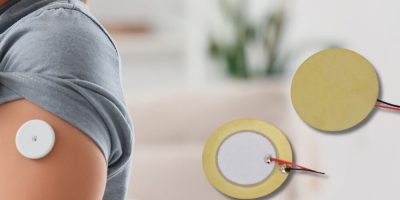
Raltron has announced the expansion of its piezo-electric element portfolio, showcasing a broad range of high‑performance components engineered for demanding audio applications, with emphasis on medical devices, IoT, Fire & Safety, and consumer electronics applications.

Raltron’s piezo-electric elements are available in diameters from 9 mm up to 65 mm, giving engineers wide design flexibility from ultra-compact wearables to larger, high-output acoustic transducers. These elements support frequency ranges from below 2 kHz up to 9 kHz, enabling precise tuning for audio signalling, alarms, prompts, and feedback tones in critical devices.

Manufactured with brass, nickel, or stainless-steel substrates, and with or without the third-wire feedback loops, the line is customisable with lead wires and connectors allowing designers to balance acoustic performance, mechanical robustness, and cost based on each application.

With stable audio performance and tightly controlled capacitance (2,300 pF to 35,000 pF), Raltron’s piezo elements support efficient drive requirements and consistent SPL output. This enables reliable audio signalling in compact, power-sensitive designs.

raltron.com

> Read More

About Smart Cities

This news story is brought to you by smartcitieselectronics.com, the specialist site dedicated to delivering information about what’s new in the Smart City Electronics industry, with daily news updates, new products and industry news. To stay up-to-date, register to receive our weekly newsletters and keep yourself informed on the latest technology news and new products from around the globe. Simply click this link to register here: Smart Cities Registration