


ST introduces new battery-saving wireless MCUs optimised for remote controls

STMicroelectronics has introduced the STM32WL3R, a wireless microcontroller (MCU) optimised for remote control units in consumer products and home automation. Evolved from the STM32WL3 sub-GHz wireless MCU, the STM32WL3R contains a low-power RF transceiver, flexible power-saving states, and six individual wake-up pins that facilitate creating energy-efficient remotes.

ST co-developed the STM32WL3R with France-based building-automation innovator Somfy group, which produces smart systems including wirelessly controlled electric roller shutters, garage openers and connected solutions for home and commercial applications. Engineers at Somfy labs worked with ST to design the new MCU for their next-generation RF remotes and sensors, resulting in a compact and cost-efficient unit that offers flexibility and extended battery life for a great user experience. “This single-chip wireless MCU, optimised for use in remote-control units, lets us continue setting the pace in systems for smarter, more comfortable, and environmentally friendly buildings,” said Serge Robin, RF Development Manager at Somfy.

With its specially engineered RF transceiver, the STM32WL3R is the world’s first Cortex-M0+ multiband wireless MCU to operate in the 315MHz band allocated for remote controls in North America, while the support of the 850MHz and 950MHz ISM bands qualifies its use in products approved for sale worldwide.

Specially adapted for the STM32WL3R, the MCU’s extra power-saving states give greater control to deactivate unused circuitry while also optimising the system wake-up time. In these states, battery life is extended while RAM retention preserves the application context to ensure fast wake-up and thus provide the best possible user experience. Among the states available, ultra-deep stop draws just 450nA while retaining 16KB of RAM data and there is also an incredibly frugal 14nA shutdown mode with up to six wakeup pins.

By providing six wake-up pins, instead of one, the STM32WL3R allows richly featured remotes while simplifying circuit layout and facilitating reuse of the PCB design in multiple product variants.
www.st.com

> Read More

ST reveals new NB-IoT modules for cellular connectivity

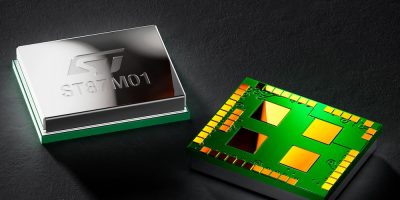
STMicroelectronics has introduced two new ST87M01 NB-IoT wireless modules and revealed an enhanced development ecosystem designed to facilitate the creation of smart IoT solutions with narrowband cellular connectivity. Typical applications include smart logistics, environmental monitoring, smart lighting, smart parking, industrial condition monitoring, livestock and pet tracking, alarms, and remote healthcare.

Existing modules in the ST87M01 family are already installed in smart meters deployed throughout Europe, helping utilities capture real-time granular data to meet environmental and operational goals. “We are now taking the next step to make our module technology and fully owned, resilient supply chain accessible across a wider variety of markets and environments. This all-in-one solution combines industry-leading compactness and ultra-low power consumption with reliability and security, enabling scalable and secure IoT deployments,” said Domenico Arrigo, General Manager, Application Specific Analog Product Division, STMicroelectronics.

The two new modules include the ST87M01-1001, supporting NB-IoT narrowband cellular data connectivity, and the ST87M01-1301 which adds GNSS and Wi-Fi positioning capabilities for outdoor and indoor geolocation. The EVKITST87M01-2 evaluation kit is a comprehensive development platform with a ready-to use Conexa IoT SIM card and two SMA antennas, for prototyping and testing NB-IoT connectivity in real-world applications. ST’s expanded ecosystem also includes the “Easy-Connect” software library and design examples.

ST’s “Easy-Connect” library helps developers to quickly communicate with the module, configure and exercise the NB-IoT, GNSS, and Wi-Fi functionalities, and exchange data with the cellular network, over a C-like, totally hardware agnostic, and OS independent platform. The IoT SIM card provides 50MB of data, valid for 6 months after user activation, through the Conexa network. Operated by ST Authorised Partner Wireless Logic, Conexa supports NB-IoT connectivity across many international markets, with this SIM specifically configured for use in Europe, Middle East, and Africa (EMEA).

“Wireless Logic’s cellular connectivity, included free of charge with ST’s latest NB-loT module evaluation kits, provides the easiest and fastest way to connect and develop prototypes,” commented John Dillon, Product and Marketing Managing Director, Wireless Logic. “Our Conexa IoT network and management platforms provide extensive geographical coverage and ensure resilient and future-proof NB-loT connectivity.”

The Virtual Antenna technology from Ignion, alongside its seven different antenna components and Oxion AI-powered integration platform of RF projects, helps customers select and design-in the right Virtual Antenna chip to meet size, performance, and bill-of-materials constraints. Using Oxion’s antenna integration platform, ST87M01 developers can trial shortlisted antennas, apply best practices, and quickly iterate their designs to fine-tune performance.

Jaap Groot, CEO of Ignion, said, “Our Virtual Antenna® and Oxion™ AI-powered platform solutions make RF design simpler, faster, and more predictable, giving engineers confidence and control throughout development. Working closely with ST, we’ve brought this capability to the new ST87M01 modules, reflecting our shared commitment to deliver integrated, ready-to-scale wireless solutions that help customers save time and focus on what matters most: innovation.”

DAOS can optionally support ST customers throughout system development, from hardware and software design to production, accelerating time-to-market and unlocking the potential of the ST87M01 module in IoT projects.

www.st.com

> Read More

Next-Generation of optical ethernet PHY transceivers from Microchip

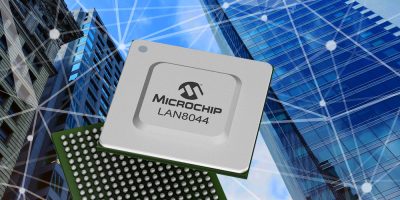
The rise of smart factories, remote monitoring and connected infrastructure are increasing the demand for advanced networking systems that can operate over long distances and in challenging environments. To address the need for reliable and secure connectivity solutions, Microchip has announced its new portfolio of Optical Ethernet PHY transceivers, available in 25 Gbps and 10 Gbps versions, featuring IEEE 1588 Precision Time Protocol (PTP) and Media Access Control Security (MACsec) encryption.

Microchip’s optical Ethernet PHY transceivers provide a secure, deterministic and scalable alternative to traditional copper-based Ethernet solutions. They support link lengths of up to 10 kilometres over single-mode fibre for seamless deployments over dispersed infrastructure such as company and college campuses or warehouses. The integration of PTP time stamping delivers sub-nanosecond (<1ns) synchronisation accuracy across distributed nodes. This level of timing precision is essential for time-sensitive applications such as industrial automation, telecommunications and robotics.

“Design engineers are looking for solutions that simplify complex networking systems, adding PTP or MACsec could mean a complete overhaul of an existing design, our solution helps preserve our customers’ core-processing investment,” said Charlie Forni, corporate vice president of Microchip’s networking and connectivity solutions business. “We’ve integrated these capabilities into our transceivers, enabling bolt-on functionality to help engineers build smarter, more secure and scalable networks.”

The new variants support Ethernet speeds ranging from 1 Gbps to 25 Gbps, enabling higher bandwidth for data-intensive applications such as data centers, campus area networks, and robotic / industrial automation. Designers can easily scale their networks by selecting the appropriate data rate and media (Optical or DAC – Direct Attach Copper) to match their application requirements.

To help safeguard sensitive data in connected environments, security is integrated at the silicon level with support for MACsec (IEEE 802.1AE) encryption. This hardware-based implementation protects against network data breaches by encrypting traffic between Ethernet devices. MACsec is designed to thwart common cyberattacks including man-in-the-middle attacks, denial-of-service (DoS), eavesdropping and spoofing, to ensure data integrity across the network.

microchip.com

> Read More

NXP improves battery health monitoring with EIS capable battery management chipset

NXP Semiconductors has announced its industry-first Electrochemical Impedance Spectroscopy (EIS) battery management chipset with hardware-based nanosecond-level synchronisation of all devices. The new system solution is designed to enhance safety, longevity, and performance in electric vehicles and energy storage systems. It integrates EIS measurement directly into three battery management system (BMS) chipset units, enabling carmakers to gain deeper insights into battery health and behaviour.

OEMs today face increasing pressure to deliver safe and faster charging, longer battery life, and safer battery energy storage systems – all while keeping costs and design complexity in check. Traditional, software-based battery monitoring methods often struggle to precisely detect dynamic, millisecond level events that serve as early indicators of failure. To ensure safe and fast charging, these systems frequently require additional sensors and software.

NXP’s new chipset tackles these challenges by embedding EIS directly into the hardware, consisting of three BMS units: the BMA7418 cell sensing device, the BMA6402 gateway, and the BMA8420 battery junction box controller. It enables real-time, high-frequency monitoring without the need for extra components or costly redesigns. The hardware-based solution operates in highly precise synchronisation to deliver highly accurate impedance measurements with directly in-chip integrated discrete Fourier transformation, helping OEMs better manage safe and fast charging, detect early signs of battery failure, and reduce system complexity.

“The EIS solution brings a powerful lab-grade diagnostic tool into the vehicle. It simplifies system design by reducing the need for additional temperature sensors and supports the shift toward faster, safer and more reliable charging without compromising battery health”, said Naomi Smit, VP and GM, Drivers and Energy System at NXP. “The chipset also offers a low-barrier upgrade path, with pin-to-pin compatible packages that can be directly upgraded to on cell module and battery junction box control units.”

The technology of Electrochemical Impedance Spectroscopy is based on sending controlled electrical excitation signals through the entire battery. NXP’s system solution includes an electrical excitation signal generator, which both pre-charges the high-voltage circuit and produces the excitation signal. This setup allows the DC link capacitors to act as a secondary energy storage—alongside the battery—making the excitation process more energy efficient.

By measuring how the cells respond across different frequencies to the current excitation, the responses reveal subtle changes in the cell’s internal condition, such as temperature gradients, ageing effects, or micro short circuits. Unlike traditional time-based measurements, EIS provides a fast and reliable way to assess the impedance of each cell and distinguish from capacity fade, to estimate battery health even during dynamic conditions like charging or load shifts.

https://www.nxp.com

> Read More

About Smart Cities

This news story is brought to you by smartcitieselectronics.com, the specialist site dedicated to delivering information about what’s new in the Smart City Electronics industry, with daily news updates, new products and industry news. To stay up-to-date, register to receive our weekly newsletters and keep yourself informed on the latest technology news and new products from around the globe. Simply click this link to register here: Smart Cities Registration