
ST’ half-bridge gate drivers ease design with GaN in low-voltage systems

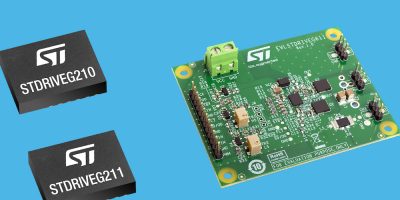
ST’ STDRIVEG210 and STDRIVEG211 half-bridge gallium nitride (GaN) gate drivers are tailored for systems powered from industrial or telecom bus voltages, 72V battery systems, and 110V AC line-powered equipment. Rated for maximum rail voltage of 220V, the drivers integrate linear regulators to generate high-side and low-side 6 V gate signals and provide separate sink and source paths for optimum control.

The STDRIVEG210 is featured for power-conversion applications such as server and telecom supplies, battery chargers, adapters, solar micro-inverters and optimisers, LED lighting, and USB-C power sources. Suitable both for resonant and hard-switching topologies, its 300ns startup time permits to minimise the wake-up time especially during intermittent operation (burst mode).

The STDRIVEG211, equipped with overcurrent detection and smart shutdown, targets motor drives in power tools, e-bikes, pumps, and servos, as well as class-D audio amplifiers, in addition to power supplies.

Both devices simplify and minimise BOM by integrating the bootstrap diode to easily supply high-side driver. The separate gate-driving paths can sink 2.4A and source 1.0A to ensure fast switching transitions and easy dV/dt tuning. Protection features include interlocking to prevent cross conduction, while the high-side and low-side drivers have a short propagation delay with 10 ns matching time for low dead time operation. Under-voltage lockout (UVLO) prevents operating in low-efficiency or dangerous conditions and the STDRIVEG211, which is oriented towards motor-drive applications, has additional high-side UVLO protection.

The devices also have over-temperature protection and dV/dt immunity up to ±200V/ns, while input-voltage tolerance up to 20V helps simplify the controller interface circuitry. A standby pin facilitates power management and a separated power ground allows optimal Kelvin source gate driving or the use of a current shunt.

www.st.com 

> Read More

Renesas expands sensing portfolio with 3 magnet-free IPS ICs 

Renesas has introduced a new family of magnet-free inductive position sensor (IPS) ICs that can be fully customised for various coil designs compatible with a wide range of industrial applications such as robotics, medical and healthcare, smart buildings, home appliances and motor commutation. Built for high resolution, precision, and robust performance, the new RAA2P3226, RAA2P3200, and RAA2P4200 sensor ICs offer a cost-effective alternative to traditional magnetic and optical encoders, which can be bulky, expensive, and require frequent maintenance. Renesas also launched a web-based design tool that allows customers to create custom sensing elements to meet their specific system needs.

Operating on non-contact coil sensor technology, Renesas IPS products use a simple metallic target and dual-coil or single-coil configurations to detect absolute rotary, linear, or arc positions. These sensor ICs are designed to maintain stable operation even in environments with elevated temperatures (-40 to 125°C), particulate matter, moisture, mechanical vibration and electromagnetic interference. Moreover, they are immune to stray magnetic fields and require no maintenance, unlike magnetic- or optical encoder-based sensors. Their durability and low upkeep make them a reliable and cost-effective sensing solution for motor drives, actuators, valves, service robots and infrastructure applications, where reliability and long-term performance are critical.

All three products offer precision in detecting target positions, with accuracy better than 0.1 percent of the full-scale electrical range. Two of the products, the RAA2P3226 and RAA2P3200 operate at 600K RPM (electrical) with propagation delays under 100ns. The RAA2P3226 supports dual-coil sensing with up to 19-bit resolution and 0.01° absolute accuracy, providing the high-precision performance required for robotic applications. The RAA2P4200 targets low-speed applications such as medical devices and power tools and the RAA2P3200 is optimised for high-speed motor commutation. All three products include automatic calibration and linearisation to simplify integration and improve system-level performance.

In addition to these three products, Renesas will also introduce automotive-grade IPS, RAA2P452x and RAA2P4500, which will be available later this year. The dual-channel RAA2P452x allows customers to achieve ASIL D safety compliance when paired with Renesas MCUs.

Designing with inductive position sensors typically involves integrating a PCB, an IC with passive components, and a metal target mounted to the moving part. The most complex part is the external sensing element, such as the transmitter and receiver coils, which must be precisely configured to realize accuracy and customised to the system’s mechanical and environmental requirements. Renesas’ web-based Inductive Position Sensor Coil Optimiser tool tackles this challenge by automating coil layout, simulation, and tuning, significantly reducing the learning curve for developers. With this tool, engineers can also obtain accurate performance estimates and overcome manufacturing constraints by optimising the coil layout.

The RAA2P3226, RAA2P3200 and RAA2P4200 are available in volume production, along with evaluation kits. The automotive-grade RAA2P452x and RAA2P4500 will be in production in Q4/2025. The Inductive Position Sensor Coil Optimiser is available now and supports all Renesas IPS products.

www.renesas.com

> Read More

Sony Semi to release RGB-IR image sensor for in-cabin monitoring cameras

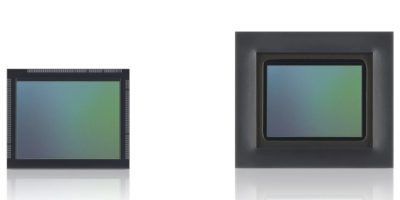
Sony Semiconductor has announced the upcoming release of the IMX775 CMOS RGB-IR image sensor with the industry’s smallest*1 pixel size of 2.1 µm, delivering both RGB and IR imaging on a single chip and a resolution of approximately 5 effective megapixels,*2 designed for in-cabin monitoring cameras.

The new RGB-IR image sensor offers a high resolution of approximately 5 effective megapixels and is capable of capturing wide-angle images of the interior of the vehicle including the driver and passengers. It also delivers high image quality in both visible light (RGB) and 940 nm near-infrared light (NIR) imaging on a single chip with the industry’s highest near-infrared sensitivity and RGB dynamic range.

With the increasing need for advanced safety performance in automobiles, it is now becoming mandatory for vehicles to monitor driver status in order to support safe driving and prevent accidents. Laws and regulations are becoming more rigorous about confirming passenger body type, physical posture, and seat belt usage to ensure passenger safety. Against this backdrop, the new image sensor will contribute to driver and passenger safety and help prevent accidents by enhancing the precision of in-cabin monitoring.

The new image sensor uses Sony’s proprietary pixel structure to achieve both the industry’s smallest pixel size of 2.1 µm and the highest NIR sensitivity at the 940 nm NIR wavelength at the same time. The miniaturised pixels enable a resolution of 5 effective megapixels and a wide angle of view for single-chip monitoring of vehicle interiors including the driver and passengers. A high level of quantum efficiency (QE) in NIR contributes to high-precision recognition of the driver’s line of sight and passenger status even in low-light conditions, and regardless of the time of day.

Furthermore, the product is driven by a hybrid rolling and global shutter system for exposures to deliver the industry’s highest*1 110 dB dynamic range in RGB imaging. A new signal processing algorithm is also used to remove NIR elements from the RGB pixels for on-chip processing, thereby delivering superb colour reproduction.

sony-semicon.com

> Read More

Ambient Scientific announces new AI-native processor for edge applications

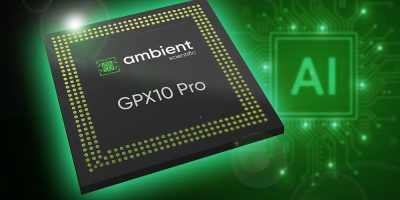
Ambient Scientific has launched the GPX10 Pro, a system-on-chip (SoC) which uses innovative AI-native silicon technology to enable high-performance AI inference on battery-powered edge devices.

The GPX10 Pro’s AI engine supports all important neural networking model types, including CNNs, RNNs, LSTMs and GRUs, locally at the edge. Offering up to 100x improvements in power, performance and area compared to conventional 32-bit microcontrollers, the GPX10 Pro is based on Ambient Scientific’s proprietary DigAn silicon architecture.

This technology enables a neural network model’s matrix-multiply operations and activation flows to be mapped directly to in-memory analog compute blocks, a structure which eliminates the wasted cycles and overheads of a conventional processor’s general-purpose instruction set.

As a result, the GPX10 Pro performs common edge AI functions such as voice recognition, keyword spotting, low-frequency computer vision and intelligent sensing much faster and at much lower power than today’s MCUs, NPUs or GPUs can.

The GPX10 Pro is a highly integrated SoC which enables local AI inference in edge and endpoint devices, even those powered by just a single coin cell battery.

AI processing is performed in two sets of five MX8 AI cores in two separate power domains. One set is in an always-on block which supports ultra-lower power sensor interfacing and fusion – for instance, when performing always-on keyword spotting, the chip consumes less than 100µW. The 10 MX8 cores perform up to 2,560 multiply-accumulate (MAC) operations per cycle, producing total peak AI throughput of 512 GOPs.

The GPX10 Pro’s compute function is supported by 2MB of on-chip SRAM – ten times more than in the existing GPX10 – to enable implementation of larger and more complex AI models.

The GPX10 Pro also features an Arm Cortex-M4F CPU core for classic control functions. Integrated analog functionality includes an ultra-low power ADC, enhanced I2S logic, and interfaces for up to eight simultaneous analog and 20 digital sensors.

Ambient Scientific provides the Nebula AI enablement toolchain to accelerate the training, development and deployment of AI models to the GPX10 and GPX10 Pro. It is compatible with leading model training frameworks including TensorFlow, Keras and ONNX. The chip’s AI cores, which are programmable in the Nebula toolchain, give designers the flexibility to adapt to evolving AI model types and topologies.

Ambient Scientific also provides the SenseMesh hardware sensor fusion layer, which enables low-latency sensor fusion by connecting multiple sensors to a core via a tightly-coupled mesh. This produces instant responses to trigger events, and ultra-low Idle mode power, as it offloads sensor polling from the CPU.

https://www.ambientscientific.ai/

> Read More

About Smart Cities

This news story is brought to you by smartcitieselectronics.com, the specialist site dedicated to delivering information about what’s new in the Smart City Electronics industry, with daily news updates, new products and industry news. To stay up-to-date, register to receive our weekly newsletters and keep yourself informed on the latest technology news and new products from around the globe. Simply click this link to register here: Smart Cities Registration