


Microchip PIC MCUs integrate logic and control to reduce latency and cost

Engineers designing timing‑critical systems for motor control, industrial automation and automotive safety applications often face challenges with latency and unpredictable software execution. To help address these challenges without adding the cost and complexity of multi-chip designs, Microchip Technology is expanding its Configurable Logic Block (CLB)–based microcontroller (MCU) portfolio. The PIC16F13276 and PIC18-Q35 families combine Complex Programmable Logic Device (CPLD)-like programmable logic and an MCU in a single, low-power device.

Microchip’s CLB is designed to simplify multitasking by enabling users to implement logic functions in dedicated hardware instead of software. This helps reduce power consumption, provide more predictable system behaviour and improve throughput compared to software only MCU solutions or discrete CPLD‑plus‑MCU implementations. The new device families offer the option to automatically load the CLB at power‑up or reset, allowing the logic to initialise independent of the CPU, supporting predictable startup behaviour that may be required in functional safety, industrial and automotive systems.

The PIC16F13276 family has 32 logic elements and the PIC18‑Q35 family has 128 logic elements, enabling engineers to implement parallel, deterministic logic alongside embedded control on a single chip. This integrated approach can replace separate CPLD and MCU designs, reducing bill of materials (BOM), board space and overall system cost and complexity.

The devices are drop-in compatible with existing PIC16 and PIC18 designs, enabling customers to adopt hardware-based logic without a complete redesign of their systems. Additionally, Programming and Debugging Interface Disable (PDID) provides anti‑tamper protection to help safeguard designs from unauthorised access and malicious modification.

With hardware‑based timing paths, Microchip’s CLB addresses timing challenges in software-based systems and a CLB timing analysis tool allows designers to identify signal delays, critical paths and potential timing risks early in the design cycle. Verifying timing issues upfront helps reduce debug time. Visit the website to learn more about Microchip’s portfolio of CLB-enabled MCUs.

microchip.com

> Read More

ST reveals high-precision op amps for high precision applications

STMicroelectronics’ TSB192 dual op amps deliver very high precision for applications that need a wide operating-voltage range, with offset voltage of 20µV, temperature drift of 100nV/°C, and gain-bandwidth of 8MHz.

While op amps with comparable offset voltage are usually precision devices that require a low-voltage supply, ST’s TSB192 can operate from any voltage between 4V to 36V. With 30µV maximum offset across the full temperature range and the low drift, the TSB192 minimises reliance on compensation in signal-conditioning networks within industrial, automotive, healthcare, and consumer-electronic equipment. Drawing up to 1.9mA per channel extends the runtime of battery-operated equipment and rail-to-rail outputs maximise the available dynamic range.

The precision and linearity of the TSB192 ensures repeatable performance in analog integrators and measurement circuitry of equipment such as temperature detectors, medical instrumentation, electronic scales, and industrial test instruments. The generous gain-bandwidth, combined with 5V/µs slew rate and 11nV/√Hz input noise, enhances frequency response and minimises distortion in amplifiers for transducers, bridges, strain gauges, and in precision active filters. The devices operate from -40°C to 125°C, making them suitable for automotive applications, and have ESD tolerance up to 4kV HBM.

www.st.com

> Read More

Rohm launches new lineup of 17 high-performance Op Amps

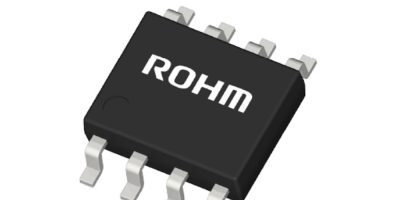
Rohm has added the new CMOS op amp series “TLRx728” and “BD728x“ to its lineup. These are suitable for a wide range of applications including automotive, industrial, and consumer systems.

In recent years, demand for high-accuracy op amps has been rapidly increasing as automotive and industrial systems become more sophisticated, demanding faster speed, better precision, and higher efficiency. In applications requiring amplification of sensor outputs, minimising signal error and delay is essential. To meet these requirements, a well-balanced set of key characteristics is needed, including Input Offset Voltage, Noise, and Slew Rate.

These new products are high-performance op amps that offer a low input offset voltage, low noise, and high slew rate. TLRx728 features an input offset voltage of 150 µV (typ.), while the BD728x offers 1.6 mV (typ.). Both series have a noise voltage density of 12 nV/√Hz at 1kHz and a slew rate of 10 V/µs. They are therefore suitable for a wide range of precision applications, including sensor signal processing, current detection circuits, motor driver control, and power supply monitoring systems. Both series are designed to balance versatility and high performance rather than being limited to specific applications.

Rail-to-Rail input/output capability allows maximum utilisation of the power supply voltage range, ensuring a wide dynamic range.

Furthermore, in addition to 1 channel, 2 channels, and 4 channels configurations, a diverse range of packages is available, enabling optimal product selection based on application and board size.

rohm.com

> Read More

Power‑management optimized ICs for STM32 microprocessors in industrial applications

ST’s STPMIC1L and STPMIC2L power-management ICs (PMICs) help designers leverage the embedded-processing muscle of ST’s Arm Cortex-A microprocessors (MPUs) in performance-oriented industrial applications.

Tailored for the 32-bit STM32MP1x and 64-bit STM32MP2x series, the new PMICs deliver cost-effective power and protection while saving board space, simplifying hardware design, and minimising the bill of materials. With multiple fixed and adjustable LDOs and DC/DC buck converters for all MPU power rails, each PMIC also contains an LDO suited to powering external DDR DRAM.

The PMICs target equipment such as point-of-sale (POS) terminals, network gateways, home-automation systems, edge-processing platforms, printers, barcode scanners, and metering systems. With their extended junction temperature rating from -40°C to 125°C, the devices withstand harsh environments in applications like industrial controls, thermostats, and smart-factory devices.

The STPMIC1L for the STM32MP1 series has two DC/DC buck converters and four LDOs, one LDO for DRAM, and two external pins for power control. The STPMIC2L for the STM32MP2 series has three DC/DC buck converters and seven LDOs for the 64-bit MCUs, one DRAM LDO, and three pins for power control. Each has a large input voltage range, from 2.8V to 5.5V, easing the design of equipment powered from a low-voltage AC/DC wall adaptor, USB outlet, or Li-ion or Li-Po batteries.

The buck converters of these PMICs implement adaptive constant on-time (COT) to ensure fast transient response, as well as supporting dynamic voltage scaling for optimal efficiency. Safety and protection include programmable output discharge modes, selectable overcurrent protection (OCP), and power-rail monitoring. The PMICs also handle power-up/down sequencing and meet the MPUs’ accuracy and settling-time specifications.

Two evaluation boards, STEVAL-PMIC1LKV1 and STEVAL-PMIC2LKV1, are available to help engineers kick-start their projects and accelerate development. Each has a dedicated graphical user interface that eases configuring and monitoring the PMIC on the evaluation board and setting up the NVM parameters.

Both STPMIC1L and STPMIC2L are fully supported by the STM32 MPU ecosystem, in OpenSTLinux.

www.st.com/STPMIC1L-2L

> Read More

About Smart Cities

This news story is brought to you by smartcitieselectronics.com, the specialist site dedicated to delivering information about what’s new in the Smart City Electronics industry, with daily news updates, new products and industry news. To stay up-to-date, register to receive our weekly newsletters and keep yourself informed on the latest technology news and new products from around the globe. Simply click this link to register here: Smart Cities Registration