

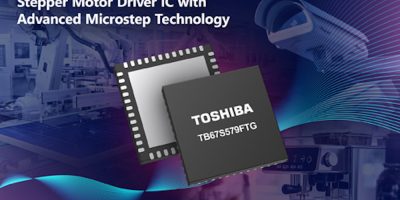
Toshiba launches stepper motor driver IC featuring next-gen Advanced Microstep Technology

Toshiba has launched the TB67S579FTG, a next-generation stepper motor driver IC featuring Advanced Microstep Technology. This two-phase, bipolar stepper motor driver employs a constant current control method. With its advanced functions, it achieves high efficiency, low vibration, and low noise in motor operation. Target applications include office equipment, such as printers and scanners, as well as a wide range of commercial and industrial equipment, including surveillance cameras, projectors, ATMs, 3D printers, sewing machines, and many more.

The high-efficiency stepper motor driver IC is Toshiba’s first product featuring the newly developed Advanced Microstep Technology, including three key functions: second-generation Active Gain Control (AGC2), the newly developed Automatic Wave Generation System (AWGS), and the newly developed Continuous Microstepping. Continuous Microstepping significantly reduces vibration and noise, especially during low-speed rotation, by creating a continuous, sinusoidal motor drive current waveform.

Typical microstep control methods require increasing the input clock (CLK) frequency in proportion to the number of microsteps. Automatic Wave Generation System (AWGS) is a function that enables driving a stepper motor in microstepping mode using a single CLK signal as required for full-step rotation control. Even in applications where a stepper motor is initially driven in full-step mode, to quickly generate torque and then switch to microstepping for lower vibration and noise, a smooth transition can be achieved without the need to adjust control signals. As a result, the processing load on control devices such as microcontrollers (MCUs) can be significantly reduced.

Generally, a stepper motor is continuously driven at the maximum current required under peak load conditions. Active Gain Control (AGC2) detects the induced voltage during motor operation to determine the load and automatically adjusts the required motor drive current. This mechanism enables the motor to operate with the minimum required current under light-load conditions, allowing for higher efficiency and, therefore, lower power consumption. AGC2 also improves the current waveform and torque by realising a ‘full’ full-step operation.

In addition to the conventional GPIO configuration interface, the TB67S579FTG offers a flexible serial configuration interface, enabling easy adjustment of advanced features such as microstepping, AGC2, and decay modes without increasing pin count or system complexity.

TB67S579FTG’s output stage (covering the upper and lower transistors) has an RDS(ON) of just 0.6Ω (typ.). When in sleep mode, the device draws a maximum current of 1A. To simplify system integration, the driver operates with a single motor power supply, ranging from 4.5V to 34V. The product also employs Toshiba’s Advanced Current Detection System (ACDS), eliminating the need for external current sense resistors. The built-in charge pump circuit does not require an external capacitor. Eliminating the need for these external components enables substantial space savings in the mounting area and reduces the bill-of-materials (BoM) cost.

Additional features include Advanced Dynamic Mixed Decay (ADMD), which can achieve up to 30% higher rotation speed without increasing noise and vibration. The driver IC also implements comprehensive protection functions, including overcurrent detection, thermal shutdown, under-voltage lockout, error flag output, and open-load and stall detection. The integrated stall detection function reliably identifies motor lock conditions, enhancing operational safety and preventing potential damage to mechanical components and electronics.
toshiba.semicon-storage.com

> Read More

Infineon launches the next-generation of USB 2.0 peripheral controller

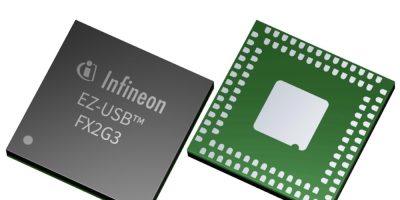
Infineon is introducing the EZ-USB FX2G3, a next-generation USB 2.0 peripheral controller designed to deliver superior performance, robust security, and advanced power efficiency for USB devices. This new controller builds on the EZ-USB FX2LP platform and offers a highly adaptable solution for industries requiring seamless and secure connectivity.

The demand for efficient and secure data transfer is driving innovation across industries, and USB technology plays a critical role in enabling this connectivity. EZ-USB FX2G3 controllers include Serial Communication Blocks (SCB), a crypto engine for enhanced security, and a high-bandwidth data subsystem that facilitates DMA data transfers from LVCMOS input to USB output at speeds up to 480 Mbps, suitable for USB Hi-Speed-based host systems. A 1024 KB SRAM is integrated within the high-bandwidth data subsystem to provide ample buffering for data.

EZ-USB FX2G3’s versatility enables it to seamlessly integrate into a variety of industries. In biometric systems, for example, the FX2G3 powers secure and fast fingerprint recognition or facial authentication, providing consumers with a convenient and secure way to access their devices. In medical and healthcare devices, the controller drives portable diagnostic tools, imaging systems, and patient monitoring, enabling healthcare professionals to provide more effective and efficient care. In industrial systems, the controller facilitates real-time data collection and communication in robotics and automation systems, improving productivity and efficiency. In consumer electronics, the controller’s speed and efficiency enhance gaming devices, audio peripherals, and other USB accessories, providing consumers with a more enjoyable and immersive experience. In robotics, EZ-USB FX2G3 supports sensor integration and advanced control, delivering high responsiveness in both industrial and consumer designs.

infineon.com

> Read More

Infineon introduces the industry’s first Wi-Fi 7 IoT 20 MHz tri-radio device optimised for IoT

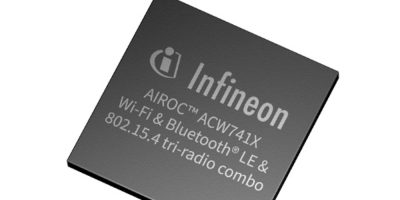
To support continued growth of connected devices in home, industrial and commercial markets, Infineon has introduced the AIROC ACW741x, a new product family that integrates a tri-radio with Wi-Fi 7, Bluetooth LE 6.0 with Channel Sounding, and IEEE 802.15.4 Thread, with Matter ecosystem support in a single device. This product family introduces the industry’s first 20 MHz Wi-Fi 7 device for IoT, provides Wi-Fi 7 Multi-Link for IoT for enhanced robustness in congested environments and has the industry’s lowest Wi-Fi connected standby power.

With the IoT connectivity market projected to reach 30 billion devices by 2030 [1], IoT device manufacturers continue to demand reliable, energy-efficient and cost-effective solutions. The Wi-Fi Alliance is introducing the 20 MHz device category for Wi-Fi 7 aimed at addressing the needs of the broader IoT ecosystem, and the AIROC ACW741x is the industry’s first product to support 20 MHz-only channels, with optimised radio performance and ultra-low power consumption.

As Wi‑Fi–connected IoT devices proliferate across homes and commercial environments, spectrum congestion and interference increasingly undermine wireless connectivity and performance. With Wi‑Fi 7 Multi‑Link for IoT, the ACW741x boosts link reliability with Adaptive Band Switching to mitigate congestion and interference. By maintaining concurrent links across 2.4, 5, and 6 GHz, Wi‑Fi 7 Multi‑Link for IoT delivers a more consistent, always‑connected experience for applications such as security cameras, video doorbells, alarm systems, medical devices, and HVAC systems.

The Infineon ACW741x product family has an optimised 20 MHz design to achieve the industry’s lowest power consumption, and is ideal for battery-operated applications such as security cameras, door locks, and thermostats that require ultra-low Wi-Fi connected standby power. Compared to other IoT Wi-Fi products on the market, the ACW741x offers up to 15x lower standby power consumption, which delivers significantly longer battery life.

The ACW741x also integrates wireless sensing capabilities, which adds contextual awareness to smart IoT devices to create differentiated offerings such as home automation and personalisation. Wi-Fi Channel State Information (CSI) 802.11bf enables enhanced Wi-Fi sensing with intelligence sharing between same-network devices, whereas Channel Sounding delivers accurate, secure, low-power ranging with centimeter-level accuracy.

Combining extensive on-chip integration—including transmit/receive switches, power amplifiers, low-noise amplifiers, power management, and a low-power oscillator—with a QFN package that enables low-cost two-layer PCB designs, the ACW741x provides a cost-efficient migration path to Wi‑Fi 7.

https://www.infineon.com/promo/acw741x.

> Read More

Nordic Semiconductor simplifies edge AI for billions of IoT devices

Nordic Semiconductor is bringing AI intelligence and functionality to the smallest battery-powered IoT devices. With an ultra-low-power Edge AI solution, Nordic accelerates the arrival of a new generation of devices with integrated edge AI intelligence – combining energy efficiency with unmatched ease of use for developers.

“AI factories train intelligence, but Nordic deploys it – on device, at the edge, where the world happens – said Vegard Wollan, CEO at Nordic Semiconductor. “Edge AI is no longer optional – it’s the only way to deliver safety, privacy, and sustainability at scale. Nordic’s edge AI solution enables millisecond decisions without round-trip latency to the cloud, ensures compliance through local processing, and delivers radically improved battery life for billions of connected devices. This is the new standard for ultra-low-power edge AI and Nordic is defining it.”

In 2023, Nordic acquired Atlazo and its Axon technology. The nRF54LM20B SoC is the first large-memory member of the nRF54L Series, integrating the Axon Neural Processing Unit (NPU), an ultra-efficient AI hardware accelerator, to supercharge demanding edge AI workloads. Axon delivers up to 7 times faster performance and up to 8 times higher energy efficiency versus competing solutions for tasks such as sound classification, keyword spotting, and image-based detection.

The nRF54LM20B SoC pairs the Axon NPU with 2 MB NVM, 512 KB RAM, a 128 MHz Arm Cortex-M33 plus RISC-V coprocessor, high-speed USB, up to 66 GPIOs, and Nordic’s fourth-generation ultra-low-power 2.4 GHz radio supporting Bluetooth® LE, Bluetooth Channel Sounding, Matter over Thread, and more.

The Neuton models are ultra-tiny, CPU-run edge AI models that are typically under 5 KB and up to 10 times smaller, faster, and more efficient than other CPU-run models. Nordic Edge AI Lab helps developers generate custom Neuton models for anomaly detection, activity and gesture recognition, biometric monitoring, and more – delivering privacy-preserving, real-time intelligence on tiny batteries and constrained memory, without cloud dependency.

With Nordic Edge AI Lab and Neuton models, intelligence moves from concept to reality without complexity. One recent deployment illustrates this: A global supply chain solution upgraded its smart tracking devices with AI models created in Nordic Edge AI Lab effortlessly, enabling detection of real handling events such as shock, shaking, and transportation directly on an nRF54L Series SoC. These AI-driven insights were rolled out across an entire fleet without operational disruption, thanks to Nordic’s nRF Cloud lifecycle services.

“With Nordic Edge AI Lab, Neuton models, and the Axon NPU, Nordic makes advanced on-device AI practical for every embedded developer,” said Oyvind Strom, EVP Short-Range BU at Nordic Semiconductor. “Developers get the simplicity to move fast, and the disruptive performance to scale from wearables to industrial sensing – all enabled within Nordic’s trusted ultra-low-power hardware solutions.”

As intelligence moves to the edge, the need for OTA management and deep observability is growing. At the same time, cloud-based lifecycle services remain critical for device management, embedded observability, and location services. Manufacturers increasingly need continuous insight into device performance – not just to improve products in real time, but to meet growing regulatory and customer requirements. Using data from deployed devices enhances features and optimises performance without disrupting the user experience. This ensures connected products can evolve securely and efficiently throughout their lifecycle.

www.nordicsemi.com

> Read More

About Smart Cities

This news story is brought to you by smartcitieselectronics.com, the specialist site dedicated to delivering information about what’s new in the Smart City Electronics industry, with daily news updates, new products and industry news. To stay up-to-date, register to receive our weekly newsletters and keep yourself informed on the latest technology news and new products from around the globe. Simply click this link to register here: Smart Cities Registration