


ST scales STM32 microprocessors for cost-efficient, low-power, and flexible performance

ST has introduced STM32MP21 microprocessors (MPUs) for cost-aware edge applications in smart factories, smart homes, and smart cities, combining advanced cores and peripherals with strong security targeting SESIP Level 3 and PCI pre-certification.

Extending ST’s STM32MP2 series, the new MPUs with a 1.5GHz 64-bit Arm Cortex-A35 core and advanced 32-bit Cortex-M33 at 300MHz ensure fast execution times with flexibility. The two cores handle complex tasks and real-time control, adding the opportunity for boot processing on the Cortex-M33 to launch services quickly and accelerate system wake-up from power-saving modes.

Bringing a focused feature set, STM32MP21 MPUs integrate MIPI CSI-2 and image signal processing (ISP) pipeline for machine-vision applications such as industrial inspection and barcode or QR-code readers. Also, two Gigabit Ethernet ports with Time-Sensitive Networking (TSN) support applications that need determinism, low latency, jitter-free communication, synchronisation, and scheduling, including industrial automation, robotics, functional safety, and sensor-data capture.

On top of DDR4/LPDDR4 DRAM support, the series supports DDR3L memory, enabling designers to optimise system performance, footprint and BoM, while maintaining competitive pricing and secure supply amid ongoing DDR4/LPDDR4 shortages and price surges.

The security architecture shared throughout the STM32MP2 series is built to comply with increasingly strengthened regulations worldwide, including the incoming EU Cyber Resilience Act (CRA). The MPUs’ SESIP Level 3 security-assurance target aligns with CRA implementation guidelines that specify AVA_VAN.2 or AVA_VAN.3 resistance for Important (Class II) products and at least AVA_VAN.4 for Critical products. Customers’ applications are protected even before delivery with ST’s in-factory secure secret provisioning (SSP) to load the unique identity and immutable passwords for authentication and attestation. A secure hardware cryptographic accelerator inhibits physical attacks, while supporting secure boot and applicative needs. Code isolation with Arm TrustZone protects startup and sensitive processes, completed with hardware protection of memory and peripherals leveraging ST’s proprietary resource isolation framework (RIF) to prevent tampering.

Product developers can take advantage of the STM32 ecosystem that provides extensive software and tools for building and testing MPU applications. These include ST Edge AI desktop and cloud tools, OpenSTLinux and software expansion packages, as well as evaluation boards, the STM32MP215F-DK Discovery kit, and adapter boards. On top of the well-established OpenSTLinux distribution, with Yocto and Buildroot flavors, a bare metal offer will be available for the STM32MP2 series in 2026, as presented previously for the STM32MP13 series.

The new STPMIC2L power-management IC (PMIC) provides the power supplies needed for the STM32MP21 and DRAM, to simplify system design and minimise circuit footprint. Additional PMICs are available, suited to other combinations of STM32 MPU and peripherals, and are described online at ST’s website. CAD resources in the STM32 MPU product pages give access to Altium projects for the most commonly used configurations to further accelerate customers’ designs.

STM32MP21 package options include 8mm x 8mm 225-pin and 10mm x 10mm 361-pin VFBGAs suited to 6-layer high-density interconnect (HDI) boards. In addition, a 11mm x 11mm 273-pin VFBGA and 14mm x 14mm 289-pin TFBGA are available for cost-conscious 4-layer boards. The 10mm x 10mm VFBGA361 is pin-to-pin compatible across the entire STM32MP2 series.

www.st.com

> Read More

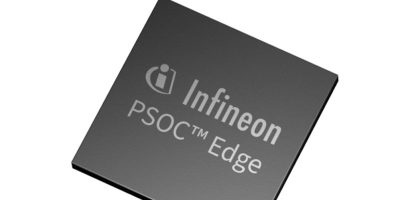
Infineon PSOC Edge MCUs for robotics, industrial, and smart home applications

Mouser is now shipping the new PSOC Edge machine learning microcontrollers (MCUs) from Infineon Technologies. The PSOC Edge is Infineon’s enhanced and advanced high-performance machine learning (ML) MCU for next-generation devices in smart home, robotics, industrial, and human-machine interface (HMI) applications.

The Infineon PSOC Edge MCUs are designed for a new generation of responsive, user-centric machine learning-based edge devices, with hardware-accelerated neural net compute support for continuous low-power, high-performance operation in a fully integrated microcontroller. These MCUs integrate Arm Cortex-M55 processors and M33 coprocessors. These devices are enhanced with Infineon’s NNLite accelerator, right-sized peripherals, state-of-the-art security, and support for Helium DSP and Arm Ethos-U55 integration, making them “always-on” IoT and industrial applications. The PSOC Edge series is supported by a rich set of enablement features, including industry-recognised ModusToolbox software, DEEPCRAFT Studio AI with off-the-shelf DEEPCRAFT-ready models and graphics, as well as support for voice, audio, and vision, enabling easy migration and upgrades from current designs.

Mouser offers two different development kits for the PSOC Edge. The KITPSE84AITOBO1 PSOC Edge E84 AI evaluation kit utilises the versatile PSOC Edge E84 MCU, which features a hardware platform designed for ML and Edge AI. The kit is optimised for rapid prototyping and development of embedded systems utilising Infineon’s ML platform DEEPCRAFT Studio, with ML models and other software products. The Infineon KITPSE84EVALTOBO1 PSOC Edge E84 kit, offers the PSOC Edge E84 MCU on a detachable SODIMM-based system-on-module (SOM) board, along with an AIROC Wi-Fi and Bluetooth combo-based connectivity module. The carrier board includes multiple onboard multimedia connectivity features, including custom MIPI-DSI displays, audio interfaces, and more. Arduino and mikroBUS-compatible headers enable easy expansion.

www.mouser.com

> Read More

ST’ precision op amp brings accuracy, speed, and stability

ST’ TSZ901 operational amplifier (op-amp) combines precision and zero-drift properties with 10MHz gain-bandwidth (GBW), adding enhanced stability to applications that demand high speed with high accuracy.

Leveraging chopper-stabilisation, unusual among 10MHz op amps, the TSZ901 has input-offset voltage of just 5µV at 25°C and within 8µV across the full operating-temperature range from -40°C to 125°C. Unlike op amps that require trimming to deliver required accuracy only within a limited temperature range, this one delivers consistent performance at all temperatures.

With input noise of just 9nV/√Hz, the TSZ901 demands minimal power, drawing just 1.5mA at 5V and operating with a supply voltage from 5.5V down to 2.5V.

These properties ensure the TSZ901 performs strongly in circuits such as MEMS-sensor interfaces, current-sense amplifiers, precision active filters, instrumentation buffers, transimpedance amplifiers, precision analog front-ends, and voltage references. Designers can minimise calibration and external compensation components to lower overall circuit footprint and complexity, simplify design, and reduce the bill of materials. Production test can be faster and lifetime maintenance can be reduced.

www.st.com

> Read More

New ultra-compact wireless SoC from Nordic Semi for miniaturised applications

With the recently launched nRF54LV10A, Rutronik is expanding Nordic Semiconductor’s ultra-low-power wireless portfolio with a new, particularly energy-efficient system-on-chip (SoC) for miniaturised applications in the medical and wearable segment. The SoC combines an extremely compact chip-scale package with high computing power, advanced security features and a radio architecture that supports Bluetooth LE, proprietary 2.4 GHz protocols and Bluetooth channel sounding in low-voltage operation for the first time. Samples and development kits of the nRF54LV10A are available through an early access program.

The nRF54LV10A sets a new benchmark in the field of low-voltage wireless SoCs. Developed for battery-powered medical devices such as continuous glucose monitors (CGMs) and wearable biosensors, its supply voltage of only 1.2 to 1.7 volts allows it to be powered directly by silver oxide button cells – without additional voltage regulators.

At its core is a 128 MHz Arm Cortex-M33 processor combined with a 128 MHz RISC-V coprocessor, which provides accelerated calculations and energy-efficient processing. In addition, the SoC has 1 MB NVM and 192 KB RAM, enabling demanding real-time applications and wireless protocols to run simultaneously.

The integrated 2.4 GHz transceiver supports Bluetooth LE, Bluetooth Channel Sounding for accurate distance measurements, and proprietary protocols with data rates up to 4 Mbps – ideal for latency-critical sensor applications.

For safety-critical healthcare products, the nRF54LV10A offers comprehensive protection mechanisms, including secure boot, secure firmware update, trusted execution environment via Arm TrustZone, cryptographic accelerators and integrated tamper detection.

Nordic’s architecture – including low-leakage RAM, multi-protocol radio and global RTC in system-OFF state – facilitates the development of long-lasting wearables with minimal system complexity. Low-voltage GPIOs allow sensors and MCUs to be connected without level shifters, further reducing space requirements.

Application examples:
Continuous glucose monitors (CGMs)
Wearable biosensors & medical monitoring devices
Connected-health solutions
Fitness & wellness trackers
Low-voltage sensor nodes and compact IoT devices

www.rutronik24.de

> Read More

About Smart Cities

This news story is brought to you by smartcitieselectronics.com, the specialist site dedicated to delivering information about what’s new in the Smart City Electronics industry, with daily news updates, new products and industry news. To stay up-to-date, register to receive our weekly newsletters and keep yourself informed on the latest technology news and new products from around the globe. Simply click this link to register here: Smart Cities Registration