


POLYN Technology announces first silicon-implemented NASP chip

POLYN Technology has announced the successful manufacturing and testing of the world’s first silicon-proven implementation of its unique NASP (Neuromorphic Analog Signal Processing) technology.

The NASP platform employs trained neural networks in the analog domain to perform AI inference with much lower power consumption than conventional digital neural processors.

NASP chips with AI cores process sensor signals in their native analog form in microseconds, using microwatt-level power and eliminating all overhead associated with digital operations. This is ideal for always-on edge devices. Application-specific NASP chips can be designed for a diverse range of edge AI applications, including audio, vibration, wearable, robotics, industrial, and automotive sensing.

NASP technology and POLYN’ design tools automatically convert trained digital neural network models into ultra-low-power analog neuromorphic cores ready for manufacturing in standard CMOS processes. The testing confirmed the chip’s parameters strictly match its model.

This first chip contains a VAD core for real-time voice activity detection. It marks the first step toward a new level of voice processing offered by POLYN. It will be followed by other cores POLYN is developing for speaker recognition and voice extraction, enhancing home appliances, critical communications headsets, and other voice-controlled devices.

Customers developing products with ultra-low power voice control can apply online for the NASP VAD chip evaluation kit.

POLYN’s NASP technology and design tools give semiconductor and AI developers a new way to quickly implement neural networks directly in analog silicon. It offers process-agnostic design across 40–90 nm CMOS nodes and automatic conversion from digital ML models.

POLYN is preparing evaluation kits for early adopters and extending the implementation of its NASP product families for automotive, critical communication, and wearable applications.
polyn.ai

> Read More

Renesas adds new MCU groups to RA8 series with 1GHz performance and embedded MRAM

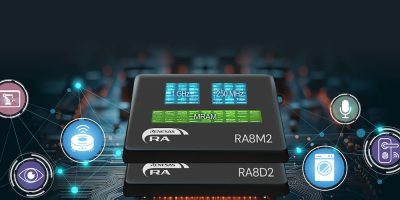
Renesas has introduced the RA8M2 and RA8D2 microcontroller (MCU) groups. Based on a 1 GHz Arm Cortex-M85 processor with an optional 250 MHz Arm Cortex-M33 processor, the new MCUs are the latest Renesas offerings to deliver an unmatched 7300 Coremarks of raw compute performance, the industry benchmark for MCUs. The optional Cortex-M33 processor enables efficient system partitioning and task segregation.

Both RA8D2 and RA8M2 devices are ultra-high performance MCUs as part of the second generation of the RA8 Series – the RA8M2 are general-purpose devices, and the RA8D2 MCUs are packed with a variety of high-end graphics peripherals. They are built on the same high-speed, low-power 22-nm ULL process used for the RA8P1 and RA8T2 devices introduced earlier this year. The devices include single and dual core options, and a specialised feature set to address the needs of a broad base of compute intensive applications. They take advantage of the high performance of the Arm Cortex-M85 processor and Arm’s Helium technology to offer a significant performance boost for digital signal processor (DSP) and machine learning (ML) implementations.

The RA8M2 and RA8D2 devices offer embedded MRAM that has several advantages over Flash technology – high endurance & data retention, faster writes, no erase needed, and byte addressable with lower leakage and manufacturing costs. SIP options with 4 or 8 MB of external flash in a single package are also available for more demanding applications. Both the RA8M2 and RA8D2 MCUs include Gigabit Ethernet interfaces and a 2-port TSN switch to address industrial networking use cases.

Both of the MCU Groups provide a combination of the performance of the Cortex-M85 core, together with large memory and a rich peripheral set, making them particularly suitable for a wide range of IoT and industrial use cases. The lower power CM33 core can act as a housekeeping MCU, executing system tasks while the high performance CM85 core stays in sleep mode, to be woken up only as needed for high compute tasks, thus lowering the system power consumption.

The new RA8M2 and RA8D2 Group MCUs are supported by Renesas’ Flexible Software Package (FSP). The FSP enables faster application development by providing all the infrastructure software needed, including multiple RTOS, BSP, peripheral drivers, middleware, connectivity, networking, and security stacks as well as reference software to build complex AI, motor control and cloud solutions. It allows customers to integrate their own legacy code and choice of RTOS (FreeRTOS and Azure RTOS) with FSP, thus providing full flexibility in application development. In addition, Zephyr support is now included. Using the FSP will ease migration of existing designs to the new RA8 Series devices.

www.renesas.com/RA8M2

www.renesas.com/RA8D2

> Read More

Microchip adds single-chip wireless platform designed for advanced connectivity

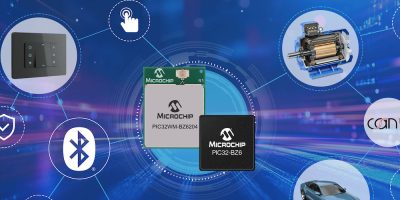
Microchip has released the highly integrated PIC32-BZ6 MCU that serves as a common, single-chip platform to reduce development cost, complexity and time-to-market for multi-protocol products featuring advanced connectivity and scalability.

RF design for smart devices has become increasingly complex, and wireless solutions typically require multiple chips to add new features or frequent redesigns to support evolving industry standards. The PIC32-BZ6 MCU replaces these multi-chip solutions and reduces the redesign burden with a single, highly integrated chip that removes the complexity of multi-protocol wired and wireless connectivity. The MCU also includes analog peripherals to simplify motor control development, along with touch and graphics capabilities for advanced user interfaces and enhanced memory to support complex applications, heavy workloads and Over the Air (OTA) firmware updates.

The PIC32-BZ6 MCU platform streamlines development of products in the smart home and for automotive connectivity, industrial automation and wireless motor control use cases. Key features include:

• High memory and scalable package choices to support demanding applications and OTA updates: The high-performance MCU includes 2 MB Flash memory and 512 KB RAM and is available in 132-pin ICs and modules with additional pin and package variants planned.
• Multi-protocol wireless networking: Qualified against Bluetooth Core Specification 6.0, the device also supports 802.15.4-based protocols such as Thread and Matter plus proprietary smart-home mesh networking protocols.
• Design flexibility that extends product options and scaling opportunities: Versatile and comprehensive selection of on-chip peripherals goes beyond wireless connectivity and OTA updates to support:
o Wired connectivity: Multiple interfaces include two CAN-FD ports for automotive and industrial communication, a 10/100 Mbps Ethernet MAC for high-speed wired connectivity and a USB 2.0 full-speed transceiver for seamless data transfer and PC integration.
o Touch and graphics: Incorporates peripherals that enable advanced user interfaces including Capacitive Voltage Divider (CVD)-based touch capabilities with up to 18 channels.
o Motor control: Simplifies system development through advanced analog peripherals such as 12-bit ADCs, 7-bit DAC, analog comparators, PWMs and QEI for precise motor position and speed control.
• Security by design to protect applications and IP: Includes immutable secure boot in ROM and an advanced on-board hardware-based security engine supporting AES, SHA, ECC and TRNG encryption.
• Reliability in harsh environments: The device is qualified to AEC-Q100 Grade 1 (125 °C) specifications for automotive and industrial environments.

Development Tools
Microchip simplifies development and product certification for the PIC32-BZ6 MCU by offering proven chip-down reference designs and wireless design check services, helping to minimise design risk. To further ease regulatory compliance, pre-certified modules are available in multiple regions worldwide. The PIC32-BZ6 MCU family is supported by the PIC32-BZ6 Curiosity Board that enables testing of all MCU I/Os, connectivity and peripheral features. Developers also benefit from a comprehensive development environment through Microchip’s MPLAB® Integrated Development Environment (IDE) and the Zephyr® Real Time Operating System (RTOS).

microchip.com

> Read More

Synaptics launches the next generation of Astra multimodal GenAI processors

Synaptics has announced the new Astra SL2600 Series of multimodal Edge AI processors designed for power and performance. The Astra SL2600 series enables a new generation of cost-effective intelligent devices that make the cognitive Internet of Things (IoT) possible.

The SL2600 Series will launch with the SL2610 product line, featuring five processor families tailored for diverse Edge AI applications. These processors are purpose-built for the next wave of smart appliances, home and factory automation equipment, charging infrastructure, healthcare devices, retail point of sale terminals and scanners, autonomous robotic systems, UAVs, casual gaming devices, and more.

The Astra SL2610 processors are powered by the new Synaptics Torq Edge AI platform, combining future-ready NPU architectures with open-source compilers, to set a new standard in IoT AI application development. Torq delivers the first production deployment of Google’s RISC-V-based Coral NPU with dynamic operator support, future-proofing Edge AI designs. Leveraging an open-source IREE/MLIR compiler and runtime, it embodies a developer-first approach. The SL2610 product line integrates Arm Cortex-A55, Cortex®-M52 with Helium, and Mali GPU technologies, and these processors take a comprehensive, multi-layered approach to building security directly into the silicon, enabling immutable root of trust, threat detection, and an application crypto coprocessor to manage intensive AI workloads.

The SL2610 product line encompasses five pin-to-pin compatible families: SL2611, SL2613, SL2615, SL2617, and SL2619, built for a wide range of solutions from battery-powered and passively cooled devices to high-performance industrial vision systems. These processors deliver hallmark power efficiency and seamless integration with Synaptics Veros Connectivity—across Wi-Fi 6/6E/7, BT/BLE, Thread, and UWB—providing a unified developer experience that accelerates time-to-market.

The Synaptics Astra SL2610 product line is sampling to customers now with general availability planned for calendar Q2 2026.

www.synaptics.com

> Read More

About Smart Cities

This news story is brought to you by smartcitieselectronics.com, the specialist site dedicated to delivering information about what’s new in the Smart City Electronics industry, with daily news updates, new products and industry news. To stay up-to-date, register to receive our weekly newsletters and keep yourself informed on the latest technology news and new products from around the globe. Simply click this link to register here: Smart Cities Registration