
ST introduces the first automotive microcontroller with AI acceleration for edge intelligence

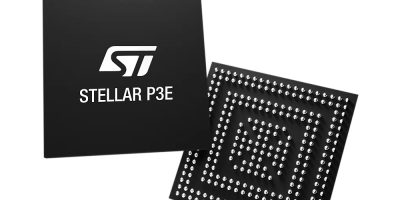
ST has announced the Stellar P3E, the first automotive microcontroller (MCU) with built-in AI acceleration for automotive edge intelligence. Designed for future software-defined vehicles, the Stellar P3E simplifies multi-function integration for X-in-1 Electronic Control Units (ECUs) that reduce system cost, weight, and complexity.

A defining feature of the Stellar P3E is its integrated ST Neural-ART Accelerator for real-time AI efficiency, making it the first MCU with an embedded neural network accelerator for the automotive industry. Powered by this dedicated neural processing unit (NPU) with an advanced data-flow architecture for AI workloads, and combined with its rich sensing capabilities, the P3E enables smart sensing that opens the door to new applications such as virtual sensors.

The P3E delivers inference processing at microsecond speeds, achieving up to 30x greater efficiency compared to traditional MCU core processors. This enables always-on, low-power artificial intelligence (AI) that can support real-time functions, including predictive maintenance and smart sensing, delivering significant benefits across a wide range of applications. For example, these capabilities can enhance charging speed and efficiency in electric vehicles and enable rapid deployment of new features, whether in the factory or in the field. Original equipment manufacturers (OEMs) can introduce new functions and more intuitive behaviours through different AI models, reducing the need for additional sensors, modules, wiring, and integration effort.

As the automotive industry embraces the shift toward software-defined vehicles (SDVs), Stellar P3E’s integrated xMemory, ST’s proprietary non-volatile memory based on phase-change memory (PCM), provides the essential scalability and flexibility needed. Offering twice the density of traditional embedded flash memory and qualified for automotive environments, this extensible memory solution enables dynamic expansion of software storage to accommodate new features and updates without requiring any hardware redesign.

The P3E is fully supported within the ST Edge AI Suite, a comprehensive edge-AI ecosystem that spans from dataset creation to on-device deployment for data scientists and embedded engineers. As part of this suite, NanoEdge AI Studio tool is now available for the entire Stellar MCU family. In addition, the Stellar P3E is already integrated into Stellar Studio, ST’s all-in-one development environment tailored for automotive engineers. Together they reinforce a robust hardware and software ecosystem designed to streamline the deployment of sophisticated edge AI solutions in demanding automotive environments.

st.com

> Read More

Microchip has extended its edge AI offering with full-stack solutions

A major next step for AI and machine learning (ML) innovation is moving ML models from the cloud to the edge for real-time inferencing and decision-making applications in today’s industrial, automotive, data centre and consumer Internet of Things (IoT) networks. Microchip has extended its edge AI offering with full-stack solutions that streamline development of production-ready applications using its microcontrollers (MCUs) and microprocessors (MPUs) – the devices that are located closest to the many sensors at the edge that gather sensor data, control motors, trigger alarms and actuators, and more.

The new solutions turn its MCUs and MPUs into complete platforms for bringing secure, efficient and scalable intelligence to the edge. The company has rapidly built and expanded its growing, full-stack portfolio of silicon, software and tools that solve edge AI performance, power consumption and security challenges while simplifying implementation.

“AI at the edge is no longer experimental—it’s expected, because of its many advantages over cloud implementations,” said Mark Reiten, corporate vice president of Microchip’s Edge AI business unit. “We created our Edge AI business unit to combine our MCUs, MPUs and FPGAs with optimized ML models plus model acceleration and robust development tools. Now, the addition of the first in our planned family of application solutions accelerates the design of secure and efficient intelligent systems that are ready to deploy in demanding markets.”

Microchip’s new full-stack application solutions for its MCUs and MPUs encompass pre-trained and deployable models as well as application code that can be modified, enhanced and applied to different environments. This can be done either through Microchip’s embedded software and ML development tools or those from Microchip partners.

The new solutions include:
• Detection and classification of dangerous electrical arc faults using AI-based signal analysis
• Condition monitoring and equipment health assessment for predictive maintenance

• Facial recognition with liveness detection supporting secure, on-device identity verification
• Keyword spotting for consumer, industrial and automotive command-and-control interfaces

Engineers can leverage familiar Microchip development platforms to rapidly prototype and deploy AI models, reducing complexity and accelerating design cycles. The company’s MPLAB X Integrated Development Environment (IDE) with its MPLAB Harmony software framework and MPLAB ML Development Suite plug-in provides a unified and scalable approach for supporting embedded AI model integration through optimised libraries. Developers can, for example, start with simple proof-of-concept tasks on 8-bit MCUs and move them to production-ready high-performance applications on Microchip’s 16- or 32-bit MCUs.

For its FPGAs, Microchip’s VectorBlox Accelerator SDK 2.0 AI/ML inference platform accelerates vision, Human-Machine Interface (HMI), sensor analytics and other computationally intensive workloads at the edge while also enabling training, simulation and model optimisation within a consistent workflow.

Other support includes training and enablement tools like the company’s motor control reference design featuring its dsPIC® DSCs for data extraction in a real-time edge AI data pipeline, and others for load disaggregation in smart e-metering, object detection and counting, and motion surveillance. Microchip also helps solve edge AI challenges through complementary components that are required for product design and development. These include PCIe® devices that connect embedded compute at the edge and high-density power modules that enable edge AI in industrial automation and data center applications.

microchip.com

> Read More

ST’ hybrid controller simplifies full-feature implementation of USB-C sink premium applications

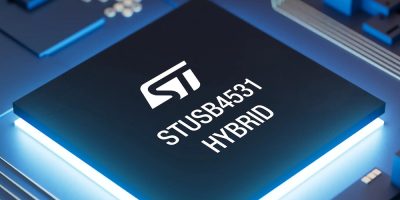
STMicroelectronics’ STUSB4531 USB Power Delivery (PD) sink controller introduces a new, patented hybrid mode that simplifies implementing optional USB PD features for added value in USB-powered and USB-chargeable devices.

The STUSB4531 contains a certified, hardwired USB PD stack that works with ST-proprietary AUTORUN algorithms to enable software-free power negotiation, supervision, and management. These AUTORUN algorithms simplify developing battery-charging and VBUS-powered electronics in equipment such as portable audio devices, wearables, set-top boxes, Wi-Fi access points, healthcare devices, and lighting. The latest updated algorithms can negotiate with AC adapters to ensure the optimum power profile, including adjustable voltage supply (AVS) and high-power charging in dead-battery mode for faster device reactivation.

The new hybrid mode now added to the STUSB4531 lets an external application processor interact with the stack to leverage the protocol layers for USB PD communication. This gives engineers extra flexibility to implement functions such as battery messaging, data role swapping, Alternate modes, and vendor-defined messages (VDM) while also easing software development and accelerating time to market.

Typical applications for charging with USB data include hard disk drives, point-of-sale (POS) terminals, printers, drones, and portable industrial devices. While VR headsets, infotainment devices, portable displays, and gaming consoles often combine USB power with Alternate modes for DisplayPort or Thunderbolt protocols, VDM enhances consumer accessories and medical devices.

By combining hardwired speed and simplicity with software-enabled flexibility, the STUSB4531 facilitates adoption of USB-C for charging and powering devices, mandated by ecodesign norms worldwide conceived to reduce electronic waste. The IC is certified according to the latest USB-C® 2.4 and USB PD 3.2 standards, as well as IEC 62680 confirming EU-conformity.

An extensive ecosystem supports developers using the STUSB4531, including an evaluation board (EVAL-SCS007V1), certified minimalistic reference design (EVAL-SCS006V1), graphical user interface (STSW-STUSB020), and NVM flasher (STSW-STUSB021). An open-source software library (STSW-STUSB022) will be available soon.

www.st.com

> Read More

Rutronik expands its storage portfolio with KIOXIA e-MMCs for industrial and consumer applications

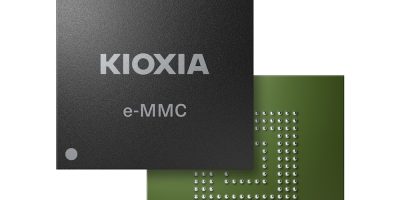
With KIOXIA’s e-MMC memory solutions, Rutronik offers compact and powerful embedded components based on the BiCS FLASHTM generation 5 TLC 3D flash memory. The e-MMCs are available in 64 GB (THGAMSG9T15BAIL_TRAY / THGAMSG9T15BAIL_REEL) and 128 GB (THGAMST0T25BAIL_TRAY / THGAMST0T25BAIL_REEL) and support the JEDEC e-MMC 5.1 protocol, operate with an I / O voltage of 1.8 V and achieve transfer rates of up to 340 MB / s (read) and 230 MB/s (write) in HS400 mode. The memory solutions are specified for a wide temperature range from -25 °C to +85 °C.

The KIOXIA e-MMC series combines state-of-the-art BiCS FLASHTM TLC 3D flash memory technology with an integrated controller and multi-chip architecture (MCP), enabling high data density with low power consumption. The modules are housed in a compact 153-ball BGA package (11.5 mm × 13 mm, 0.8 mm high) and offer full compatibility with existing host systems via the standardised MMC Version 5.1 interface (1-, 4- or 8-bit I / O).

With a read speed of 340 MB / s and a write speed of 230 MB / s in HS400 mode, the e-MMCs deliver significantly improved performance compared to the fourth generation – with stable operating characteristics even under load and at high temperatures.

Benefits at a glance:
BiCS FLASHTM generation 5 TLC 3D flash memory
JEDEC e-MMC 5.1 standard for broad compatibility
High performance: up to 340 MB/s read / 230 MB/s write
Extended temperature range (-25 °C to +85 °C)
Integrated controller with ECC and wear levelling
Low energy consumption thanks to 1.8 V I / O voltage
Stable performance during continuous operation and temperature changes
Long-term availability and quality manufacturing from KIOXIA

Application examples:
Industrial automation and control systems
HMI and edge devices
Smart home and IoT applications
Digital cameras, wearables and portable devices

rutronik24.com

> Read More

About Smart Cities

This news story is brought to you by smartcitieselectronics.com, the specialist site dedicated to delivering information about what’s new in the Smart City Electronics industry, with daily news updates, new products and industry news. To stay up-to-date, register to receive our weekly newsletters and keep yourself informed on the latest technology news and new products from around the globe. Simply click this link to register here: Smart Cities Registration