

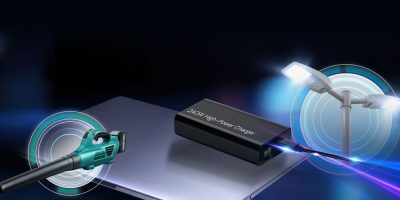
Renesas’s new GaN charging solution delivers 500W of power

Renesas has expanded its suite of AC/DC and power adapter solutions with a new GaN-based Half-Wave LLC (HWLLC) platform that supports 500W or higher operation across IoT, industrial and infrastructure systems. The new HWLLC converter topology scales an ultra-efficient, compact power architecture from 100W-class designs to 500W, enabling the next wave of high-speed chargers for power tools, e-bikes and other appliances without the size, heat and efficiency penalties of legacy topologies.

The portfolio expansion adds four controller ICs that build on Renesas’ proprietary zero-standby power (ZSP) technology. At the heart is the RRW11011, an interleaved power factor correction (PFC) and HWLLC combo controller engineered for high power density and high efficiency. The PFC with phase-shift control cancels ripple, reduces component size and cost, balances current and ensures robustness. The combo controller allows designers to lower operating temperature while delivering the wide output range (5V to 48V) required by USB Extended Power Range (EPR) and other variable-load charging systems. The new solution also features the RRW30120 USB Power Delivery (USB PD) protocol and closed-loop controller, which achieves maximum USB power delivery of 240W, and the RRW40120 half-bridge GaN gate driver and RRW43110 intelligent synchronous rectifier controller.

The HWLLC’s wide 500W power envelope broadens the addressable charging market to encompass large TVs and monitors, as well as higher-power appliances like vacuums, power tools, outdoor and industrial lighting and some medical devices. The new HWLLC-based AC/DC topology also helps designers move beyond 100W USB-C charging devices and adopt 240W USB EPR charging to shrink proprietary brick chargers in smartphones, laptops and many gaming systems. Renesas’ compact, high-power fast charging technology was recently incorporated into a GaN-based charger from Belkin. The Belkin Z-Charger features an innovative ZSP chip with Renesas’ advanced SuperGaN depletion mode (d-mode) GaN technology.

GaN technology drives the efficiency and power density behind Renesas’ next-generation AC/DC designs, enabling higher switching performance that helps shrink magnetics, reduce losses and keep thermals in check. Renesas’ SuperGaN d-mode technology employs a cascode configuration that is more robust and easier to drive than other GaN implementations, with a higher threshold voltage and drop-in compatibility with standard silicon gate drivers. The result is a faster path for customers to achieve compact, high-efficiency power supplies they can scale, validate and manufacture with greater confidence.

By eliminating transformer winding and reducing component count versus traditional LLC implementations, Renesas reduces design complexity and enables more compact magnetics. The enhancement accelerates design re-use across product families that support different wattages, voltages and form-factors while improving reliability and easing BOM management. The highly integrated, wide Vin/Vout offline solution helps customers build smaller, cooler and readily compliant products while achieving standout no-load/standby performance that supports higher energy-efficiency ratings.

renesas.com

> Read More

u-blox brings secure tri-band Wi-Fi 6E for industrial IoT

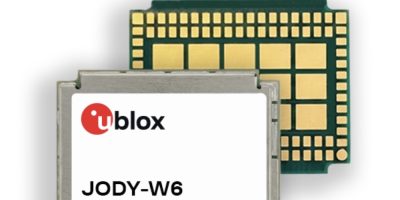
u-blox has announced the launch of the JODY-W6, the latest addition to its JODY family of modules. Based on the NXP Semiconductors IW623 chipset, the JODY-W6 combines tri-band Wi-Fi 6E (2.4 / 5 / 6 GHz) with 2×2 MIMO and Bluetooth Dual-Mode including LE Audio and qualified against Bluetooth Core 5.4. This powerful integration delivers higher throughput, better network availability, and an improved audio experience while addressing the industry’s growing need for secure, professional-grade wireless connectivity in industrial and IoT applications. The introduction of Wi-Fi 6E and Bluetooth LE Audio comes at a critical time, as industries face increasing spectrum congestion, demand for richer user experiences, and the need to comply with emerging cybersecurity regulations.

JODY-W6 is built on the NXP IW623 chipset and supports tri-band Wi-Fi 6E with 2×2 MIMO: Featuring Bluetooth Dual-Mode including LE Audio, JODY-W6 is qualified against Bluetooth Core 5.4. With a compact footprint and pin compatibility with the JODY module family, the new host-based multiradio module facilitates seamless migration across technology generations, offering simplicity, flexibility and cost savings in design. JODY-W6 provides a professional-grade solution designed to withstand harsh operating environments (-40 °C to +85 °C) while bringing enhanced security features, including NXP EdgeLock and secure boot on chip, to address growing cybersecurity requirements across industrial IoT deployments.

The JODY-W6 is well suited for industrial automation, healthcare, network infrastructure, and smart building applications, as well as security and surveillance systems that demand secure, high-throughput, and low-latency wireless performance.

Supporting SDIO or PCIe interfaces, the JODY-W6 offers flexibility for a wide range of host-based designs. The module is available in variants with two or three antenna pins, making it adaptable to diverse product requirements. Evaluation kits, including EVK-JODY-W683 and an M.2 form factor option, simplify design, testing, and integration.

By integrating the latest NXP IW623 chipset and supporting Wi-Fi 6E and Bluetooth LE Audio, the JODY-W6 addresses critical industry challenges such as spectrum congestion, cybersecurity compliance, and demand for high-performance wireless solutions.

u-blox.com

> Read More

NXP delivers new innovations for advanced physical AI with NVIDIA

NXP has announced robotics solutions for real-time data processing, data transport, and networking designed to support sensor fusion, machine vision, and motor control. The solutions were developed in collaboration with NVIDIA and implement NVIDIA Holoscan Sensor Bridge with NXP system-on-chip devices, reducing the number of discrete components and lowering footprint, power consumption, and system cost while simplifying software for robotic sensing and actuation, including humanoid robot designs.

Humanoid and other advanced robotic systems require low-latency data processing and communication to support synchronised motion, multiple sensors, and distributed actuation. These systems depend on reliable data transport between sensors, processors, and control units across the robot body.

NXP’s integrated robot body solutions combine edge processing with low-latency networking to support real-time communication. The solutions integrate NVIDIA Holoscan Sensor Bridge with NXP software support, enabling real-time processing and direct data transport between sensors, control nodes, and central processing units, reducing latency in robotic control systems.

The platform combines NXP edge processors, motor-control microcontrollers, networking devices, and high-speed data transport technology with NVIDIA AI processing infrastructure to form a system architecture intended for humanoid and other complex robotic platforms.

Initial Holoscan Sensor Bridge-ready solutions include a machine-vision platform based on the i.MX 95 applications processor for high-bandwidth sensor data, and a motor-control platform based on i.MX RT1180 crossover MCUs connected through an S32J TSN switch. The motor-control design supports industrial networking protocols including EtherCAT and TSN. The solutions are designed to reduce component count, power consumption, and system size while supporting safety, security, and real-time performance requirements in robotic systems.

www.nxp.com

> Read More

ST’s single-chip buck converter for domestic appliances and industrial loads

Capable of supplying 3A from a 3mm x 1.6mm footprint, STMicroelectronics’ DCP3603 monolithic buck converter simplifies design, saves PCB space, accelerates time to market, and enhances system reliability. With a 3.3V-to-36V input-voltage range, this miniature converter can power equipment such as smart meters, domestic appliances, and industrial 24V loads.

Leveraging synchronous rectification, and available with either 1MHz or 500kHz fixed switching frequency, the DCP3603 maintains high efficiency across the load range, reaching 93% at 600mA with 12Vin and 5Vout. With power switches and compensation built-in, only an inductor, bootstrap and filter capacitors, and feedback resistors are needed to complete the circuit, ensuring a minimal bill of materials.

Designers can choose from two variants, configured for forced-PWM operation for optimal performance in noise-sensitive applications, or pulse-skipping for minimal power consumption at light load. Both variants implement frequency dithering, to reduce noise power at the switching frequency, and have extremely low quiescent current of 85µA to minimise overall power consumption. An Enable pin allows the converter to be turned off to maximize power savings.

A dedicated evaluation board, STEVAL-3603BC1, is available to help quickly evaluate the DCP3603 in new designs. The board has a compact footprint and is quickly connected with screw terminals and headers, ready to power-up out of the box.

 www.st.com

> Read More

About Smart Cities

This news story is brought to you by smartcitieselectronics.com, the specialist site dedicated to delivering information about what’s new in the Smart City Electronics industry, with daily news updates, new products and industry news. To stay up-to-date, register to receive our weekly newsletters and keep yourself informed on the latest technology news and new products from around the globe. Simply click this link to register here: Smart Cities Registration