

Smart sensors are the jewel in the crown

Scientists have taken inspiration from the biomimicry of butterfly wings and peacock feathers to develop an opal-like material for use in smart sensors.

Scientists, led by the Universities of Surrey and Sussex, have developed colour-changing, flexible photonic crystals that could be used to develop sensors that warn when an earthquake might strike next.

The research draws on the Materials Physics Group’s (University of Sussex) expertise in the liquid processing of two-dimensional nanomaterials, Soft Matter Group’s (University of Surrey) experience in polymer colloids and combines it with expertise at the Advanced Technology Institute in optical modelling of complex materials. Both universities are working with the Sussex-based company Advanced Materials Development (AMD) Ltd to commercialise the technology.

The wearable, robust and low-cost sensors can respond to light, temperature, strain or other physical and chemical stimuli making them a promising option for cost-effective, smart, visual sensing applications in sectors such as healthcare and food safety.

In research, published by Advanced Functional Materials, the team outlines a method to produce photonic crystals containing a minuscule amount of graphene and which results in outputs that can be directly observed by the naked eye.

The material is intensely green under natural light, but the sensors change colour to blue when stretched, and turn transparent when heated.

Dr. Izabela Jurewicz, Lecturer in Soft Matter Physics at the University of Surrey’s Faculty of Engineering and Physical Sciences, said “This work provides the first experimental demonstration of mechanically robust yet soft, free-standing and flexible, polymer-based opals containing solution-exfoliated pristine graphene. While these crystals are beautiful to look at, we’re also very excited about the huge impact they could make to people’s lives.”

Potential applications for the sensors are time-temperature indicators (TTI) for intelligent packaging. The sensors are able to give a visual indication if perishables, such as food or pharmaceuticals, have experienced undesirable time-temperature histories. The crystals are extremely sensitive to even a small rise in temperature between 20 and 100 degrees C.

They can also be used in fingerprint analysis where their pressure-responsive shape-memory characteristics can reveal fingerprints, showing well-defined ridges, for biometric access systems.

They sensors’ mechanochromic response also makes them suitable as body sensors to help improve technique in sports players. They could also be used in a wrist band which changes colour to indicate to patients if their healthcare practitioner has washed their hands before entering an examination room.


http://www.sussex.ac.uk

> Read More

Signal conditioner IC targets industry 4.0, medical and IoT sensor applications

The latest addition to the sensor signal conditioner (SSC) range is the ZSSC3240. According to Renesas, it delivers high accuracy, sensitivity, and flexibility for sensor applications such as resistive pressure sensors and medical infra red thermometers. It is also claimed to deliver best-in-class performance and speed with up to 24 bits analogue to digital conversion (ADC) resolution.

The ZSSC3240 has a flexible sensor front end and a range of output interfaces, enabling the SSC to be used for nearly all types of resistive and absolute voltage sensor elements. Engineers can develop complete sensing platforms from a single SSC device, said Renesas. It is also small in size, for use in a variety of sensor-based devices for the industrial, consumer, and medical markets, including smart meters, continuous smart health monitors, factory automation devices, industrial pressure transmitters, HVAC sensors and weight scales.

Unlike micro-machined and silicon-based sensing elements which provide mostly non-linear and very small signals, which need to be converted into a linearised output, the ZSSC3240 SSC provides programmable, wide gain and quantisation functions, combined with powerful, high-order digital correction and linearisation algorithms, explained Renesas. High performance, and flexible sensor front end configuration and analogue output options enable sensor platform design using a single IC, allowing users to leverage the SSC cost effectively for a wide variety of sensor elements that have different characteristics.

The ZSSC3240 SSC has a high-gain analogue front end supporting up to 540V per Volt (V/V) and an integrated 26bit DSP for high-precision sensor calibration. Current loop output is 4.0 to 20 mA.

The ZSSC3240 SSC is available now in a 4.0 x 4.0mm, 24-lead QFN package. The SSC is also available in bare die format.

 http://www.renesas.com

> Read More

Renesas extends Bluetooth 5.0 security to RA 32-bit microcontrollers

Bluetooth 5.0 connectivity has been extended to the RA family of 32-bit microcontrollers by Renesas Electronics, with the introduction of the RA4W1, with an Arm Cortex-M core.

In addition to the 8MHz, 32-bit Arm Cortex-M4 core, it has an integrated Bluetooth 5.0 low energy radio and is delivered in a 56-pin QFN package. The RA4W1 microcontroller and Flexible Software Package (FSP) enables engineers to immediately begin development with Arm ecosystem software and hardware building blocks, says Renesas. FSP features FreeRTOS and middleware for device-to-cloud development. Renesas also points out that options can be replaced and expanded with any other RTOS or middleware.

The RA4W1 microcontroller allows embedded designers to develop safe and secure IoT endpoint devices for industry 4.0, building automation, metering, healthcare, consumer wearable and home appliance applications. It is intended for engineers developing IoT edge devices for wireless sensor networks, IoT hubs, an add-on to gateways and an aggregator to IoT cloud applications.

Sakae Ito, vice president of IoT Platform Business Division at Renesas, said that customers can use the on-chip features, such as Renesas’ Secure Crypto Engine. This feature supports customers with symmetric encryption and decryption, hash functions, true random number generation (TRNG), and advanced key handling with key generation and microcontroller-unique key wrapping for strong key management for IoT security. It also has what is claimed to be best-in-class output power consumption and sensitivity for secure, longer range applications.

The Arm Cortex M4 core and Bluetooth 5.0 core are housed in a 7.0 x 7.0mm 56-pin QFN. The single-chip RA4W1 48MHz microcontroller features 512 kbyte flash memory, 96 kbyte SRAM and connectivity such as USB, CAN and Renesas’ HMI capacitive touch technology.

Bluetooth 5.0 support includes 2 Mbits per second data throughput, all advertising extension functions with maximum advertising length (1,650 byte), periodic advertisements and channel selection algorithm #2 for applications requiring large amounts of traffic. The RA4W1 also offers low peak power consumption at 3.3mA during receiving and 4.5mA (at 0dBm) while transmitting. Renesas claims its sensitivity of -105dBm in 125 kbits per second mode is an industry best and is achieved without additional loss from external components.

Renesas provides several API functions that conform to all standard profiles, including a heart rate profile (HRP), an environment sensing profile (ESP) and an automation I/O profile (AIOP), to allow users to quickly start and speed up prototype development and evaluation.

Renesas’ Smart Configurator GUI generates Bluetooth code and microcontroller peripheral function driver code as well as pin settings for the e2 Studio integrated development environment (IDE). The Renesas QE tool for Bluetooth LE generates programs for custom profiles and embeds them in user application programs to support application program development. The Bluetooth Trial Tool Suite GUI allows users to perform initial wireless characteristics evaluations and Bluetooth functional verification. Users can typically have the RA4W1 evaluation board up and running with the downloadable smartphone applications demo in less than 30 minutes, says Renesas.

Integrating a high-precision, low-speed on-chip oscillator, an RF oscillator adjustment circuit and on-chip matching circuit for easy antenna connection reduces both bills of materials costs and circuit board area.

http://www.renesas.com

> Read More

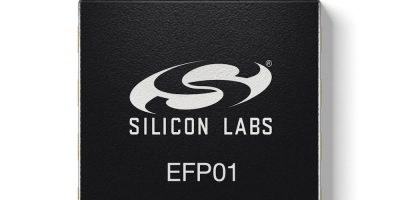
PMICs halve current to boost efficiency, says Silicon Labs

Energy-friendly power management ICs (PMICs) from Silicon Labs, the EFP01 family are companion chips for EFR32 wireless devices and EFM32 microcontrollers. They enable developers to choose the optimal battery type and chemistries for their applications. Target applications include IoT sensors, asset tags, smart meters, home and building automation, security, and health and wellness products. The PMICs also enable developers to control a product’s power supply over multiple output rails and voltages.

Developers often use PMICs to meet the low-power requirements of IoT designs, but choosing the right one can be challenging. The EFP01 PMICs “provide a turnkey power management companion solution for our wireless SoC and MCU families, combined with Simplicity Studio tools, reference designs, sample applications and ‘PMIC-aware’ wireless stacks for easy development,” said Matt Saunders, vice president of IoT marketing and applications at Silicon Labs.

“If you want the easiest to configure, lowest power wireless solution, Silicon Labs’ EFP01 PMIC with Wireless Gecko is the best choice,” he continued. “The EFP01 is optimised for our IoT connectivity platforms, eliminating the need to incorporate multiple vendor reference designs into a schematic or layout.”

EFP01 PMICs include low-voltage DC/DC converters and regulators and a flexible mechanism to manage the power rails in a system design.

The EFP01 PMIC family features include flexible I/O voltage, a wide input voltage range (0.8 to 5.5V) to support an array of batteries. They also have wide output voltages to support a variety of peripherals, microcontrollers and radios.

The PMICs enable buck and boost voltage conversion as well as combined boost and buck (boost bootstrap) supporting low-voltage, high-current rails for IoT products requiring coin cell batteries and higher transmit power (up to +20 dBm).

They also feature multiple output power rails which allows an IoT product to be powered by one low-cost PMIC. This uses less board real estate and simplifies software/hardware design, says Silicon Labs.

The EFP01 offers quiescent current as low as 150 nA to reduce sleep current and enhance battery life.  It also supports coulomb counting which offers vital information for battery life estimation and preventive maintenance.

Samples and production quantities of EFP01 PMICs in a 3.0 x 3.0mm QFN20 package are available now. Silicon Labs also provides three development boards – the SLWRB4179B radio board and two PMIC evaluation boards. Simplicity Studio offers energy profiler and network analyser tools, wireless stacks and reference designs. It is available free of charge.

http://www.silabs.com

> Read More

About Smart Cities

This news story is brought to you by smartcitieselectronics.com, the specialist site dedicated to delivering information about what’s new in the Smart City Electronics industry, with daily news updates, new products and industry news. To stay up-to-date, register to receive our weekly newsletters and keep yourself informed on the latest technology news and new products from around the globe. Simply click this link to register here: Smart Cities Registration