


Infineon secures contactless transactions with crypto controllers

As contactless payment, identity, ticketing and access operations gain traction, Infineon Technologies has developed the 40nm SLC36 / SLC37 security controller platforms. They are based on the high performance, energy efficient 32bit Arm SecurCore SC300 dual interface security chips and supplemented with a Solid Flash memory.

The 40nm technology enables internal clock frequencies of up to 100MHz, which is particularly crucial for short transaction times, says Infineon. The two security controller families have a range of dual interface and contactless modules, including traditional and inductive coupling technologies.

The 40nm technology platform complies with cryptological requirements for AES and ECC standards and is qualified for Secora solution, for payment, IoT and ID applications. Infineon adds that contactless transactions can be reliably secured and that transaction times can also be reduced. They also support the ISO14443 type A/B and ISO18092 (NFC) standards for contactless, and ISO7816, for contact-based interfaces

The crypto controllers support the implementation of sophisticated payment, ID, and multi-applications, including small form factor wearables, such as watches, rings, jewellery, and metal cards.

All products can be adapted to all regional requirements for regional market requirements.

Products of the 40nm SLC36 / SLC37 controller-based crypto platforms are available now. Certificates from EMVCo and BSI for CC are available.

http://www.infineon.com

> Read More

Renesas RF microcontrollers are supported by Segger

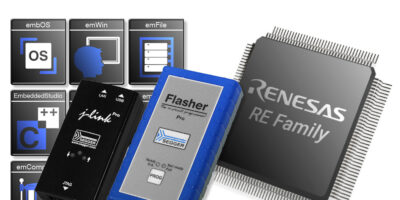
Development tools, embedded software and production tools for the entire Renesas RE microcontroller family are available from Segger Microcontroller.

According to the company, the support makes firmware development for the Arm-based Renesas RE microcontrollers fast and easy.

Segger’s Embedded Studio integrated development environment (IDE) includes an optimised run-time library and the company’s own compiler and linker to generate small and efficient application code.

The J-Link debug probe offers the fastest flash download, including an unlimited number of breakpoints in flash memory, claims the company.

Application software includes an RTOS and communication, security, GUI and IoT software designed in-house, specifically for embedded systems. Segger’s system verification tool, SystemView, reveals the true runtime behaviour of the application. On completion of development, Segger’s Flasher series of production programmers can be used for mass production.

Trial versions of the software are available. Segger’s technical team and ecosystem offer support throughout the development process.

The power efficient Renesas RE family microcontrollers, combined with the low resource usage of Segger software, minimises – and sometimes even removes  – the need to recharge or replace batteries. This efficiency is particularly useful for home and building automation, smart farming and factory applications as well as for a range of medical devices and wearable applications.

Segger Microcontroller has over 25 years’ experience in embedded computer systems, and produces software libraries, and offers software tools and hardware tools for development and production.

Its software libraries include communication, security, data compression and storage and user interface software.

The company’s range of software libraries and tools for embedded system development are optimised for the requirements imposed by resource-constrained embedded systems.

The company was founded by Rolf Segger in 1992. It is privately held and has a US office in the Boston area, branch operations in Silicon Valley and the UK, and distributors on most continents.

Segger software is not covered by an open-source or required-attribution license and can be integrated in any commercial or proprietary product, without the obligation to disclose the combined source.

http://www.segger.com

> Read More

Evaluate NFC technology with NFC Tag kit

Smart packaging and connected products company, Tapwow has partnered with materials science specialist, Avery Dennison Smartrac and introduced the Getting Started with NFC Tag kit, based on NXP chip technology. It allows customers to evaluate NFC technology with customised content and use cases.

The kit features a variety of the most popular NFC tags from Avery Dennison Smartrac based on NXP NFC ICs combined with the DIRX2 tag management software platform from Tapwow. The NFC use NXP’s NTAG and ICODE chip technology to offer a mix of functionalities and security levels, to meet customers’ specific needs.

The kit has been introduced to allow customers to get started with NFC projects quickly and easily. As more customers are pursuing the opportunities in smart packaging and connected products featuring NFC technology, the kit is designed to be easy to use and to allow customers to use NFC tags in their own environment and assign meaningful content.

With a few clicks within the DIRX2 platform from Tapwow, a customer could create a working demo or proof of concept including tap analytics that could be accessed from any smartphone.

“It is an exciting time for touchless connectivity throughout the world,” said Michael Sher, CEO of Tapwow. “We worked with Avery Dennison Smartrac . . . to get NFC tags in the hands of the end user to see what was possible and how easy the technology is to use,” he explained.

“With recent surges in touchless connectivity and payments, more brands have been looking at how to take advantage of NFC technology to create a Hand to Brand connection with their customers. This kit gives them the tags and the software to get started,” he continued.

Avery Dennison has experience in the design, development, production and implementation of NFC tags across many industries. “Based on our NFC Forum Certifications around both quality and performance, our NFC Tags are reliable and positioned to globally scale to enterprise volumes at a moment’s notice,” added Amir Khoshniyati, head of NFC business at Avery Dennison Smartrac.

The tag kit is designed to showcase NFC products, featuring NXP ICs in a format that makes the technology accessible and easy to configure with the Tapwow software, he explained.

The kit is suitable for a wide variety of industries, from pharmaceuticals, consumer goods to healthcare, wine andspirits. According to Avery Dennison, the capabilities of NFC can provide exciting opportunities in customer engagement, brand protection, traceability, and reuse and recycle.

The Getting Started with NFC Tag kit is available today.

 http://www.tapwow.net

http://www.averydennison.com

> Read More

SiP integrates cellular and GNSS technology

Swiss positioning and wireless communication specialist, u-blox, has integrated low power wide area (LPWA) connectivity and a global navigation satellite system (GNSS) technology into a small system in package (SiP) form factor. The Alex-R5 is a miniature cellular module designed for size-constrained asset tracking, wearable and healthcare applications.

It features the secure u-blox UBX-R5 LTE-M / NB-IoT chipset with Secure Cloud functionality and the u-blox M8 GNSS chip for location accuracy.

Alex-R5 has a small footprint of 14 x 14mm footprint. The SiP design reduces its size by half, compared to the functionally equivalent u-blox SARA-R5 module.

Its 23dBm cellular transmission power guarantees that end devices operate effectively in all signal conditions, even at cell edges, underground, or in other challenging scenarios. A dedicated GNSS antenna interface enables fully independent, simultaneous operation of the u-blox M8 GNSS chip, matching the performance of a stand-alone u-blox M8 module. To further enhance positioning, there is the u-blox IoT Location-as-a-Service with CellLocate and AssistNow (online, offline, and autonomous).

Alex-R5 is optimised for power-sensitive and battery-dependent applications, says u-blox, including wearables and connected medical devices. The lower power modes of the u-blox UBX-R5 and UBX-M8 chipsets give users options to balance power consumption and performance using GNSS Super-E mode.

The rugged SiP construction is suitable for harsh environments, where moisture or vibration would be a concern for conventional modules, says u-blox. Alex-R5 is rated at moisture sensitivity level 3 (MSL 3), offering reduced handling and device production complexity.

u-blox guarantees long-term device availability and provides lifetime support for the entire platform, down to the chipset level. Secure Cloud functionality supporting IoT-Security-as-a-Service based on an internal, hardware-based secure element enables a pre-shared key management system specifically designed for LPWA devices.

In addition, Alex-R5 futureproofs IoT devices and networks by enabling customers to software upgrade deployed devices for compatibility with 5G networks in a seamless transition as 5G networks are rolled out by mobile operators.

Engineering samples of the Alex-R5 SiP will be available by Q1, 2021.

http://www.u-blox.com

> Read More

About Smart Cities

This news story is brought to you by smartcitieselectronics.com, the specialist site dedicated to delivering information about what’s new in the Smart City Electronics industry, with daily news updates, new products and industry news. To stay up-to-date, register to receive our weekly newsletters and keep yourself informed on the latest technology news and new products from around the globe. Simply click this link to register here: Smart Cities Registration