

Cryptographic controller protects with lowest power budget, claims Analog Devices

Claimed to provide 30 times lower power and industrial-grade protection for battery-powered devices, the MAXQ1065 has been released by Analog Devices.

The low power cryptographic controller features ChipDNA PUF (physically unclonable functionality) technology, which is claimed to offer the strongest protection for edge to cloud IoT nodes, including medical and wearable devices, against invasive security attacks. The security co-processor provides 30 times lower power when compared to similar products, claimed ADI and its extended lifetime and operating range make it suitable for long-term deployments in harsh environments.

The MAXQ1065 security co-processor provides turnkey cryptographic functions for root of trust, mutual authentication, data confidentiality and integrity, secure boot, secure firmware update, and secure communications. It includes standard algorithms for key exchange and bulk encryption, or complete transport layer security (TLS) support. The device integrates 8kbyte of secure storage for user data, keys, certificates and counters with user-defined access control and life cycle management functionality for IoT equipment.

The MAXQ1065’s small footprint and low pin count allow for easy integration into medical and wearable devices. The MAXQ1065 life cycle management allows flexible access control rules during the major life cycle stages of the device and end equipment, enabling it to be used for long-term operation in harsh environments. In addition to the proprietary PUF technology to resist attacks, the MAXQ1065 is also supported by Analog Devices’ secure key pre-programming service for customers who want keys, data and life cycle state initialised prior to shipment to a contract manufacturer.

Analog Devices has a comprehensive suite of analogue and mixed signal, power management, radio frequency (RF), and digital and sensor technologies. ADI serves 125,000 customers worldwide operating in the industrial, communications, automotive, and consumer markets.
https://www.analog.com

> Read More

Single axis MEMS capacitive accelerometers measure on three axes

Low noise, low cost MEMS capacitive accelerometer modules from Silicon Designs offer measurements on up to three orthogonal axes.

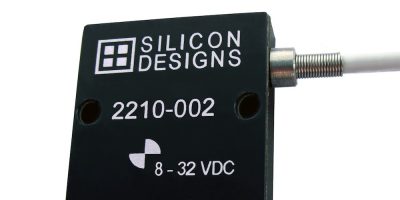
The Model 2210 series modules offer repeatable measurements across a variety of lower frequency vibration testing applications, including those common to vibration analysis, machinery control, modal analysis, robotics, and crash event detection, said Silicon Designs.

The modules are offered in standard ranges from ±2g to ±400g and incorporate a MEMS capacitive accelerometer chip together with high drive, low impedance buffering. They can be used in a Silicon Designs-recommended mounting block accessory, such as the Model 2330-BLK, to measure vibration and acceleration on either one, two, or three orthogonal axes with equal accuracy and repeatability. This degree of versatility in measurement allows customers to specify just one part number for multiple measurement requirements, reducing in-house costs and inventory counts.

All Silicon Designs’ Model 2210 series MEMS capacitive accelerometer modules generate two analogue voltage outputs which vary in response to applied acceleration. Customers can utilise either a single-ended or differential output. Using the latter doubles accelerometer sensitivity. The sensitive axis of the Model 2210 module is perpendicular to the package bottom, with positive acceleration defined as a force pushing on the bottom of that package. Output scale factor is independent from the supply voltage of +8.0 to +32V. At zero acceleration, differential output voltage is nominally 0V DC. At full scale, differential output is ±4V DC.

A simple, but robust, four-wire connection and internal voltage regulator minimise supply voltage variation effects. The MEMS capacitive sense element of each Model 2210 series accelerometer module is packaged within a lightweight, epoxy sealed and anodized aluminium housing which occupies a total footprint of one square inch (25mm), said Silicon Designs.

All Model 2210 series MEMS capacitive accelerometer modules are relatively insensitive to temperature changes and can self-calibrate.

Modules are designed, developed and manufactured at the company’s headquarters and ISO9001:2015 certified R&D centre, just outside of Seattle, Washington, USA. Each accelerometer also undergoes rigorous quality testing prior to shipment.

http://www.SiliconDesigns.com

> Read More

Sensor evaluation board accelerates IoT development, says Bosch Sensortec

R&D effort can be simplified to assist rapid prototyping and reduce time to market for the segmented IoT market, using the Application Board 3.0, says Bosch Sensortec. It offers Bluetooth connectivity and a small form factor for IoT applications and supports the full range of Bosch Sensortec sensors

The Application Board 3.0 simplifies the evaluation and prototyping of sensors for a wide range of applications, particularly in Industry 4.0, IoT, smart home systems, and wrist- and head-mounted wearables, explained Bosch-Sensortec.

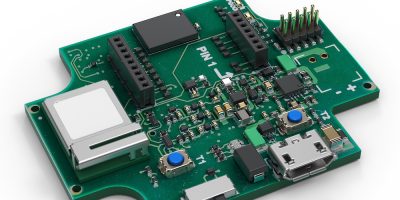
Any Bosch Sensortec sensor mounted on a ‘shuttle board’ is simply plugged into the socket on the Application Board. All shuttle boards have an identical footprint, and Bosch Sensortec’s software automatically detects which sensor is plugged in at any given moment to launch the appropriate software. This enables the straightforward evaluation of a wide range of sensors and solutions, said Bosch Sensortec. Prototypes can be built to quickly test different use case configurations, added the company.

 The board measures just 47.0 x 37.0 x 7.0mm3, which is practical for evaluating sensors used in portable applications, observed Bosch Sensortec. The board can be powered using a 3.7V Li-ion battery or a standard 5V USB power supply.

“The Application Board 3.0 makes it quick and easy for developers to build their projects with any of our sensors on a single platform, meaning that they can now focus on creating unique use cases and differentiating their products,” says Dr. Stefan Finkbeiner, CEO at Bosch Sensortec. “Our customers also benefit from efficient support through regional field application engineers and Bosch offices,” he continued.

The integrated development environment (IDE) software provided with the board includes a simplified graphical user interface (GUI) to evaluate and tune sensor parameters, as well as to visualise and record sensor data. The software also saves time in troubleshooting sensor-related issues, claims Bosch Sensortec.

Application Board 3.0 is designed around the u-blox NINA-B302 Bluetooth Low Energy (BLE) module and is based on the nRF52840 chipset from Nordic Semiconductor, which includes an Arm Cortex-M4F CPU. It is certified and compliant with multiple directives for different international regions: CE, RoHS, China RoHS, FCC, IC, VCCI, SRRC and NCC.

The board is supplied with 256kbyte RAM, 1Mbyte of internal flash and 2Gbyte of external flash memory for data logging. It provides full-speed micro-USB 2.0 connectivity and BLE to connect to a host, such as a PC, for transferring the logged sensor data from the board.

The Application Board 3.0 is available now.

http://www.bosch-sensortec.com

> Read More

Secure embedded controllers integrate AI/ML acceleration

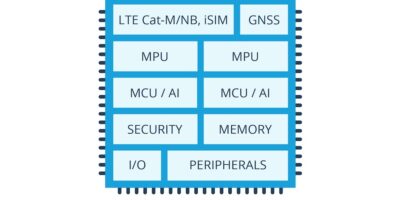
Built to power the next generation, always-connected IoT products, Alif Semiconductor’s Ensemble and Crescendo families are power-efficient devices which integrate AI/ML acceleration, multi-layered security, LTE Cat-M1 and NB-IoT connectivity, GNSS positioning, and memory.

The Ensemble family scales from single Arm Cortex®-M55 microcontrollers to so-called fusion processors which blend up to two Cortex-M55 cores, up to two Cortex-A32  microprocessor cores capable of running high-level operating systems, and up to  two Arm Ethos-U55 microNPUs for artificial intelligence (AI) and machine learning (ML)  acceleration.

The Ensemble family devices contain an advanced secure enclave that provides device integrity protection, secure identity, strong  root-of-trust and secure lifecycle management. They also have large on-chip SRAM and non-volatile memory, accelerated graphics, imaging, making them suitable for smart home automation, appliances, point of sale (PoS) terminals and robotics applications, said the company.

The Crescendo family offers the same functionality as the Ensemble family, with the addition of LTE Cat-M1 and NB-IoT cellular connectivity, optional iSIM for simplified subscriber management, integrated RF, power amplifiers, and a concurrent GNSS receiver. These capabilities make them well-suited for smart city, connected infrastructure, asset tracking, healthcare devices and wearable devices said the company, using a single chip to minimise size and weight.

To address the reliance on battery power in IoT devices, which can be challenging when there is a high requirement for local processing, AI/ML, and wireless communication, Alif Semiconductor has also introduced Autonomous Intelligent Power Management (aiPM) technology that allows fine-grained control of when resources  in the chip are being powered. This results in low power operation, enabling intelligent devices to last longer on smaller batteries.

“The solution that Alif delivers fills a significant gap in the market,” said Jerome Schang, head of Microsoft Azure Edge Silicon devices strategy. “We are always on the lookout for the most efficient technology platforms for our Edge experiences, and the Ensemble and Crescendo families are very well aligned with our customers’ needs.”

Ensemble and Crescendo devices are sampling now to lead customers. They are supported by Alif Semiconductor’s software, development tools and kits. Production qualification will be complete in 1Q22.

https://www.alifsemi.com/

> Read More

About Smart Cities

This news story is brought to you by smartcitieselectronics.com, the specialist site dedicated to delivering information about what’s new in the Smart City Electronics industry, with daily news updates, new products and industry news. To stay up-to-date, register to receive our weekly newsletters and keep yourself informed on the latest technology news and new products from around the globe. Simply click this link to register here: Smart Cities Registration