

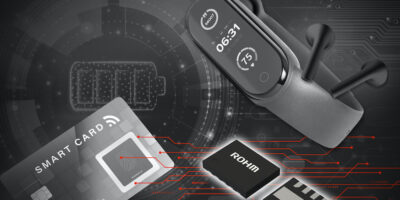
Battery charger IC is designed for low voltage charging for wearables

A battery charger IC has been designed by Rohm for low-voltage charging. The BD71631QWZ is suitable for wearables like wireless ear buds and thin, compact IoT devices such as smart displays powered by rechargeable batteries.

The need for safer, higher density rechargeable batteries has led to the development of new battery types, including all- or semi-solid types and using novel materials for the electrode part and batteries that adopt different terminal compositions. Many of the latest rechargeable batteries are small and thin, requiring low voltage charging in the 2.0 to 3.0V range. There are currently no battery charger ICs that can handle a wide voltage range, says Rohm.

The BD71631QWZ battery charger IC supports low voltage charging of Li-ion but also new types of rechargeable batteries such as all-solid and semi-solid state models. The IC achieves low voltage charging over a wide range from 2.0 to 4.7V by improving the stability of the internal circuit

Unlike general battery charger ICs that provide a fixed voltage, the BD71631QWZ battery charger IC allows the charge voltage to be easily set by simply changing the external resistor, reducing design load when changing batteries. The original package technology results in a compact package just 0.4mm thick, which is 60 per cent lower than conventional products in this market to make devices smaller and thinner. Each charging characteristic like charge/termination current can be set for CCCV charging, providing an optimal charging environment for thin, compact IoT and wearable devices usng the latest rechargeable batteries.

In addition to devices using low voltage and single-cell Li-ion rechargeable batteries, the battery charger IC can be used in wearable devices, such as wireless ear buds, electronic pens, e-cigarettes, smart displays or tags and other compact IoT devices.

An evaluation board, BD71631QWZ-EVK-001, is also available.

Rohm Semiconductor develops and manufactures a large product range from SiC diodes and MOSFETs, analogue ICs such as gate drivers and power management ICs to power transistors and diodes to passive components. 
http://www.rohm.com/eu

> Read More

NFC Type 2 tag IC has permanent write locks and configurable kill mode

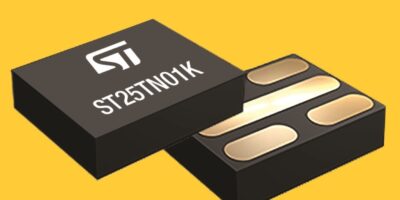
Consumer engagement, production information and brand protection are offered with the ST25TN512 and ST25TN01K NFC Forum Type 2 tag ICs by STMicroelectronics. They can also be used for access control.

The ST25TN512 and ST25TN01K NFC tag ICs support multiple user-protection and privacy mechanisms including a 7-bit unique chip-identifier code, TruST25 digital signature, NFC Forum T2T permanent write locks at block level, and a configurable kill mode that permanently deactivates the tag.

The two ICs are certified to NFC Forum Type 2 specifications and leverage ISO 14443 standards. They can be used with NFC-compatible mobiles or a dedicated short-range reader. The embedded device memory includes up to 208 bytes (1664 bits) dedicated to user content.

There is also support for messages in NFC data exchange format (NDEF) which triggers native actions on a smartphone without needing a dedicated app, such as launching a web browser or starting Bluetooth pairing. Augmented NDEF (ANDEF) enables reading dynamic information such as custom messages and unique tap codes without explicitly updating the EEPROM.

The ST25TN512 and ST25TN01K are produced by a new in-house manufacturing process. Both NFC tag ICs contain an internal tuning capacitance of 50pF, which allows plug-and-play integration by inlay manufacturers. The tags harvest energy from the 13.56MHz RF transmitter field and require only an antenna to complete the design.

They also have a long data retention and operate over a wide temperature range of -40 to +85 degrees C. The ICs can be supplied in sawn and bumped wafer format or housed in a DFN5 package.

Both the ST25TN512 and ST25TN01K are available in volume production.

http://www.st.com

> Read More

Sensor development kit delivers AI/ML for smart industrial applications

AI tool developer, SensiML has teamed up with onsemi to deliver ML for autonomous sensor data processing and predictive modelling. SensiML develops AI tools for building intelligent IoT endpoints. Its analytics toolkit development software has been combined with the RSL10 sensor development kit from onsemi for edge sensing applications such as industrial process control and monitoring. SensiML can support AI functions in a small memory footprint, and the RSL10 provides advanced sensing and Bluetooth Low Energy connectivity for smart sensing without the need for cloud analytics of highly dynamic raw sensor data.

Claimed to have the industry’s lowest power Bluetooth Low Energy connectivity,  the RSL10 sensor development kit combines the RSL10 radio with a range of environmental and inertial motion sensors onto a tiny form factor board that interfaces with the SensiML Toolkit. Developers using the RSL10-based platform and the SensiML software together can add low latency local AI predictive algorithms to industrial wearables, robotics, process control, or predictive maintenance applications regardless of expertise in data science and AI. 

The auto-generated code enables smart sensing embedded endpoints that transform raw sensor data into critical insight events where they occur and can take appropriate action in real time. The smart endpoints reduce network traffic by communicating data only when it offers valuable insight.

“Cloud-based analytics add unwanted, non-deterministic latency, and are too slow, too remote and too unreliable for critical industrial processes,” said Dave Priscak, vice president of Applications Engineering at onsemi. 

“Other AutoML solutions for the edge rely only on neural network classification models with only rudimentary AutoML provisions, yielding suboptimal code for a given application,” adds Chris Rogers, SensiML’s CEO. The company’s AutoML model search includes neural networks with an array of classic ML algorithms, as well as segmenters, feature selection, and digital signal conditioning transforms, he explains.

The SensiML analytics toolkit is available now from SensiML and the RSL10 sensor development kit is available now from onsemi.

 http://www.sensiml.com

> Read More

Intelligent sensors automatically sense human presence

Three sensors, the PerSe Connect, PerSe Connect Pro and PerSe Control, have been released by Semtech.  They can be used in smartphones, laptops and wearables.

The PerSe sensors intelligently sense human presence near the mobile device and other consumer electronics, and enable advanced RF control when the user is in close proximity. The smart human sensing feature, low power and tiny footprint enable the sensors to be used in a range of wearable applications, such as gesture control and automation. 

Consumer electronics manufacturers can integrate the sensors for connectivity in 5G/Wi-Fi 6 with increased RF performance in smartphones and laptops, while also helping ensure compliance with the worldwide Specific Absorption Rate (SAR) regulations, explains Semtech. PerSe is claimed to provide best-in-class sensing and robust noise immunity allowing OEMs and ODMs to design devices with longer detection distance within a smaller sensor area.

The PerSe Connect sensor enhances connectivity for smartphones and laptops (5G Sub-6, 4G and Wi-Fi). They help optimise the RF power for best connectivity and help to maintain SAR compliance while delivering a fast wireless experience, says Semtech. 

The PerSe Connect Pro is designed for high band 5G mmWave devices in smartphones, laptops and tablets. It enables higher sensing distance to safely manage the increased RF exposure, confirms Semtech. 

The third model is PerSe Control which enables smarter control in wearables. It enables human detection, automatic on/off and start/stop response. It also delivers gesture control and response including smart assistant, noise cancellation activation and media player control.

“Smart sensors, such as the PerSe portfolio from Semtech, can differentiate between humans and inanimate objects, including handheld positions. This advanced sensing capability is essential for mobiles, wearables and 5G mmWave devices to deliver a superior user experience,” said Joe Hoffman, director, intelligent edge and sensor technologies research at SAR Insight. “Mobile, portable and wearable devices complicate the design window of performance, battery life and human RF absorption,” he added. 

http://www.semtech.com

> Read More

About Smart Cities

This news story is brought to you by smartcitieselectronics.com, the specialist site dedicated to delivering information about what’s new in the Smart City Electronics industry, with daily news updates, new products and industry news. To stay up-to-date, register to receive our weekly newsletters and keep yourself informed on the latest technology news and new products from around the globe. Simply click this link to register here: Smart Cities Registration