

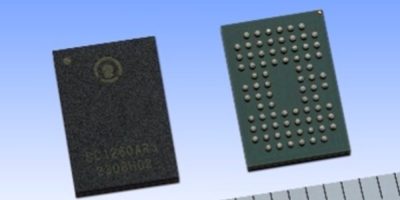
Compact, low power RF sensors detect position and passenger movement

RF ranging sensors for automotive applications in the SC1260 series use the 60GHz frequency band. Socionext has also integrated time division multiplexing (TDM-MIMO) operation with multiple transmitting and receiving antennas to detect the position and movement of passengers in a vehicle with maximum accuracy.

The SC1260 incorporates antennas and radar signal operation circuits for maximum detection accuracy in a low power, compact package. The sensors use a wide band of 6.8GHz (57.1 to 63.9GHz), TDM-MIMO and built-in radar signal operation circuits for range-finding and angle calculation.

TDM-MIMO operation enables high-precision sensing, such as the detection of passengers when three people are sitting in a row inside the vehicle, added Socionext.

The sensors are claimed to enable easy acquisition of 3D position information without requiring advanced expertise in high frequency devices and signal operation. Each sensor combines antennas, RF circuits, ADCs, FIFO memory, an SPI and intelligent power control sequencer for flexible duty cycle control. The sensor requires only 0.72mW at 0.1 per cent duty cycle operation.

The sensors are suitable for a range of automotive applications, such as tracking the position and movements of passengers in a vehicle while suppressing the load on the vehicle battery when the engine is off, said Socionext.

The SC1260 series complies with the global broadband 60GHz radio equipment standard. Sample and evaluation kit shipments are scheduled for June, with production volumes to be available in Q1 2024.

The company is believed to be the first to develop compact, low power 60GHz RF ranging sensors with built-in radar signal operation circuits for range-finding and angle calculations. It used its experience and knowledge accumulated through the development of millimeter-frequency wireless communication ICS and 24GHz radio-frequency ranging sensors, observed Teruaki Hasegawa, head of Socionext’s IoT & radar sensing business unit.

The sensor is supplied in a FC-BGA with dimensions of 6.0 x 9.0 x 1.2mm.

Socionext Europe is a fabless SoC supplier. Its headquarters is in Frankfurt, Germany with offices in Munich, Germany and Maidenhead, UK. 

The Munich Design and Support Centre, specialises in hardware and software product development for the automotive sector. Maidenhead supports Socionext’s IP Development & Engineering Centre with a focus on high speed data conversion IP. 

https://www.socionext.com/en/

> Read More

Edge sensors in AMD’s Artix UltraScale+ family are ADAS-optimised

Addressing market needs for faster signal processing and smaller form factors in systems using edge sensors, such as lidar, radar and 3D surround-view camera systems, AMD has added two edge sensors to its Automotive XA Artix UltraScale+ family.

The XA AU10P and XA AU15P processors are cost-optimised processors, which is a requirement in the consumer driven automotive market. They are automotive-qualified and optimised for use in advanced driver assistance systems (ADAS) sensor applications. The Artix UltraScale+ devices join the automotive-grade Spartan 7, Zynq 7000 and Zynq UltraScale+ product families. 

The XA Artix FPGAs are shipping now. They offer high serial bandwidth and signal compute density in an compact form factor. The Artix UltraScale+ devices maximise system performance via DSP bandwidth for cost-sensitive and low-power ADAS edge applications including networking, vision and video processing and secure connectivity. 

XA Artix UltraScale+ processors are certified for functional safety up to ASIL-B, which is critical for automotive ADAS sensors from cameras to lidar systems, said AMD, for use in vehicles and robotaxis, for example.

“As automotive systems have grown in complexity, safety is more critical than ever before with automotive OEMs and Tier 1 suppliers requiring ASIL-B certification for LiDAR, radar and smart edge sensor applications,” said Ian Riches, vice president, global automotive practice, TechInsights. 

Automotive designers can use XA Artix UltraScale+ devices for sensor fusion, bringing in data from multiple edge sensors and performing image and video processing before porting it to an external SoC. The new XA Artix UltraScale+ devices can also be connected to multiple displays in the vehicle to enhance infotainment features, advised AMD.

http://www.xilinx.com 

> Read More

Microchip extends rad-tolerant GbE PHYs with copper and fibre support

Support for both copper and fibre interfaces is provided by the VSC8574RT PHY, the latest addition to Microchip’s radiation-tolerant family of Gigabit Ethernet (GbE) PHYs.

To streamline the implementation of Ethernet for aerospace and defence customers, Microchip Technology has created the VSC8574RT PHY which supports the Serial Gigabit Media Independent Interface (SGMII) and Quad Serial Gigabit Media-Independent Interface (QSGMII) to reduce the overall signal pins in the design and free up the host device.

The VSC8574RT Ethernet PHY builds on Microchip’s commercial off the shelf (COTS) -based devices, allowing customers to begin developing applications using the COTS version and substitute a radiation-tolerant version device for the final mission. 

Being compatible with both copper and fibre interfaces makes new application use cases possible, said Microchip. Although copper is primarily used in today’s design, the fibre interface is expected to be specified more as the industry requires data rates exceeding 1Gbit. 

The VSC8574RT PHY is equipped with a quad port to support 10, 100 and 1000BASE-T Ethernet connections for optimal speed and reach, depending on the device requirements. The PHY also has advanced features, such as Synchronous Ethernet (SyncE) and IEEE 1588v2 Precision Time Protocol (PTP), for network timing and synchronisation in applications requiring highly precise timing. 

The VSC8574RT specifications include single event latch-up immunity above 78MeV.cm²/mg and total ionising dose tested up to 100krad. It is applicable for projects from low earth orbit (LEO) to deep space.

“The VSC8574RT PHY with advanced timing features provides our customers with a connectivity solution for deterministic real-time applications,” said Bob Vampola, vice president of Microchip’s aerospace and defence business unit.

Available in limited sampling upon request, it joins Microchip’s VSC8541RT and VSC8540RT COTS-based GbE PHY devices. 

Microchip also offers support in the form of the VSC8574-EV evaluation board for the user to evaluate the device in multiple configurations.

http://www.microchip.com

> Read More

Imagination says IMG CXM is the smallest GPU to support HDR user interfaces

Seamless visual experiences for cost-sensitive consumer devices are assured with the IMG CXM GPU of RISC-V compatible cores, said Imagination Technologies. The range includes what is claimed to be the smallest GPU to support HDR user interfaces natively. 

The IMG CXM cores can lower the cost of DTV and other consumer devices in smart homes, for example, said Imagination. Another driver is content providers seeking to integrate 4K and HDR features to enrich content, continued the company.

There are three new configurations which extend the range of performance options already available in Imagination’s GPU family of products for the consumer space. Imagination has released the CXM-2-64, claimed to be the smallest GPU to support native HDR applications. It is suitable for wearable devices, SmartHubs or mainstream set-top boxes.

The CXM-4-64 is suitable for integrating into SmartHubs, set-top boxes or mainstream DTVs and the CXM-4-128 is a performance dense option for premium DTVs, advised Imagination.

The company has boosted the performance density of the IMG BXE and BXM range of GPUs for the CXM GPUs and added native support for HDR. 

The CXM GPUs support 10bits RGBA / YUV to deliver a HDR graphical user interface with images with less visible banding. To smooth the outline of texts and images, they employ 4xMSAA (Microsoft Active Accessibility, an application programming interface (API) for user interface accessibility).  

TFBCv2, the new generation of Imagination’s Tiny Frame Buffer Compression, delivers higher quality lossy / lossless compression and an additional compression level (37.5%) for improved design flexibility.

The IMG CXM GPU range boasts nearly a 50 per cent uplift in performance density compared to the IMG BXM range.

The IMG CXM is supported by software that supports APIs, including Vulkan 1.3, and has been optimised for leading CPU architectures including Arm and RISC-V application processors.

Dr. Charlie Su, CTO and president of Andes Technology said: “The RISC-V ecosystem is growing rapidly. To continue its growth and showcase the many possible ways it can be deployed, we partnered with Imagination to provide a quick and easy path to validated GPU and CPU IP blocks that can reduce SoC design time, risk, and cost for our customers. With Imagination’s flexibly designed GPU, and our AndesCore high performance, low power RISC-V CPU, we are able to satisfy the requirements for display-oriented SoC in a short time and generate the optimum configuration.”

James Chapman, chief product officer, Imagination Technologies commented the CXM GPUs will “transform user experiences” and he expects to see the GPUs deployed in a diverse range of applications from wearables to premium 8K DTVs.

Imagination will be demonstrating TFBCv2 at the 2023 RISC-V Con Shanghai and 2023 RISC-V Con Beijing events, hosted by Andes Technology.

https://www.imaginationtech.com/

> Read More

About Smart Cities

This news story is brought to you by smartcitieselectronics.com, the specialist site dedicated to delivering information about what’s new in the Smart City Electronics industry, with daily news updates, new products and industry news. To stay up-to-date, register to receive our weekly newsletters and keep yourself informed on the latest technology news and new products from around the globe. Simply click this link to register here: Smart Cities Registration