

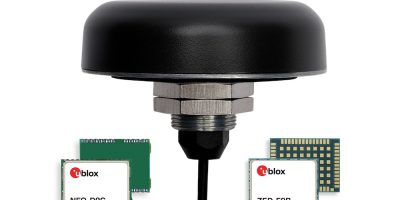
u-blox and Tallysman Wireless collaborate on augmented smart antennas

As part of a design partnership between u-blox and Tallysman Wireless, the ZED-F9R GNSS and NEO-D9S L-band receivers will be integrated with Tallysman’s Accutenna technology in the next generation PointPerfect augmented smart GNSS PPP-RTK augmented smart antennas. 

The PointPerfect GNSS augmentation service is now available in North America, Europe, and parts of Asia Pacific.

“The TW5390 solution offers users high-precision with rapid convergence times, access to precise, reliable, and easy to use PointPerfect PPP-RTK GNSS augmentation data. The result is centimetre-level accuracy in seconds on a continental scale for exceptional precision,” said Christopher Russell, Tallysman’s vice president of sales. The design partners expect to integrate the antenna and receiver technologies 

The multi-band (L1/L2 or L1/L5) architecture removes ionospheric errors and the multi-stage enhanced XF filtering improves noise immunity while relying on the dual feed Tallysman Accutenna element mitigates multi-path signal interference rejection. Some versions of the smart antenna solutions include an inertial measurement unit (IMU) for dead reckoning and an integrated L-band corrections receiver to ensure operation beyond terrestrial network reach.

“Tallysman and u-blox offer a turnkey silicon-to-cloud solution since PointPerfect is already pre-integrated with u-blox ZED-F9R and NEO-D9S high-precision GNSS modules. Our intuitive cloud platform provides a self-serve environment from which users have autonomy to manage IoT device fleets. This eliminates complexities and allows users to engage more efficiently and reduce time-to-market,” said Franco de Lorenzo, principal product owner, services at u-blox. 

u-blox provides positioning and wireless communication in automotive, industrial, and consumer markets. Its services and products let people, vehicles, and machines determine their precise position and communicate wirelessly over cellular and short range networks. The company has a broad portfolio of chips, modules and secure data services and connectivity to develop solutions for the IoT, quickly and cost-effectively. It has headquarters in Thalwil, Switzerland with offices in Europe, Asia, and the USA. 

http://www.u-blox.com

> Read More

Cadence introduces tools for Arm TCS23 for a fast path to tapeout

Cadence has finetuned its RTL-to-GDS digital flow and delivered corresponding 3nm and 5nm rapid adoption kits (RAKs) for Arm Cortex-X4, Cortex-A720 and Cortex-A520 CPUs and Immortalis-G720, Mali-G720 and Mali-G620 GPUs.

This part of Cadence Design Systems’ expanding collaboration with Arm to advance mobile device silicon, providing customers with a faster path to tapeout through the use of Cadence digital and verification tools and the new Arm Total Compute Solutions 2023 (TCS23) for the cores and GPUs.

Cadence delivered comprehensive RTL-to-GDS digital flow RAKs for 3nm and 5nm nodes to help customers achieve power and performance goals using the new Arm TCS23. The Cadence tools optimised for the new Arm TCS23 include the Cadence Cerebrus Intelligent Chip Explorer, Genus Synthesis, Modus DFT software, Innovus implementation system, Quantus extraction, Tempus timing signoff and ECO Option, Voltus IC Power Integrity, conformal equivalence checking and conformal low power. Cadence Cerebrus provided Arm with AI-driven design optimisation capabilities that resulted in 50 per cent better timing, a 10 per cent reduction in cell area and 27 per cent improved leakage power on the Cortex-X4 CPU, empowering Arm to achieve power, performance and area (PPA) targets faster, reported Cadence.

The digital RAKs provide Arm TCS23 users with benefits, for example the AI-driven Cadence Cerebrus automates and scales digital chip design, providing customers with improved productivity versus a manual, iterative approach. Cadence iSpatial technology provides an integrated implementation flow, offering improved predictability and PPA, leading to faster design closure. The RAKs also incorporate a smart hierarchy flow that enables accelerated turnaround times on large, high-performance CPUs. The Tempus ECO Option, which provides path-based analysis, is integrated into the flow for signoff-accurate, final design closure. Finally, the RAKs use the GigaOpt activity-aware power optimisation engine, incorporated with the Innovus implementation system and the Genus Synthesis to dramatically reduce dynamic power consumption.

Arm used the Cadence verification flow to validate the Cortex-X4, Cortex-A720 and Cortex-A520 CPU-based and Immortalis-G720, Mali-G720 and Mali-G620 GPU-based mobile reference platforms. The Cadence verification flow supports Arm TCS23 and includes the Cadence Xcelium logic simulation platform, Palladium Z1 and Z2 Enterprise emulation platforms, Helium Virtual and Hybrid Studio, JasperÒ formal verification platform and Verisium Manager planning and coverage closure tools.

The Cadence verification flow lets Arm TCS23 users improve overall verification throughput and leverage advanced software debug capabilities. Cadence also validated that Cadence Perspec system verifier, VIP and System VIP tools all support TCS23-based designs to enable customers to accelerate time to market when assembling TCS23-based SoCs. The virtual and hybrid platform reference designs include the Arm Fast Models to enable early software development and verification through the Cadence Helium Studio as well as the Cadence Palladium and Protium platforms, also known as the dynamic duo.

The Cadence digital and verification flows support the Cadence Intelligent System Design strategy, which enables customers to achieve SoC design excellence. 

http://www.cadence.com 

> Read More

Renesas adds three motor control MCU groups drawn from multiple families

Targeting motor control applications, Renesas Electronics has introduced three microcontroller (MCU) groups, including devices from its RX and RA families.

There are two new MCU groups from the RA family of Arm Cortex-M devices. The RA4T1 Group delivers 100MHz performance with up to 256kbyte of flash and 40kbyte SRAM. The MCUs are based around 100MHz Arm Cortex-M33 CPU cores with TrustZone and have integrated flash memory options from 128kbyte to 256kbyte and 40kbyte SRAM. In addition to an integrated trigonometric function unit as a hardware accelerator, they feature integrated analogue functions, including 12bit ADC, PGA, comparator and 12bit DAC. The MCUs are available in 32- to 64-pin packages options.

The second addition is the RA6T3 Group which offers 200MHz operating frequency and provides 256kbyte of flash and 40kbyte SRAM. These are based around a 200MHz Arm Cortex-M33 CPU core with TrustZone and have integrated flash memory of 256kbyte and 40kbyte SRAM.  They have the same analogue functions as the RA4T1 Group and integrated communications options including USB 2.0, CAN FD, I3C, SCI and SPI. They are available in package options from 32- to 64-pin.

Both new groups offer features and functions specifically for motor control applications, including trigonometric function units (TFUs) for acceleration, advanced ADC with integrated PGA (programmable gain amplifier), with a choice of communication interfaces including CAN FD. 

The MCUs are supported by the Renesas Flexible Software Package (FSP) to allow designers to port designs from other RA family devices.

Another introduction is the RX26T Group of MCUs from the RX family operating at 120MHz with up to 512kbyte of flash memory and 64kbyte SRAM. Renesas claimed that it has industry-leading real-time performance of 120MHz with no-wait flash memory access. The MCUs support 5.0V power supplies with high noise immunity and control accuracy, added Renesas. They also provide TFUs, on-chip timing, and interrupt control. Designers using Renesas’ RX24T MCUs can scale designs to the RX26T devices to take advantage of existing design software while realising performance and control efficiency improvements, said Renesas. 

All of the new MCUs are available now and supported by Renesas’ Flexible Motor Control development kit that enables easy evaluation of motor control using permanent magnet synchronous motors (brushless DC motors), and the Renesas Motor Workbench development tool.

http://www.renesas.com 

> Read More

Synopsys and Arm push on with next-gen mobile SoC designs

Synopsys combines EDA and IP with Arm’s Total Compute Solutions at Computex Taipei. The AI-enhanced design collaboration tackles mobile chip designs on advanced nodes down to 2nm. At the show, Synopsys announced Synopsys.ai full-stack AI-driven EDA suite, Synopsys Interface and Security IP and Synopsys Silicon Lifecycle Management PVT IP have been optimised for the highest levels of performance and power for Arm’s latest compute platform

These advancements continue the decades of collaboration between the two companies to accelerate customers’ delivery of Arm-based SoCs for smartphones and VR / AR applications.

Shankar Krishnamoorthy, general manager of Synopsys EDA group, commented: “Collaborating with Arm to optimise our EDA and IP solutions enables mutual customers to tackle some of the toughest multi-die system integration challenges from design, IP integration and verification to software development. The addition of the Synopsys.ai EDA suite starts a new phase, where co-operative keystone companies, like Synopsys and Arm, align expertise to help mutual customers turbo-charge the delivery of their Arm-based SoC designs.”

Arm announced its Total Compute Solutions 2023 (TCS23) platform at the show in Taipei. “The new TCS23 platform delivers a suite of segment-specific technology, designed with the system in mind, so that our customers can tap into the compute performance required for the next generation of visual computing experiences,” said Chris Bergey, senior vice president and general manager, client line of business, at Arm.

For TCS23, the Synopsys.ai full-stack AI-driven EDA suite leverages the power of AI from system architecture through manufacturing to optimise power, performance and area (PPA) and enhance time to market, said the company.

The Synopsys Verification family accelerates architecture exploration, software development and verification throughput for Arm SoCs containing Arm Cortex-X4, Cortex-A720 and Cortex-A520 CPUs and Immortalis-G720 and Mali-G720 GPUs. 

Early adopters of TCS23 are using Synopsys virtual prototypes with Arm Fast Models, Synopsys hardware-assisted verification and verification IP for the latest Arm AMBA interconnect to deliver SoCs to market faster.

Synopsys Interface and Security IP for PCI Express 6.0 with Integrity and Data Encryption (IDE), CXL 3.0 with IDE, DDR5 with Inline Memory Encryption (IME) and UCIe, are all optimised for performance with Arm-specific features and for pre-silicon interoperability with Arm cores to minimise risk and to accelerate time to market.

The Synopsys Silicon Lifecycle Management Family PVT monitor IP can be integrated into Arm cores to monitor chip health from development to the field to measure and optimise performance.

Synopsys Fusion QuickStart Implementation Kits (QIKs) are tuned to extract maximum entitlement from the latest five, four and 3nm process technologies. They provide the most efficient path to realising optimally scaled compute architectures for the most demanding end-user applications, said the company.

Synopsys QIKs include implementation scripts and reference guides that enable early adopters of the newest Armv9.2 cores to accelerate time to market and achieve their demanding performance per Watt targets. These QIKs are available today by request through the Arm support hub or from Synopsys SolvNet.

Synopsys also incorporates the latest Arm Fast Models for virtual prototypes and delivers verification IP for the latest Arm AMBA interconnect, emulation and prototyping hardware to accelerate hardware-software bring-up and power and performance validation, resulting in shorter time to market.

Synopsys IP for PCI Express 6.0 with IDE, CXL 3.0 with IDE, DDR5 with IME and UCIe are available now.

http://www.synopsys.com 

> Read More

About Smart Cities

This news story is brought to you by smartcitieselectronics.com, the specialist site dedicated to delivering information about what’s new in the Smart City Electronics industry, with daily news updates, new products and industry news. To stay up-to-date, register to receive our weekly newsletters and keep yourself informed on the latest technology news and new products from around the globe. Simply click this link to register here: Smart Cities Registration