


Amplifiers and comparators shrink space requirements

Smaller personal electronics, enterprise, industrial and communications designs can be achieved with the INA185 current-sense amplifier, and open-drain TLV4021 and push-pull TLV4041 comparators, claims Texas Instruments.

The INA185 is claimed to be the industry’s smallest current-sense amplifier in a leaded package and the TLV4021 and push-pull TLV4041, with an internal 1.2 or 0.2V reference, are claimed to be the smallest, most accurate comparators. In addition, says Texas Instruments, pairing the amplifier with one of the comparators produces the smallest, highest performing overcurrent detection solution in the industry.

The INA185 current-sense amplifier achieves more precision in less space, says the company. It is offered in a small-outline transistor (SOT)-563 package (1.6 x 1.6mm or 2.5mm2), making it 40 per cent smaller than the closest competitive leaded packages, says Texas Instruments.

It has a 55 microV input offset that enables higher precision measurements at low currents, and enables the use of lower-value shunt resistors to cut system power consumption. The 350kHz bandwidth and 2.0V/micro second slew rate enable phase-current reproduction to enhance motor efficiency and also save system power.

The matched resistive gain network enables a maximum gain error down to 0.2 per cent, which contributes to robust performance over temperature and process variations. The device’s typical response time of two micro seconds enables fast fault detection to prevent system damage.

The TLV4021 and TLV4041 comparators are available in a small die-size ball grid array (DSBGA) 0.73 x 0.73mm package. Both have an integrated voltage reference which saves board space and supports precise voltage monitoring to optimise system performance.

The comparators can monitor voltages down to 0.2V internal reference and feature a high threshold accuracy of one per cent across a full temperature range from -40 to +125 degrees C. Low 2.5 microA quiescent current delivers extended battery life for smart, connected devices, while a fast propagation delay (as low as 450 nano seconds) reduces latency and enables systems to monitor signals and respond quickly to fault conditions.

When used in combination, the INA185 and the TLV4021 or TLV4041, produce  the smallest, highest-performing overcurrent detection partnership, around 15 per cent smaller and 50 times faster than competitive devices, points out Texas Instruments.

Pairing the amplifier with one of the comparators to support overcurrent detection on rails as high as 26 V delivers more headroom to better manage current spikes, adds Texas Instruments.

TINA-TI SPICE models and reference designs to simulate system designs and predict circuit behaviour when using the INA185 current-sense amplifier and TLV4021 and TLV4041 comparators are available, together with evaluation modules, the INA185EVM and TLV4021-41EVM.
http://www.ti.com

> Read More

Renesas announces memory technology for AI

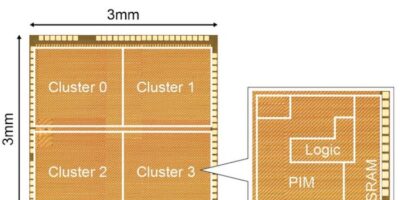
Renesas Electronics has developed an AI accelerator that performs convolutional neural network (CNN) processing at high speeds and low power.  A test chip with this accelerator has achieved the power efficiency of 8.8Tera operations per second per W (TOPS/W), which is the industry’s highest class of power efficiency, reports Renesas. The accelerator is based on the processing-in-memory (PIM) architecture, in which multiply-and-accumulate (MAC) operations are performed in the memory circuit as data is read out from that memory.

To create the new AI accelerator, Renesas developed three technologies. The first is a ternary-valued (-1, 0, 1) SRAM structure PIM technology that can perform large-scale CNN computations. The second is an SRAM circuit to be applied with comparators that can read out memory data at low power. The third is a technology that prevents calculation errors due to process variations in the manufacturing. Together, these technologies achieve a reduction in the memory access time in deep learning processing and a reduction in the power required for the MAC operations. As a result, the accelerator achieves the industry’s highest class of power efficiency while maintaining an accuracy ratio more than 99 per cent when evaluated in a handwritten character recognition test (MNIST), claims Renesas.

Before this development, the PIM architecture was unable to achieve an adequate accuracy level for large-scale CNN computations with single-bit calculations because the binary (0,1) SRAM structure was only able to handle data with values 0 or 1. Additionally, process variations in the manufacturing reduced the reliability of these calculations. The technologies developed by Renesas resolve these issues and can be applied to implement AI chips of the future and e-AI solutions for applications such as wearable equipment and robots that require both performance and power efficiency, says Renesas.

Since introducing the embedded AI (e-AI) concept in 2015, Renesas has defined classes based on the effectiveness of e-AI and applications that are implemented and has been developing e-AI solutions based on four classes: judging the correctness or abnormality of signal waveform data; judging correctness or abnormality using real-time image processing; performing recognition in real time and enabling incremental learning at an endpoint.

https://www.renesas.com 

> Read More

Accelerometers support CAN or RS-422 protocols

Accelerometers added to the Seiko Epson (Epson) portfolio can monitor the health of the wearer or buildings and infrastructure, as the company releases the M-A352 and the M-A552xxx accelerometers.

The M-A352 accelerometer is designed for infrastructure health monitoring. It  provides the necessary noise performance of one micrG/√Hz or better (servo accelerometer class) for a stable supply and cost competitiveness, says Epson.

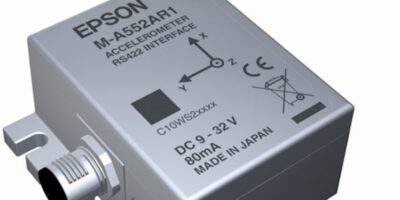
The M-A552AC1 and M-A552AR1 three-axis accelerometers boast the same performance as the M-A352 but are equipped with the controlled area network (CAN) and RS-422 interfaces, respectively. These interfaces are widely used in industrial applications. The M-A552AC1 and M-A552AR1 are housed in metal packages that provide IP67-equivalent protection against water and dust.

This level of protection against the elements enables the accelerometers to be used in a range of industrial applications that require long distances, stability and reliability, says Epson.

The accelerometers make it easy for developers to build multi-node (multi-point) measurement systems, synchronised measurement systems and other complex, sophisticated measurement systems. They are easy to install, connect, and use even outdoors and under other harsh environmental conditions, adds Epson, and can reduce customer system development times.

Samples of the new products will begin shipping in the summer of 2019, with volume production scheduled for the spring of 2020.

The MA-A552AC1 (CAN) and MA-A552AR1 (RS-422) accelerometers can be used in structure health monitoring to monitor buildings, bridges, tunnels, and steel towers for earthquake detection, environmental vibration measurement and industrial equipment monitoring. They can also be used in unmanned vehicles (e.g., terrestrial vehicles, undersea probes), and for the measurement of the vibration and path of industrial equipment and vehicles.

Epson Europe Electronics is a marketing, engineering and sales company and the European headquarters for electronic devices of Seiko Epson, Japan. Headquartered in Munich, Germany, since 1989, Epson Europe Electronics has 50 employees, European sales representatives and a Europe-wide network of distributors. Epson Europe Electronics provides value added services for semiconductors, sensors, sensing systems and timing devices for a variety of markets, including industrial, automotive, medical, and communications.

http://www.epson-electronics.de

> Read More

Arm introduces CPU and GPU for 5G mobiles

At Computex in Taiwan this week, Arm has unveiled the latest Cortex CPU, a new Mali GPU. Based on a new architecture and a processor for machine learning.

The latest Cortex CPU, the Cortex-A77 improves instruction per cycle (IPC) performance by 20 per cent, compared with the Cortex-A76 for machine learning, augmented reality and virtual reality (ML, AR and VR).

The Arm Mali-G77 GPU is based on Valhall architecture and is intended for use in mobile devices to deliver graphics at increased efficiency, according to Arm. Microarchitecture enhancements including engine, texture pipes, and load store caches, which achieve 30 per cent better energy efficiency and 30 per cent more performance density. The Valhall architecture is claimed to deliver close to 40 per cent performance improvement compared with the Mali-G76 in devices today.

Arm also says that it boosts inference and neural net (NN) performance for ML and to deliver more immersive games for mobile apps.

A dedicated ML processor delivers up to five tera operations per second (TOPS) per W as part of Project Trillium. The ML processor and open-source Arm NN software framework was announced in 2018 and enhancements to the ML processor include more than double energy efficiency to 5TOPS/W, memory compression improved by up to a factor or three and scaling to peak next-generation performance up to eight cores for up to 32TOPS.

http://www.arm.com

> Read More

About Smart Cities

This news story is brought to you by smartcitieselectronics.com, the specialist site dedicated to delivering information about what’s new in the Smart City Electronics industry, with daily news updates, new products and industry news. To stay up-to-date, register to receive our weekly newsletters and keep yourself informed on the latest technology news and new products from around the globe. Simply click this link to register here: Smart Cities Registration