


Adaptable buck-boost converters deliver up to 2.5A in tiny packaging

A family of four high-efficiency, low-quiescent-current (IQ) buck-boost converters that feature tiny packaging with minimal external components for a small solution size is now available from Texas Instruments (TI).

The integrated TPS63802, TPS63805, TPS63806 and TPS63810 DC/DC non-inverting buck-boost converters offer wide input and output voltage ranges that scale to support multiple battery-driven applications, helping engineers simplify and accelerate their designs.

Each of the devices automatically selects buck, buck-boost or boost mode according to the operating conditions. Their complete solution size of 19.5 square mm to square mm 25 is a result of compact packaging, an advanced control topology requiring few external multilayer ceramic capacitors, and tiny 0.47-microH inductors.

The devices offer a 1.3-V to 5.5-V input and 1.8-V to 5.2-V output voltage range, to help engineers speed their designs and encourages reuse across multiple applications.

These DC/DC converters are the latest addition to TI’s low-IQ power-management portfolio, providing low 11- to 15-microA IQ for light-load efficiency while minimising power losses and extending run times in battery-driven applications such as portable electronic point-of-sale terminals, grid infrastructure metering devices, wireless sensors and handheld electronic devices.

The TPS63802 is a 2-A buck-boost converter with low 11-microA IQ consumption suitable for pulsed-load applications such as industrial Internet of Things devices. The TPS63805 is a 2-A buck-boost converter with a 22-microF output capacitor and 0.47-microH inductor resulting in a small solution size of 19.5 mm squared that meets the requirements of handheld industrial and personal electronics applications.

The new series also includes the TPS63806, a 2.5-A buck-boost converter with a focus on improved load-step regulation for applications with an aggressive load profile that require tight regulation, such as time-of-flight sensors in smartphones, cameras or augmented reality devices. And the

TPS63810 is a 2.5-A buck-boost converter with I2C interface for dynamic voltage scaling through either a two-wire interface or the VSEL pin, enabling the device to serve as a pre-regulator or voltage envelope tracker for systems found in smartphones, wireless hearing aids or headphones.

http://www.ti.com

> Read More

Microchip simplifies hardware-based IoT security

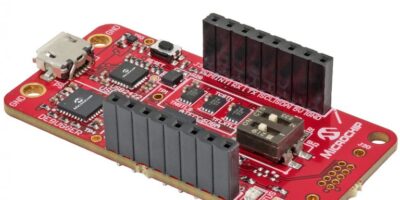
A pre-provisioned solution that provides secure key storage for low-, mid- and high-volume device deployments using the ATECC608A secure element is now available from Microchip Technology. According to the company, the Trust Platform for its CryptoAuthentication family enables companies of all sizes to implement secure authentication.

The platform consists of a three-tier offering, providing out-of-the-box pre-provisioned, pre-configured or fully customisable secure elements, allowing developers to choose the platform best suited for their individual design. As the first solution to provide ready-to-go secure authentication for the mass market, the first tier – Trust&GO – provides zero-touch pre-provisioned secure elements with a minimum orderable quantity (MOQ) as low as 10 units.

Device credentials are pre-programmed, shipped and locked inside the ATECC608A for automated cloud or LoRaWAN authentication onboarding. In parallel, corresponding certificates and public keys are delivered in a “manifest” file, which is downloadable via Microchip’s purchasing e-commerce store and select distribution partners.

With the ability to authenticate to any public or private cloud infrastructure, Microchip’s Trust Platform is also flexible and customisable. For customers who want more customisation, the program includes the TrustFlex and TrustCustom platforms.

The solution helps simplify provisioning logistics, says the company, making it easy for mass market customers to secure and manage edge devices without the overhead cost of third-party provisioning services or certificate authorities.

The second tier in the program, TrustFlex, offers the flexibility to use the customer’s certificate authority of choice while still benefiting from pre-configured use cases.

These use cases include baseline security measures such as transport layer security (TLS) hardened authentication for connecting to any IP-based network using any certificate chain, LoRaWAN authentication, secure boot, Over-the-Air (OTA) updates, IP protection, user data protection and key rotation. This can reduce the time and complexity involved in customising the device without requiring customised part numbers.

For customers who would like to customise their designs entirely, the third tier in the program – TrustCustom – provides customer-specific configuration capabilities and custom credential provisioning.

https://www.microchip.com

> Read More

ams adds laser detection auto-focus that sees through smudges

Laser detection auto-focus for a smartphone camera that can accurately zero in on the target when the cover glass is smudged or dirty is possible with TMF8801 time of flight (ToF) sensor from ams.

The sensor is claimed to be the world’s smallest integrated module for direct ToF distance measurement, providing accurate measurements from 20 to 25mm.

The TMF8801 is more than 30 per cent smaller than competing ToF sensors, claims ams, for compact designs. Unlike competing ToF sensors which struggle to accurately measure distance below dirty or smudged cover glass, the TMF8801 maintains high accuracy through use of its on-chip histogram processing, ams says.

The TMF8801 direct ToF sensor complements the TMF8701 short range ToF sensor released in 2018 and provides extended distance range sensing for smartphones. Dave Moon, senior product marketing manager in the Integrated Optical Sensors business line at ams, said: “The TMF8801 is ideally suited to provide support for improving world-facing mobile phone camera performance using laser detection auto-focus (LDAF), enabling mobile phone users to take pin-sharp photos and selfies.”

The ToF performance is achieved through use of an integrated VCSEL infra red emitter, multiple single photon avalanche photo-diode (SPAD) light detectors, time-to-digital converter, and on-chip microcontroller for processing histograms. Compared to distance averaging employed with an indirect ToF system, the direct ToF time measurement methodology used in the TMF8801 delivers higher accuracy true-distance measurements, claims ams.

High accuracy distance measurements, combined with LDAF, improve camera performance, with sharper, in-focus images under any ambient lighting conditions, and accurate adjustment of the camera flash brightness to improve picture quality.

The small size and low power consumption of the TMF8801 is suitable for fast-ranging collision avoidance detection used in autonomous vacuum cleaners, and industrial robotics. For display-based products, such as mobile computing, the TMF8801 can be used for user presence detection to automatically wake up or put the system into a low-power sleep mode based on the presence or absence of a user.

The TMF8801 is housed in a 2.2 x 3.6 x 1.0mm package and is in volume production.

https://www.ams.com

> Read More

QuickLogic partners with Nuance Communications for voice recognition

Multi-core, voice-enabled SoCs, embedded FPGA IP, and endpoint AI provider, QuickLogic is partnering with conversational AI and ambient intelligence specialist, Nuance Communications, to deliver low power, wake word and voice command technology for power-sensitive applications, such as hearable and wearable devices.

Nuance’s voice recognition technology and QuickLogic’sEOS S3 voice and sensor processing platform will provide customers an end-to-end, reliable hardware and software voice recognition solution, says QuickLogic.

The low power Nuance voice recognition technology has been integrated with QuickLogic’s advanced EOS Voice and Sensor Processing SoC. The SoC’s architecture is claimed to enable the industry’s most advanced and compute intensive sensor processing capability at a fraction of the power consumption of competing technologies.

The Nuance technology provides the performance and low power consumption required for always-on wake word detection, and specifically supports the Alexa wake-word protocol. Technical enhancements enable it to improve voice recognition accuracy in difficult or noisy environments.

The integrated system supports always-on, always-listening fixed triggers, user defined triggers and phrases, and commands that can be accurately detected in silent to extremely noisy environments.

Scott Haylock, director of product marketing at QuickLogic, explains:”In response to customer demand, and the growing hearables market, we’ve augmented the EOS S3 OPEN Software Platform to include Nuance’s technology. This addition helps QuickLogic address the largest possible product mix of new and existing voice-controlled end-products.”

The EOS S3 platform with integrated Nuance voice processing is available now.

QuickLogic is a fabless semiconductor company that develops low power, multi-core semiconductor platforms and IP for artificial intelligence (AI), voice and sensor processing. It supplies embedded FPGA IP (eFPGA) for hardware acceleration and pre-processing, and heterogeneous multi-core SoCs that integrate eFPGA with other processors and peripherals. The Analytics Toolkit provides sensor algorithms using AI technology.

http://www.quicklogic.com 

> Read More

About Smart Cities

This news story is brought to you by smartcitieselectronics.com, the specialist site dedicated to delivering information about what’s new in the Smart City Electronics industry, with daily news updates, new products and industry news. To stay up-to-date, register to receive our weekly newsletters and keep yourself informed on the latest technology news and new products from around the globe. Simply click this link to register here: Smart Cities Registration