

NIR sensor saves power for mobile 3D optical sensing systems

3D optical sensing applications such as face recognition, payment authentication can operate at much lower power than alternative implementations, using the CGSS130, CMOS global shutter sensor (CGSS) near infra red (NIR) image sensor by ams.

The CGSS130 enables battery-powered devices to run for longer between charges while supporting sophisticated sensor functions.

According to ams, the CGSS130 sensor is four times more sensitive to NIR wavelengths than other image sensors on the market today, and detects reflections from very low power IR emitters in 3D sensing systems. It is the IR emitter that consumes most of the power in face recognition and other 3D sensing applications, says ams, which means using the CGSS130 sensor will enable manufacturers to extend battery runtime in mobile devices.

The 1.3Mpixel sensor also creates the opportunity to implement face recognition in wearable devices and in other products which are powered by a very small battery, or to enable a new range of applications beyond face recognition as the increased sensitivity extends the measurement range for the same power budget.

Following ams’ partnership with CMOS image sensor supplier, SmartSens Technology, the first 3D active stereo vision (ASV) reference design based on the CGSS130 was produced. The 1.3Mpixel stacked BSI sensor offers the highest quantum efficiency at 940nm, claims ams and, by supplying all main parts of the 3D system (illumination, receiver, software) it enables superior system performance with lower costs and a faster time to market.

The stacked BSI process used to fabricate the CGSS global shutter image sensors, results in a small footprint of 3.8 x 4.2mm. The sensor produces monochrome images with an effective pixel array of 1080 x 1280 at a maximum frame rate of 120 frames per second. The high frame rate and global shutter operation produce clean images free of blur or other motion artefacts, says ams.

The sensor also offers a high dynamic range (HDR) mode in which it achieves dynamic range of more than 100dB. It also implements advanced functions such as external triggering, windowing, and horizontal or vertical mirroring.

The CGSS130 is available for sampling.

ams is demonstrating the CGSS130 at CES, in the Venetian Tower, Suite 236 / 30th floor.

https://ams.com

> Read More

Bluetooth LE Audio codec is first for power-sensitive audio says Synopsys

Optimised for Synopsys’ ARC processor IP, a low complexity communication codec (LC3) has been developed by Synopsys with the Fraunhofer Institute for Integrated Circuits (IIS).

The new codec is designed to comply with the forthcoming Bluetooth LC3 audio codec specification and is optimised to deliver high-quality audio and voice playback in battery-powered devices incorporating ARC EM and HS DSP processors, says Synopsys.

It has been added to Synopsys’ portfolio of DesignWare ARC audio codecs and post-processing software supporting popular audio standards. It also extends Synopsys’ DesignWare Bluetooth Low Energy IP offering.

The 32-bit DesignWare ARC EM and HS DSP processors are based on the scalable ARCv2DSP Instruction Set Architecture (ISA) and integrate RISC and DSP capabilities for a flexible processing architecture. The ARC EM DSP processors offer low power and what is claimed to be industry-leading performance efficiency while the multi-core-capable ARC HS DSP processors combine high-performance control and high-efficiency digital signal processing. All ARC processors are supported by the ARC MetaWare Development Toolkit, which includes a library of DSP functions to allow software engineers to rapidly implement algorithms from standard DSP building blocks. ARC processors and the LC3 codec can be combined with Synopsys’ Bluetooth 5.1-compliant DesignWare Bluetooth Low Energy IP to deliver power-efficient, high-quality wireless audio capability for smart IoT and other Bluetooth-enabled devices.

The LC3 codec is an important feature of the Bluetooth LE Audio specification to be released by the Bluetooth Special Interest Group (SIG) that enables system on chip (SoC) designers to efficiently implement high-quality voice and audio streaming in a wide range of applications, including mobile, wearables, and home automation.

The LC3 codec for ARC processors is based on an implementation by Fraunhofer IIS that is designed to meet Bluetooth SIG requirements. The LC3 codec, running on ARC EM and HS DSP processors, allows designers to rapidly integrate a complete, pre-verified hardware and software solution for voice and speech processing into Bluetooth-enabled devices requiring minimal energy consumption, explains Synopsys.

“The rapid growth of wearable devices requiring high-quality Bluetooth audio streaming is driving the need for power-efficient processor IP with DSP capabilities that can meet intensive computation requirements of voice and audio applications. Those applications require an optimised codec providing state-of-the art voice and audio quality at minimum computational complexity,” said Manfred Lutzky, head of Audio for Communications at Fraunhofer IIS. “By porting the LC3 codec to the DSP-enhanced ARC processors, Synopsys is enabling customers to quickly implement LC3 codec functionality in their low-power SoCs. We look forward to continuing our collaboration with Synopsys so that the LC3 codec for ARC processors continues to incorporate the latest updates,” he added.

“The fact that the LC3 codec can provide very high-quality audio even at low bit rates makes it a key feature of the upcoming LE Audio standard,” said Mark Powell, chief executive officer of the Bluetooth SIG. “

John Koeter, senior vice president of marketing for IP at Synopsys, said: “Designed to process high-quality audio streams and deliver superior sound, the LC3 codec for ARC processors provides designers with a certified codec that reduces the integration time and testing required to deliver superior quality audio for Bluetooth streaming applications.”

The Bluetooth LC3 codec is available now from Synopsys with DSP-enhanced ARC EMxD and HS4xD processors.

http://www.synopsys.com

> Read More

Nordic Semiconductor prepares for Bluetooth LE Audio

This year, the Bluetooth Special Interest Group (SIG) will release the Bluetooth LE (Low Energy) Audio specification. To support this forthcoming specification, Nordic Semiconductor has partnered with Bluetooth LE stack developer, Packetcraft, to develop an LE Audio evaluation platform.

It demonstrates the benefits of LE Audio and is designed to support the new LE Audio specifications which promise lower power consumption than classic Bluetooth audio, significantly extending battery life, improved audio quality and enables the development of devices capable of both wireless data transfer and audio streaming. The technology also supports broadcast for audio sharing.

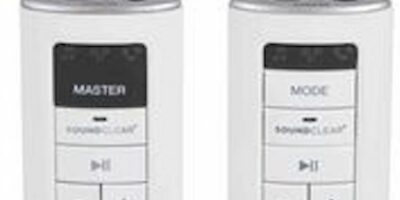
Nordic’s LE Audio comprises a hardware reference design based on its nRF52832 Bluetooth LE system on chip (SoC), Cirrus Logic’s CS47L35 smart codec with an integrated low power audio DSP, Packetcraft’s Bluetooth LE host stack and link layer supporting LE Audio and an LE Audio software development kit (SDK). The platform allows developers to start evaluating the technology for Bluetooth LE Audio wireless speakers, over-the-ear headphones and true wireless ear buds.

It is designed to operate in either source (for example, audio source, voice call headset source, and peer-to-peer call) or sink (audio playback, headset playback, and peer-to-peer call). A pair of devices (source and sink) is required to complete an LE Audio link. The LE Audio solution also features Cirrus Logic’s SoundClear for uplink noise reduction and echo cancellation, playback enhancement, voice control, and hearing augmentation.

An acoustic connector is incorporate that can accommodate up to six microphones or two speakers, a 3.5mm headset jack, a 3.5mm source jack, and a USB connector for charging, debug (using Nordic development tools), and acoustic tuning (using the Cirrus Logic WISCE platform). When wirelessly streaming audio from a source device to wireless (sink) earbuds, the LE Audio evaluation platform extends battery life by around 40 per cent compared to contemporary off-the-shelf classic Bluetooth solutions, claims Nordic Semiconductor.

http://www.nordicsemi.com

> Read More

Integrated IP and software develop contextually-aware IoT devices

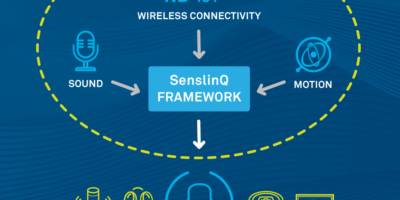
At CES this week, Ceva will demonstrate its SenslinQ integrated hardware IP and software platform, designed to streamline the development of contextually-aware IoT devices.

The platform collects, processes and links data from multiple sensors to enable intelligent devices to understand their surroundings, explains the company by aggregating sensor fusion, sound and connectivity technologies.

Contextual awareness adds value and enhances the user experience of smartphones, laptops, augmented reality/virtual reality (AR/VR) headsets, robots, hearables and wearables. The SenslinQ platform centralises the workloads that require an intimate understanding of the physical behaviours and anomalies of sensors. It collects data from multiple sensors within a device, including microphones, radars, inertial measurement units (IMUs), environmental sensors, and time of flight (ToF) sensors, and conducts front-end signal processing such as noise suppression and filtering on this data. It applies algorithms to create “context enablers” such as activity classification, voice and sound detection, and presence and proximity detection. These context enablers can be fused on a device or sent wirelessly via Bluetooth, Wi-Fi or NB-IoT, to a local edge computer or the cloud to determine and adapt the device to its environment.

The customisable hardware reference design is composed of an Arm or RISC-V microcontroller, CEVA-BX DSPs and a wireless connectivity island, such as RivieraWaves Bluetooth, wi-fi or Dragonfly NB-IoT platforms, or other connectivity standards provided by the customer or third parties. Each components of these three components are connected using standard system interfaces.

The SenslinQ software is comprised of a portfolio of ready-to-use software libraries from CEVA and its ecosystem partners. Libraries include the Hillcrest Labs MotionEngine software packages for sensor fusion and activity classification in mobile, wearables and robots, the ClearVox front-end voice processing, WhisPro speech recognition and DSP and artificial intelligence (AI) libraries. There is also third party software components for active noise cancellation (ANC), sound sensing and 3D audio.

The accompanying SenslinQ framework is a Linux-based hardware abstraction layer (HAL) reference code and application programming interfaces (APIs) for data and control exchange between the multiple processors and sensors.

https://www.ceva-dsp.com

> Read More

About Smart Cities

This news story is brought to you by smartcitieselectronics.com, the specialist site dedicated to delivering information about what’s new in the Smart City Electronics industry, with daily news updates, new products and industry news. To stay up-to-date, register to receive our weekly newsletters and keep yourself informed on the latest technology news and new products from around the globe. Simply click this link to register here: Smart Cities Registration