Digi-Key adds biometric systems with Fingerprint Cards signing

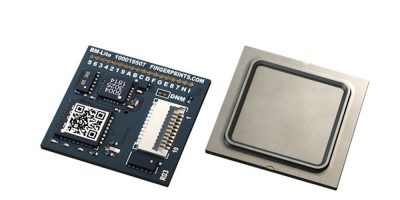
Digi-Key Electronics has signed a global distribution partnership with Fingerprint Cards to offer the Swedish company’s standalone, compact biometric fingerprint sensors.

Fingerprint Cards’ products are found in hundreds of millions of devices and applications, says the company, and are used billions of times every day, for identification and authentication of access or payment systems.

“We are excited about the new partnership with Fingerprint Cards,” said David Stein, vice president, global supplier management at Digi-Key. “Biometric authentication is growing as it continues to be implemented into new applications and devices. Digi-Key now offers customers an easy path to develop secure devices with integrated capacitive fingerprint sensor technology.”

Michel Roig, senior vice president, payments and access at Fingerprints. “Digi-Key will help us reach out and find new potential markets and application areas.”

Fingerprint Cards is a biometrics company, based in Sweden.

Digi-Key Electronics is headquartered in Thief River Falls, Minnesota, USA. It is an authorised global, full-service distributor of electronic components. It offers more than 10.2 million components, with over 2.2 million in stock and available for immediate shipment, from over 1,200 quality name-brand manufacturers.

Its Marketplace Product provides a singular shopping experience for all things related to technology innovation — IoT, industrial automation, test and measurement and more.

http://www.digikey.com

> Read More

Sensor hub DSP architecture makes sense of surroundings

Claimed to be the industry’s first high performance sensor hub DSP architecture, SensPro is configurable for parallel processing floating point and integer data types, as well as deep learning training and inferencing.

Ceva has designed it to handle the sensor processing and sensor fusion workloads for contextually-aware devices.

It addresses the need for specialised processors to efficiently handle the proliferation of different types of sensors that are required in smartphones, robotics, automotive, AR/VR headsets, voice assistants, smart home devices and for industrial and medical applications. These camera, radar, lidar, time of flight (ToF) sensors, microphones and inertial measurement units (IMUs) generate data types and bit-rates derived from imaging, sound, RF and motion, which can be used to create a full 3D contextually-aware device, says CEVA.

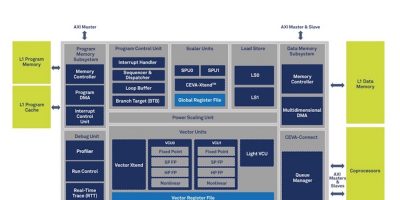
The SensPro architecture is built from the ground up to maximise performance per Watt for multi-sensor processing use cases. It combines high performance single and half precision floating-point maths required for high dynamic range signal processing, point cloud creation and deep neural network (DNN) training. It also has 8-bit and 16-bit parallel processing capacity for voice, imaging, DNN inference processing and simultaneous localisation and mapping (SLAM). SensPro incorporates the Ceva-BX scalar DSP, which offers a seamless migration path from single sensory system designs to multi-sensor, contextual-aware designs.

Dimitrios Damianos, technology and market analyst of the sensing division at Yole Développement (Yole) commented: “The proliferation of sensors in intelligent systems continues to increase, providing more precise modelling of the environment and context. Sensors are becoming smarter, and the goal is not to get more and more data from them, but higher quality of data especially in cases of environment/surround perception. . . .  where many sensors . . . must work together to make sense of their surroundings”.

Yohann Tschudi, technology & market analyst, computing and software, at Yole continued: “The challenge is to process and fuse different types of data from different types of sensors. Using a mix of scalar and vector processing, floating and fixed point math coupled with an advanced micro-architecture, SensPro offers system and SoC designers a unified processor architecture to address the needs of any contextually-aware multi-sensor device.”

SensPro uses a configurable eight-way VLIW architecture, allowing it to be easily tuned to address a range of applications. Its micro-architecture combines scalar and vector processing units and incorporates an advanced, deep pipeline enabling operating speeds of 1.6GHz at a 7nm process node.

A Ceva-BX2 scalar processor for control code execution has a 4.3 CoreMark/MHz score. It adopts a wide SIMD scalable processor architecture for parallel processing and is configurable for up to 1024 8×8 MACs, 256 16×16 MACs, dedicated 8×2 binary neural networks support, as well as 64 single precision and 128 half precision floating point MACs. This allows it to deliver 3TOPS for 8×8 networks inferencing, 20TOPS for binary neural networks inferencing, and 400GFLOPS for floating point arithmetic. Additionally, a memory architecture provides a bandwidth of 400Gbyte per second, four-way instruction cache, two-way vector data cache, DMA, and queue and buffer managers for offloading the DSP from data transactions.

Ceva also offers software and development tools, including an LLVM C/C++ compiler, Eclipse based integrated development environment (IDE), OpenVX API, software libraries for OpenCL, Ceva deep neural network (CDNN) graph compiler including the CDNN-Invite API for inclusion of custom AI engines, Ceva-CV imaging functions, Ceva-SLAM software development kit and vision libraries, ClearVox noise reduction, WhisPro speech recognition, MotionEngine sensor fusion, and the SenslinQ software framework.

Initially, SensPro DSPs will be available in three configurations:  SP250 (single vector unit with 256 8×8 MACs targeting imaging, vision, and sound centric applications), SP500F (single vector unit with 512 8×8 MACs and 64 single precision floating point MACs targeting SLAM applications) and SP1000 (dual vector units with 1024 8×8 MACs and binary networks support targeting AI applications).

The SensPro architecture and cores will be made available for general licensing from Q3 2020.

https://www.ceva-dsp.com

> Read More

Optiga Connect 5G authenticates mobile consumer devices

Infineon has extended its embedded SIM (eSIM) portfolio, adding the Optiga Connect eSIM for mobile consumer devices. It supports all GSMA standards from 3G to 5G and securely authenticates the device to the chosen subscribed carrier network of choice. It has a small imprint, making it suitable for smartphones, tablets and wearable devices (smart watches or fitness trackers).

Based on Infineon’s SLC37 security chip, the new Optiga Connect meets the GSMA’s security requirements and is tested according to Common Criteria CC EAL4+ high. The SLC37 secures sensitive keys and data against fraudulent use. The Optiga Connect eSIM complies with the latest 5G specifications from the GSMA (SIMAlliance Profile Interoperability 2.3 Spec) and the 3GPP. It supports the profiles of major mobile network providers with Remote SIM Provisioning capabilities and offers up to 1.2Mbyte of free user memory for network operator profiles, data and additional applications. The package measures just 2.9 x 2.5 x 0.4mm for the restricted PCB space of many new consumer applications.

ABI Research predicts that global shipments of eSIM enabled smartphones will reach over 225 million in 2020 and it expects a minimum of 500 million eSIM-capable smartphones to ship gloabally in 2024.

The Optiga Connect eSIM consumer chip be available from March 2020.

http://www.infineon.com

> Read More

STM32L4+ microcontrollers bring Cortex-M4 performance to smart devices

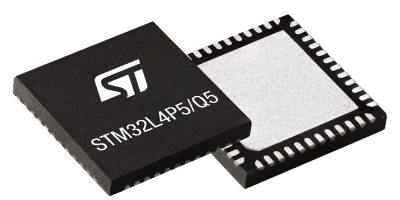
Two microcontrollers from STMicroelectronics, the STM32L4P5 and STM32L4Q5 microcontrollers bring the performance of the Arm Cortex-M4 core to cost-sensitive and power-conscious smart connected devices, says the company. Target applications include utility meters, industrial and medical sensors, fitness trackers, and smart home products.

The STM32L4+ microcontrollers have memory density down to 512kbyte flash and 320kbyte SRAM. They are available in a choice of package options: 10 x 10mm, 64-pin and 7.0 x 7.0mm, 48-pin versions designed to meet applications limited by size constraints such as wearable form factors.

They have independent power connections for circuitry such as USB and analogue peripherals, independent clock domains, and octal and quad serial peripheral interfaces (SPIs) for external memory expansion. They also feature a 5Msample/s smart ADC that can operate at full speed to minimise acquisition time, or at reduced speed with lower current.

The STM32L4+ microcontrollers exploit ST’s low-power microcontroller technologies and feature seven main low-power modes, enabling designers to creatively manage power consumption and wake-up times to minimise energy demand. The microcontrollers also support FlexPowerControl, which ensures energy-efficient handling of processing loads, as well as batch acquisition mode for energy-efficient data capture while the CPU is stopped.

To preserve system reliability and safety in industrial and medical applications, the STM32L4+ microcontrollers have flash error-correcting code (ECC) support and hardware parity checking for SRAM.

Cyber-protection features include a true random number generator and IP protection through limited access to code stored in internal memory. STM32L4Q5 devices feature additional cryptographic accelerators that support AES, RSA, DH and ECC acceleration.

The STM32 development ecosystem now includes the Nucleo-L4P5ZG Nucleo-144 board and STM32L4P5G-DK Discovery kit, each containing an STM32L4P5 microcontroller.

In the STM32Cube ecosystem, the STM32L4P5 and STM32L4Q5 are supported by the STM32CubeL4 microcontroller package, which contains hardware abstraction layer and low-layer (HAL/LL) peripheral drivers, middleware components and examples projects, and by the STM32CubeMX initialisation-code generator and configurator, which has a power consumption calculator.

ST reports EEMBC benchmark scores of 409 CoreMark and 285 ULPMark-CP for performance and energy efficiency.

Samples are available immediately and full production is ramping up, says ST.

https://www.st.com

> Read More

About Smart Cities

This news story is brought to you by smartcitieselectronics.com, the specialist site dedicated to delivering information about what’s new in the Smart City Electronics industry, with daily news updates, new products and industry news. To stay up-to-date, register to receive our weekly newsletters and keep yourself informed on the latest technology news and new products from around the globe. Simply click this link to register here: Smart Cities Registration