

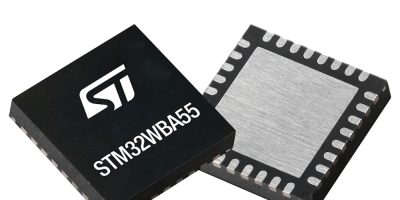
ST reveals high-performance wireless microcontrollers

ST has revealed the next generation of its short-range wireless microcontrollers. These all-in-one components enable wearables and smart objects including smart home devices, health monitors, and smart appliances to become ever more miniaturised, easy to use, secure and affordable.

Short-range wireless technologies like Bluetooth LE, Zigbee and Thread (popular in smart meters and smart buildings) are the fabric connecting smart devices to home bridges, gateways, and controllers including smartphones. As we all seek solutions for making life more economical, sustainable, and comfortable, vendors are looking to bring creative and high-performing new solutions to market more quickly, within tight cost constraints. They need to be stylish, too: tiny, low-profile, or even embedded out of sight in other equipment, such as in smart bulbs. Going wireless is a part of this trend, for freedom, flexibility, and fashion.

Wireless microcontrollers like ST’s new STM32WBA5 product line allow a one-chip solution that’s extremely compact, reduces the bill of materials, and shortens the time to market by relieving wireless design challenges. Also, being compatible with the development tools and software packs of the STM32 microcontroller development ecosystem, the new line simplifies migrating existing products designed for wired connections.

The new series’ flagship STM32WBA55 microcontroller can communicate using multiple wireless standards concurrently, including low-energy Bluetooth LE 5.4, Zigbee, Thread, and Matter (Thread RCP). Matter border router is a perfect match with the STM32WBA5 for this new open-source connectivity standard for smart-home and IoT (Internet of Things) devices. In this way, the STM32WBA55 supports a great user experience while simplifying hardware and software engineers’ development journey, aiding affordability and time to market for the new product.

With this new generation, ST has also introduced support for the recently completed Bluetooth LE Audio specifications that enable exciting and innovative new products for richer listening and hearing experiences. These include the new Bluetooth Auracast feature, which opens the door to a new world of audio broadcasting applications.

The STM32WBA series is the first wireless MCU in the market to achieve the important SESIP (Security Evaluation Standard for IoT Platforms) Level 3 security certification. With this, smart devices containing STM32WBA microcontrollers are ready to satisfy the US Cyber Trust Mark and EU Radio Equipment Directive (RED) regulations due to become mandatory in 2025.

The new STM32WBA5 product line will be available on st.com on March 12. Sample requests and pricing information are available from local ST sales offices. ST will introduce a ready-to-use module containing the STM32WBA, integrated with necessary external components including power-supply and antenna-balancing circuitry, in June 2024.
https://www.st.com/stm32wba

> Read More

u-blox releases versatile Wi-Fi 6 module for the mass market

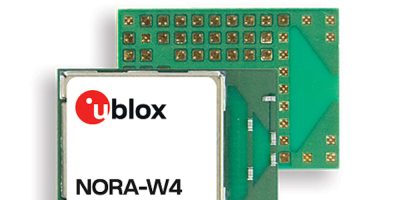
u-blox has announced its new NORA-W4 module. With a range of wireless technologies (Wi-Fi 6, Bluetooth LE 5.3, Thread, and Zigbee), compact form factor (10.4 x 14.3 x 1.9 mm), and affordability, NORA-W4 is ideal for IoT applications such as smart home, asset tracking, healthcare, and industrial automation.

NORA-W4 is a single-band tri-radio Wi-Fi 6 module built on the Espressif ESP32-C6 System-on-Chip. It enables battery-powered IoT nodes to operate directly over Wi-Fi. This simplifies implementation and reduces system-level costs by limiting the need for a Bluetooth gateway, making it a perfect match for applications like wireless battery-operated sensors.

NORA-W4 uses Wi-Fi 6 technology that is optimized for IoT and significantly reduces network congestion in environments such as factories, workplaces, or warehouses, thereby improving throughput and reducing latency. Fully backward compatible with Wi-Fi 4, the module can also be used in cases where the Wi-Fi infrastructure has not been upgraded.

The u-blox NORA-W4 module supports Matter protocol, Thread, and Zigbee technologies that are designed for new applications in the smart home environment. Consequently, it allows interoperability with other Matter smart home devices.

NORA-W4’s small form factor permits designers to adapt to device size constraints. Its compatibility with other u-blox NORA modules is key to effortless technology migration, such as transitioning from Wi-Fi 4 to Wi-Fi 6. In addition, the module is packed with enhanced security features, including secure boot, trusted execution environment, and flash encryption, to name a few.

NORA-W4 is available in 6 different variants: open CPU or u-connectXpress, antenna pin or PCB antenna, and with either 4MB or 8MB flash memory. Early samples are available now, with volume production scheduled for H2 2024.

https://www.u-blox.com

> Read More

ST expands into 3D depth sensing with latest time-of-flight sensors

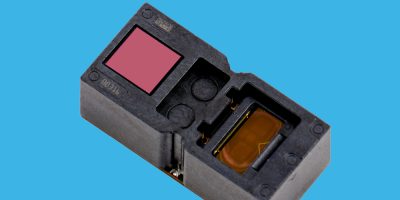
ST has announced an all-in-one, direct Time-of-Flight (dToF) 3D LiDAR module with market-leading 2.3k resolution, and revealed an early design win for the world’s smallest 500k-pixel indirect Time-of-Flight (iToF) sensor.

The VL53L9 is a new direct ToF 3D LiDAR device with a resolution of up to 2.3k zones. Integrating a dual scan flood illumination, unique in the market, the LiDAR can detect small objects and edges and captures both 2D infrared (IR) images and 3D depth map information. It comes as a ready-to-use low power module with its on-chip dToF processing, requiring no extra external components or calibration. Additionally, the device delivers state-of-the-art ranging performance from 5cm to 10 meters.

VL53L9’s suite of features elevates camera-assist performance, supporting macro up to telephoto photography. It enables features such as laser autofocus, bokeh, and cinematic effects for still and video at 60fps (frame per second). Virtual reality (VR) systems can leverage accurate depth and 2D images to enhance spatial mapping for more immersive gaming and other VR experiences like virtual visits or 3D avatars. In addition, the sensor’s ability to detect the edges of small objects at short and ultra-long ranges makes it suitable for applications such as virtual reality or SLAM (simultaneous localisation and mapping).

ST is also announcing news of its VD55H1 ToF sensor, including the start of volume production and an early design win with Lanxin Technology, a China-based company focusing on mobile-robot deep-vision systems. MRDVS, a subsidiary company, has chosen the VD55H1 to add high-accuracy depth-sensing to its 3D cameras. The high-performance, ultra-compact cameras with ST’s sensor inside combine the power of 3D vision and edge AI, delivering intelligent obstacle avoidance and high-precision docking in mobile robots.

In addition to machine vision, the VD55H1 is ideal for 3D webcams and PC applications, 3D reconstruction for VR headsets, people counting and activity detection in smart homes and buildings. It packs 672 x 804 sensing pixels in a tiny chip size and can accurately map a three-dimensional surface by measuring distance to over half a million points. ST’s stacked-wafer manufacturing process with backside illumination enables unparalleled resolution with smaller die size and lower power consumption than alternative iToF sensors in the market. These characteristics give the sensors their excellent credentials in 3D content creation for webcams and VR applications including virtual avatars, hand modelling and gaming.

First samples of the VL53L9 are already available for lead customers and mass production is scheduled for early 2025. The VD55H1 is in full production now.

ST will showcase a range of ToF sensors including the VL53L9 and explain more about its technologies at Mobile World Congress 2024, in Barcelona, February 26-29, at booth 7A61.

https://www.st.com

> Read More

ST reveals cable-free connectivity for eUSB accessories, devices and industrial applications

New short-range wireless point-to-point transceiver ICs from STMicroelectronics remove the need for cables and connectors in consumer-friendly accessories and personal electronics like digital cameras, wearables, portable hard drives, and small gaming terminals. They also address data-transfer challenges in industrial applications such as rotating machinery.

As a cost-effective cable replacement, ST60A3H0 and ST60A3H1 transceivers let designers create products with slim, aperture-free cases that can be stylish, water-resistant, and allow convenient wireless docking. Self-discovery with instant mating saves pairing, while low power consumption preserves battery runtime. They operate in the 60GHz V-band and provide eUSB2, I2C, SPI, UART, and GPIO tunnelling.

Consuming 130mW in eUSB rx/tx mode and just 90mW for UART, GPIO, and I2C modes, and with a 23µW shutdown mode, energy demand is minimal. As the devices can handle exchanges at up to 480Mbit/s, consistent with the USB 2.0 High Speed specification, wireless connections can deliver cable-like speed and low latency.

The ST60A3H1 has an integrated antenna that eases final system design. It comes in a compact 3mm x 4mm VFBGA package. The ST60A3H0 is designed for connecting an external antenna, giving flexibility to address diverse applications. It has a smaller, 2.2mm x 2.6mm footprint.

In industrial environments, wireless connections with these transceivers deliver benefits including safe galvanic isolation and immunity to environmental hazards such as dust and humidity. The devices are also ideal for rotating machinery and instruments such as radars and lidars, as well as mobile equipment like robotic arms. Being free from mechanical wear, their lifetime is not limited by the number of rotations. This ensures greater reliability than slip rings, particularly for high data rate signals, at a lower cost than fiber-optic rotating joints (FORJ).

The transceivers are easy to use without installing software drivers or protocol stack. In addition to enhancing end-user experiences, they enable fast, efficient contactless product testing and debugging, including loading firmware over the air (FOTA), during manufacture and after sales.

http://www.st.com/en/wireless-connectivity/60-ghz-contactless-products.html

> Read More

About Smart Cities

This news story is brought to you by smartcitieselectronics.com, the specialist site dedicated to delivering information about what’s new in the Smart City Electronics industry, with daily news updates, new products and industry news. To stay up-to-date, register to receive our weekly newsletters and keep yourself informed on the latest technology news and new products from around the globe. Simply click this link to register here: Smart Cities Registration