Magnachip Unveils Its First 8th-Generation MXT LV MOSFET

Magnachip has introduced its proprietary Super-Short Channel FET II (SSCFET II) technology for the first time in the Company’s new 12V Dual N-channel MOSFET (MDWC12D024PERH). SSCFET II is Magnachip’s latest design technology that significantly reduces the channel length.

Compared to the previous generation product of the same size, the RSS(on) of this product is reduced by approximately 22%. This reduction decreases power loss, shortens smartphone charging times, and lowers the internal temperature of smartphones by about 12% in fast charging mode.

With global smartphone manufacturers enhancing AI capabilities in smartphones, the importance of MOSFET products is growing. Magnachip’s new 12V MXT LV MOSFET features high power efficiency and is optimised for a wide range of battery protection applications in premium smartphones, particularly on-device AI smartphones.

“Following the development of Super-Short Channel FET I technology and the successful product rollout early last year, Magnachip has now introduced an upgraded Super-Short Channel FET II technology,” said YJ Kim, CEO of Magnachip. “We plan to continue developing innovative high-density cell trench technology and launch advanced power solutions targeting smartphones, smartwatches and earphones throughout the second half of this year.”

https://www.magnachip.com/

> Read More

Ceva Bluetooth low energy IPs bring ultra-low power wireless connectivity

Ceva has announced that Alif Semiconductor has licensed and deployed the Ceva-Waves Bluetooth Low Energy and 802.15.4 IPs in its Balletto family of wireless microcontrollers.
The Balletto family is a complete Edge AI/ML microcontroller solution for connected IoT platforms with integrated Bluetooth Low Energy 5.3 and 802.15.4 wireless subsystem and a dedicated network co-processor, enabling connectivity and machine learning in a single chip. The Balletto family delivers up to 50x boost in machine learning performance and inference efficiency versus traditional MCUs that lack neural co-processors. The Ceva-Waves Bluetooth Low Energy IP provides Balletto MCUs with the robust connectivity at ultra-low power consumption, and supports Bluetooth LE Audio and Auracast broadcast audio, for customers who wish to leverage Balletto to create highly differentiated wireless audio products. The Balletto family also relies on Ceva-Waves 802.15.4 IP for Thread, Zigbee and Matter support in smart home applications.

“Our Balletto family of connected, intelligent MCUs are tailored to meet the growing demand for AI/ML workloads in battery-powered devices,” said Mark Rootz, VP Marketing at Alif Semiconductor. “Ceva’s Bluetooth Low Energy and 802.15.4 IPs provide us with a highly-proven and robust connectivity solution for our chip design, allowing us to focus our R&D resources on differentiating our MCU to deliver outstanding performance for the most demanding wireless audio and smart home AI/ML use cases.”

“Wireless connectivity is a fundamental requirement of every intelligent device, and we’re proud to be the trusted supplier of embedded wireless IP to industry leaders and innovators alike, including Alif Semiconductor,” said Tal Shalev, Vice President and General Manager, Wireless IoT Business Unit at Ceva. “Our Bluetooth Low Energy IP has powered billions of devices to date, and we’re excited to partner with Alif to enable their Balletto family of intelligent MCUs with robust connectivity and high-bit rate audio.”

The Ceva-Waves Bluetooth IP platforms provide comprehensive solutions for both Bluetooth LE and Bluetooth dual mode connectivity, spanning RF, Modem, Baseband Controller, and complete Host and Profile software stacks. All the latest features of Bluetooth are supported, including AoA / AoD / Direction Finding, LE Audio / Auracast, Periodic Advertising with Response, and other enhancements such as Channel Sounding. It also comprises an IEEE 802.15.4 addon for Thread, Zigbee and Matter support. With more than 4.5 billion devices shipped to date and dozens of licensees, the Ceva-Waves Bluetooth IP is widely deployed in consumer, automotive, industrial, medical and IoT devices with many of the world’s leading semiconductors companies and OEMs, including smartphones, tablets, beacons, wireless speakers, wireless headsets and earbuds, hearing aids and other wearables.
The Ceva-Waves Bluetooth IP is part of the Ceva-Waves unique and broad family of wireless connectivity IP platforms that also includes the Ceva-Waves Wi-Fi, UWB, NB-IoT and Links multi-protocol platforms.

https://www.ceva-ip.com/app/connectivity/

> Read More

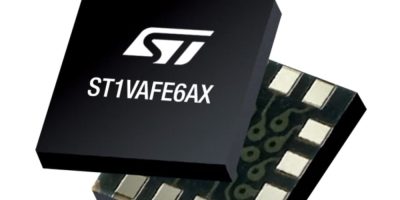
Mouser now stocking ST biosensor for smart devices and wearables

The ST1VAFE6AX provides design engineers with next generation biopotential signal detection and motion tracking for a variety of applications, including heart rate, pulse monitoring, electrocardiogram (ECG) and activity tracking for wearables and portable medical devices.

The ST1VAFE6AX features a vertical analogue front end (vAFE) channel to detect biopotential signals and includes a 6-axis inertial measurement unit (IMU) for motion tracking. This biosensor embeds advanced dedicated features and data processing for motion processing like the finite state machine (FSM), sensor fusion low power (SFLP), adaptive self-configuration (ASC), and machine learning core (MLC) with exportable artificial intelligence (AI) features and filters. The device fully synchronises biopotential and motion sensing for context-aware analysis. The ST1VAFE6AX biosensor’s compact 2.5 × 3.0 × 0.71 mm footprint makes it ideal for space-constrained applications. Application development with ST1VAFE6AX biosensor is supported by the STEVAL-MKI242A adapter board.

The STEVAL-MKI242A adapter can also be used with the STMicroelectronics STEVAL-MKI109V3 motherboard, the STEVAL-MKBOXPRO programmable wireless box kit, or the X-NUCLEO-IKS4A1 motion MEMS and environmental sensor expansion board.

https://eu.mouser.com

> Read More

Omnivision launches newest generation of the World’s smallest shutter image sensor

Omnivision has announced the new OG0TC BSI global shutter (GS) image sensor for eye and face tracking in AR/VR/MR consumer headsets and glasses. For the first time ever, Omnivision is bringing its patented DCG high dynamic range (HDR) technology to the AR/VR/MR market in the 2.2-micron (µm) pixel OG0TC GS image sensor.

With a package size of just 1.64mm x 1.64mm, the OG0TC is an ultra-small and low-power image sensor for optimizing primarily inward-facing tracking cameras. This small form factor is key to industrial designs as multiple cameras are required for tracking all aspects of the face (eyes, brows, lips, etc.). The OG0TC is pin-to-pin compatible with Omnivision’s previous-generation BSI GS image sensor for easy upgrades.

“Ultra-low power consumption is critical for AR/VR battery-powered devices, and our OG0TC BSI GS image sensor reduces power by more than 40% over our previous-generation OG0TB sensor, which is already an extremely low-power device,” says Devang Patel, marketing director – IoT/Emerging, Omnivision. “Pin-to-pin compatibility makes the upgrade to the OG0TC easy for our customers, so they do not need to make any change to their design to save power and enjoy new features like DCG™ technology.”

Key features of the OG0TC image sensor include:
● The sensor is built on Omnivision’s PureCel Plus-S stacked-die technology.
● It features Omnivision’s patented DCG HDR technology and offers 400×400 resolution with a 2.2µm pixel in a 1/14.46-inch optical format.
● Nyxel technology enables the best quantum efficiency at the 940nm near-infrared (NIR) wavelength for sharp, accurate images of moving objects.
● It consumes less than 40% of the power at 30 frames per second (fps) compared with the previous-generation sensor.
● The sensor’s high modulation transfer function enables sharper images with greater contrast and more detail.
● It supports a flexible interface, including MIPI with multi-drop, CPHY, etc.

Patel adds, “We are excited to introduce our single-exposure DCG HDR technology for ghost-free image capture to the AR/VR market. It already has proven to be extremely successful in the security, mobile and automotive industries.”

https://www.ovt.com


> Read More

About Smart Cities

This news story is brought to you by smartcitieselectronics.com, the specialist site dedicated to delivering information about what’s new in the Smart City Electronics industry, with daily news updates, new products and industry news. To stay up-to-date, register to receive our weekly newsletters and keep yourself informed on the latest technology news and new products from around the globe. Simply click this link to register here: Smart Cities Registration