

Press-fit terminal power modules for a solder-free solution in high-volume manufacturing

The E-Mobility, sustainability and data centre markets require products that are conducive to high-volume manufacturing. To better automate the installation process, Press-Fit terminals are often used because they offer a solder-free solution to mount power modules to the PCB. Microchip Technology has announced its expansive portfolio of SP1F and SP3F power modules are now available with Press-Fit terminals for high-volume applications.

Solder-free Press-Fit power module terminals allow for automated or robotic installation, which simplifies and speeds up the assembly process to reduce manufacturing costs. The high accuracy of the terminal locations and the novel Press-Fit pin design in the SP1F and SP3F power modules enables high-reliability contact with the printed circuit card. Overall, a Press-Fit power module solution can save valuable time and production costs.

There are over 200 variants available in Microchip’s SP1F and SP3F power modules portfolio, with options to use mSiC technology or Si semiconductors and an array of topologies and ratings. The SP1F and SP3F are offered in voltage range of 600V-1700V and up to 280A.

With Press-Fit technology, the power module pins are not soldered to the PCB. Instead, the electrical connection is made by pressing the pins into properly sized PCB holes. A key advantage of a Press-Fit power module solution is it eliminates the need for wave soldering. This is especially important when the PCB is made to also include Surface-Mount Technology (SMT) components.

“Our power modules with Press-Fit terminals offer customers the flexibility to fully customise their design and are cost-effective power solutions for high-volume production,” said Leon Gross, vice president of Microchip’s discrete products group. “This type of plug-and-play power solution also provides a highly reliable mounting solution for automated or robotic assembly.”

The highly configurable SP1F and SP3F power modules are fully compliant with the Restriction of Hazardous Substances Directive (RoHS).

https://www.microchip.com

> Read More

ST introduces AI-enabled automotive inertial measurement unit for always-aware applications up to 125°C

ST’s ASM330LHHXG1 inertial measurement unit (IMU) for automotive applications combines in-sensor AI with enhanced low-power operation and 125°C operating temperature range for reliability in harsh environments.

ST’s new automotive IMU contains a 3-axis accelerometer and 3-axis gyroscope and draws less than 800µA with both sensors running, cutting the system power budget and encouraging use in always-aware applications. In-sensor AI leverages the built-in machine-learning core (MLC) and finite state machine (FSM), offloading the host processor and enabling low-latency, energy-efficient event detection and classification. The extended temperature range gives flexibility to deploy smart sensors containing the ASM330LHHXG1 in harsh locations including near engine components, in direct sunlight, or whenever on-board power dissipation might increase the temperature above standard operating levels.

With the integrated MLC and FSM, the ASM330LHHXG1 handles applications that need fast and deterministic response with minimal power demand. These include navigation assistance and telematics, theft prevention, impact detection, and motion-activated functions.

ST’s MEMS ecosystem helps accelerate evaluation, prototyping and development with the ASM330LHHXG1, leveraging Unico-GUI and AlgoBuilder tools and MEMS-sensor adapter boards (STEVAL-MKI243A). Also, engineers can find ready-to-use application examples at ST’s GitHub repository area. The MLC repository contains use cases such as tilt, towing, and vehicle-status detection. The FSM repository has further inspiration including motion/stationary detection and shake detection.

While the IMU has dual operating modes that let designers optimise the data-update rate and power consumption, the accelerometer and gyroscope maintain high stability over time and temperature. The accelerometer has a selectable full-scale range of ±2/±4/±8/±16g, while the gyroscope’s angular rate can be set to ±125, ±250, ±500, ±1000, ±2000, or ±4000 degrees per second.

The ASM330LHHXG1 is AEC-Q100 qualified and in production now. It is available in an over-molded 14-lead plastic land grid array (LGA) package.

For more information, please visit http://www.st.com/automotive-experience

> Read More

Rohm’s new high power 120w laser diode for LiDAR

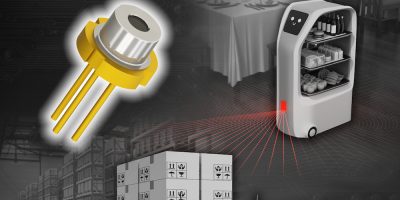
Rohm has developed a high-power laser diode – the RLD90QZW8. It is ideal for industrial equipment and consumer applications requiring distance measurement and spatial recognition.

In recent years, LiDAR is being increasingly adopted in a wide range of applications that require automation – including AGVs (Automated Guided Vehicles), robot vacuums, and autonomous vehicles – where it is necessary to accurately measure distance and recognise space. In this context, there is a need to improve the performance and output of laser diodes when used as light sources to increase detection distance and accuracy.

To meet this demand, Rohm established original patented technology to achieve a narrower emission width that contributes to longer range and higher accuracy in LiDAR applications. In 2019, Rohm released the 25W laser diode RLD90QZW5 followed by the 75W laser diode RLD90QZW3 in 2021. In response to the growing market demand for even higher output, Rohm developed the new 120W laser diode.

The RLD90QZW8 is a 120W infrared high output laser diode developed for LiDAR used in distance measurement and spatial recognition in 3D ToF systems. Original device development technology allows Rohm to reduce the temperature dependence of the laser wavelength by 66% over general products, to just Δ11.6nm (Ave. 0.10nm/°C). This makes it possible to narrow the bandpass filter while extending the detection range of LiDAR. At the same time, a uniform light intensity of 97% is achieved over the industry’s smallest class* of emission width of 270µm, representing a range of 264µm that contributes to higher resolution. Additional features that include high power-to-light conversion efficiency (PCE) enables efficient optical output that contributes to lower power consumption in LiDAR applications.

A variety of design support materials necessary for integrating and evaluating the new product is available free of charge on Rohm’s website that facilitate market introduction. In order to drive laser diodes with high nano-second order speed required for LiDAR applications, ROHM developed a reference design available now that combines ROHM’s 150V EcoGaN™ HEMT and gate drivers.

Rohm has also acquired certification under the IATF 16949 automotive quality management standard for both front-end and back-end processes at its manufacturing facilities. As a result, product development of laser diodes for automotive applications (AEC-Q102 compliant) is underway, with commercialisation planned by the end of 2024.

https://www.rohm.com

> Read More

Renesas unveils the first generation of 32-bit RISC-V CPU core

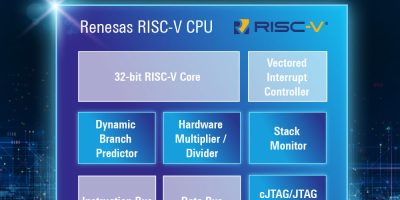
Renesas has announced that it has designed and tested a 32-bit CPU core based on the open-standard RISC-V instruction set architecture (ISA). Renesas is among the first in the industry to independently develop a CPU core for the 32-bit general-purpose RISC-V market, providing an open and flexible platform for IoT, consumer electronics, healthcare and industrial systems. The new RISC-V CPU core will complement Renesas’ existing IP portfolio of 32-bit microcontrollers (MCUs), including the proprietary RX Family and the RA Family based on the Arm Cortex-M architecture.

RISC-V is an open ISA which is quickly gaining popularity in the semiconductor industry, due to its flexibility, scalability, power efficiency and open ecosystem. While many MCU providers have recently created joint investment alliances to accelerate their development of RISC-V products, Renesas has already developed a new RISC-V core on its own. This versatile CPU can serve as a main application controller, a complementary secondary core in SoCs, on-chip subsystems, or even in deeply embedded ASSPs. This positions Renesas as a leader in the emerging RISC-V market, following previous introductions of its 32-bit voice-control and motor-control ASSP devices, as well as the RZ/Five 64-bit general purpose microprocessors (MPUs), which were built on CPU cores developed by Andes Technology Corp.

“Renesas takes pride in offering embedded processing solutions for the broadest range of customers and applications,” said Daryl Khoo, Vice President of the IoT Platform Division at Renesas. “This new core extends our leadership in the RISC-V market and uniquely positions us to deliver more solutions that accommodate a diverse range of requirements.”

“We congratulate Renesas on achieving its recent milestone in 32-bit RISC-V MCU architecture development,” said Calista Redmond, CEO at RISC-V International. “This achievement exemplifies how RISC-V ecosystem partners, such as Renesas, are rapidly advancing RISC-V innovation. Our RISC-V community now spans 70 countries with more than 4,000 members, and we eagerly anticipate further innovations emerging from this dynamic, expanding market.”

The Renesas RISC-V CPU achieves an impressive 3.27 CoreMark/MHz performance, outperforming similar architectures on the market. It includes extensions to improve performance, while reducing code size.
Renesas is sampling devices based on the new core to select customers, with plans to launch its first RISC-V-based MCU and associated development tools in Q1 2024. Details of the new MCU will be published at that time. More information about RISC-V solutions is available at: renesas.com/risc-v.

https://www.renesas.com/

> Read More

About Smart Cities

This news story is brought to you by smartcitieselectronics.com, the specialist site dedicated to delivering information about what’s new in the Smart City Electronics industry, with daily news updates, new products and industry news. To stay up-to-date, register to receive our weekly newsletters and keep yourself informed on the latest technology news and new products from around the globe. Simply click this link to register here: Smart Cities Registration