Rutronik introduces the new SoCs from Nordic Semi for next-generation (I)IoT applications

With three SoCs from the new nRF54L series, the nRF54L15, nRF54L10 as well as nRF54L05, Rutronik is expanding its portfolio of Bluetooth Low Energy Systems-on-Chip (SoCs) from Nordic Semiconductor. Higher performance, efficiency and security make this recently launched product the optimal and future-proof choice for realising the next generation of wireless IoT products.

All SoCs in the nRF54L series offer MCU functionality with a 128 MHz Arm Cortex-M33 processor, doubling the processing power and tripling the processing efficiency – compared to the nRF52840. This enables enhanced functionality in end products while consuming up to three times less power.

Security is one of the key challenges in the (I)IoT environment, which is why Nordic Semiconductor relies on advanced security features with physical protection for the nRF54L series: secure booting, secure firmware updates, secure storage, as well as a TrustZone-enabled trusted execution environment, a cryptographic accelerator with side-channel leakage protection and tamper detectors, already allow the development of applications that will meet future security regulations.

The hardware and software highlights of the nRF54L series compared to the predecessor flagship nRF52 (nRF52840):
• Significantly better specifications in terms of:
o Arm Cortex-M33 (128 MHz), instead of Arm Cortex-M4 (64 MHz)
o 1.5 MB NVM / 256 KB RAM, instead of 1 MB Flash / 256 KB RAM
o Bluetooth LE version 6.0 and higher, instead of Bluetooth LE version 5.4

Further benefits:
• Non-volatile memory: 1.5 MB (nRF54L15) // 1.0 MB (nRF54L10) // 0.5 MB (nRF54L05)
• 256 KB RAM (nRF54L15) // 192 KB RAM (nRF54L10) // 96 KB RAM (nRF54L05)
• Ultra-low power multiprotocol 2.4 GHz radio: Bluetooth Low Energy, Bluetooth Mesh, Bluetooth Channel Sounding, Zigbee, Thread, Matter, proprietary 2.4 GHz protocols and support for ecosystems such as Amazon Sidewalk, Google Find My Device and Apple Find My
• RISC-V co-processor and integrated peripherals: new real-time global clock, also available when the system is switched off, 14-bit analogue-to-digital converter and high-speed serial interfaces
• PSA Level 3 certified
• Design flexibility & pin-to-pin compatibility

Application examples:
• Smart Home & Matter, Smart Wearables, VR/AR,
• PC peripherals, HID, remote control
• (Industrial) IoT, building automation, access control
• Medical / healthcare, fitness

https://www.rutronik24.com

> Read More

ST announces availability of low-power, long-range wireless microcontrollers

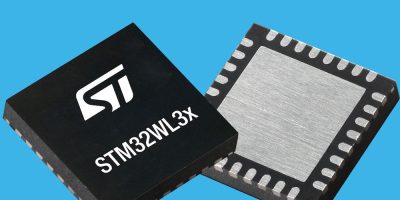
ST has announced general availability of STM32WL33 wireless microcontrollers (MCUs), integrating its latest-generation sub-GHz long-range radio, Arm Cortex-M0+ core, tailored peripherals for smart-metering applications, and power-saving enhancements. The new MCUs greatly simplify the design of wireless solutions, reduce time-to-market, and prolong battery life.

These new IoT-focused devices are used in smart utility meters, alarm systems, smart-building equipment, asset-tracking, and proximity detection. Among many other applications in cutting-edge, smart use cases, they are ideal for monitoring and control in smart cities, smart agriculture including reporting soil condition and animal welfare, forest-fire detection, water metering, and leakage detection.

Designers creating new products can take advantage of flexible options, ultra-low-power architecture, best-in-class radio efficiency, and innovative features to optimise the wireless range, simplify the design and extend battery lifetime.

A unique analog flow-sensor controller, LCSC, is integrated to streamline and optimise the design of water metering devices. The LCSC integrated circuitry can operate in conjunction with traditional coil-based mechanical meters, measuring fluid flow without any MCU intervention and providing a suitable anti-tampering feature. With these properties, the LCSC provides safety-proofing and can further enhance battery lifetime to more than 15 years while optimising the integration and cost structure of water metering devices.

In addition, there is an ultra-low-power (4.2µA) receive-only wideband radio that listens for a wake-up signal while the main communication radio is turned off to save power. This always-on radio has negligible impact on battery consumption and provides a standby mode that can quickly react upon receiving a suitable RF wake-up signal. Application use cases include drive-by reading in metering devices or wake-on-service capability in battery-operated monitoring solutions to permit applying firmware upgrades. Moreover, the wake-up signal generated, for instance, by a fixed-position beaconing tag, can transport OOK-modulated information, providing a convenient solution for asset-tracking or location-tags in logistics and warehouse applications.

A comprehensive set of integrated programmable memories, peripherals and security options let developers build richly featured applications with minimal external circuitry. These include 256Kbyte Flash, 32Kbyte SRAM and flexible peripherals including a 16-segment LCD driver, 12-bit 1Msample/s analog-to-digital converter (ADC), analog comparator, digital-to-analog converter (DAC), multiple timers, and a real-time clock (RTC). Security services include secure-boot, secure firmware updates, 128-bit AES, and a random-number generator (RNG).

All the MCUs can operate in either of the 413-479 MHz or 826-958 MHz license-free bands. A special variant, the STM32WL33CCV6A, operates in the 169MHz band.
The device embeds two programmable power amplifiers allowing a selectable RF output power of either +14dBm or +20dBm, further optimising power efficiency during active transmission time. In EU, Korea and Japan, legislation restricts the maximum to +14dBm for energy saving, while North America and Asia-Pacific allow +14dBm or +20dBm for longer range. With their dual power output, STM32WL33 wireless MCUs can be deployed worldwide and provide roaming capability for global tracking applications.

The widely configurable radio allows multi-protocol support and multi-modulation flexibility including 4-(G)FSK up to 600kbit/s, 2-(G)FSK, (G)MSK, DBPSK, DSSS, and ASK. A programmable and autonomous state-machine, the Radio Sequencer, automates common radio operations such as frequency-hopping low-duty-cycle operations, LBT, RX Sniff, auto-ack and many more saving MCU intervention and boosting radio efficiency.

With receive sensitivity of -132 dBm @300 bit/s 433 MHz OOK and -128 Bm @300 bit/s 868 MHz 2(G)FSK, the radio ensures robust communication over long distances. At +20 dBm output power and -128 dBm of sensitivity at 868 MHz, 300 bps GFSK makes it possible to achieve a link budget that supports a wireless communication range of over 1 Km.

There is also an IQ interface for custom modulation schemes and to further enhance reception sensitivity, enabling post-processing exploration with GNURadio or similar tools prior to embedding optimised protocol libraries. Supported standard protocols, besides the fully customisable proprietary options, includes wM-Bus, Mioty, Wize, Sigfox, 6LowPAN as well as Wi-SUN Home-Area-Networking (HAN).

This wireless SoC can combine seamlessly with ST’s MEMS inertial and environmental sensors, leveraging ML/AI algorithms and toolsets provided by ST. This facilitates development of applications that require positional and contextual awareness, as well as battery-operated remote monitoring and wireless sensors in industrial, smart-city or agricultural applications.

As an all-in-one system-on-chip (SoC), the STM32WL33 series connects developers with the extensive STM32 ecosystem. This now includes device-specific STM32CubeWL3 software and middleware, the NUCLEO-WL33CC1 board for 868/915MHz development, and NUCLEO-WL33CC2 for 433MHz. Also, dedicated matched filters (MLPF-WL-01D3/02D3/04D3) are now available for these MCUs, built with ST’s integrated passive device (IPD) technology, that deliver a simple and space-saving solution to optimise RF performance. In addition, a set of reference designs (STDES-WL3xxxx) saves R&D and simplifies RF design, further easing the path to market for new products. Pre-certified and fine-tuned for the STM32WL3 series, these reference designs cover several options including frequency band, RF power, MCU package, and two-layer or four-layer PCB.

The Wireless Studio Environment (STM32CubeWiSE), a graphical-UI based toolset, greatly boosts the learning curve and out-of-the-box experience. This includes the WiSE-RadioCodeGen, a code generator for RF-protocol automation that comes with the dedicated WL33 Radio Sequencer, and the WiSE-RadioExplorer. The explorer helps users make the most of the cutting-edge radio features and navigate the RF testing and certification process.

https://www.st.com

> Read More

u-blox launches tri-radio module that delivers the latest wireless technologies for IoT

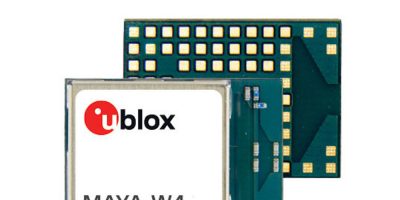
u-blox has announced the launch of the MAYA-W4, a tri-radio module that delivers the latest in wireless connectivity technologies for the mass market. With support for dual-band Wi-Fi 6, Bluetooth Low Energy 5.4, and 802.15.4 (for Thread supporting Matter), the MAYA-W4 is set to redefine the landscape of IoT applications in diverse industries, enhancing device connectivity and interoperability.
Combining three of the most critical wireless technologies into a compact, power-efficient module, the versatile MAYA-W4 meets the growing demand for reliable and secure connectivity. Whether enabling low-energy mesh networks for smart homes or providing high-speed Wi-Fi 6 connectivity for industrial tools, the MAYA-W4 offers unparalleled flexibility for developers and manufacturers. Its small size and robust design make it ideal for space-constrained applications, while its comprehensive global certifications ensure seamless deployment across regions.
The MAYA-W4 addresses the market’s need for Wi-Fi 6 solutions, driven by the rapid adoption of Wi-Fi 6 in IoT segments, as highlighted by recent market data from TSR* (Techno Systems Research CO. LTD.). It alleviates network congestion, enhances power efficiency, and, with a temperature range of -40°C to +85°C, is suitable for industrial environments. With its entry-level feature set and optimised data throughput, the MAYA-W4 offers cost-efficient connectivity without compromising performance. The inclusion of 802.15.4 enables low-power IoT and mesh networking, providing a gateway for the next generation of smart, connected devices.
The new module also eases design efforts, enabling manufacturers to scale their device designs for current and future markets. Offering a selection of antenna variants, designers can choose between pin(s) out, embedded antenna, or U.FL. connector(s) configuration. By maintaining the same compact dimensions as its predecessors (10 x 14 x 1.9 mm), u-blox simplifies migration across previous generations.

https://www.u-blox.com

> Read More

Renesas introduces new AnalogPAK programmable mixed-signal ICs

Renesas has announced new AnalogPAK ICs, including lower power and automotive-qualified devices along with the industry’s first programmable 14-bit SAR ADC (Successive-Approximation Register Analog-Digital Converter).

AnalogPAK devices are part of Renesas’ GreenPAK Family of Programmable Mixed-Signal Matrix products: cost-effective, NVM programmable devices which enable innovators to integrate many system functions while minimising component count, board space, and power consumption. GreenPAK and AnalogPAK ICs deliver functional replacement of mixed-signal standard products and stand-alone discrete circuits. They also provide reliable hardware supervisory functions for SoCs and microcontrollers. GreenPAK and AnalogPAK devices provide benefits for virtually any application, including consumer electronics, computing, white goods, industrial, communications, and automotive. Using Go Configure Software Hub and the GreenPAK Development Kit, designers can create and program a custom circuit in minutes.

Renesas’ new SLG47011 AnalogPAK device delivers a new level of performance for configurable analog integrated circuits. It includes a rich set of digital and analog features including programable multichannel 14-bit SAR ADC with Programmable Gain Amplifier (PGA). The SLG47011 also has flexible, user-defined power saving modes for all macrocells that enable designers to switch off some blocks in sleep mode and therefore reduce power consumption to the µA level.

The SLG47011 can be used to extend the performance of, or to offload an MCUs. It can also be used in conjunction with an MCU to replace a complex analog front-end (AFE). Key functions supported by the SLG47011 include measurement, data processing, logic control and data output.

In addition to the SLG47011, Renesas is introducing two other AnalogPAK devices, the cost-optimised SLG47001/3, and the automotive-qualified SLG47004-A.

SLG47001/3 AnalogPAK Devices
The SLG47001 and SLG47003 enable the implementation of precise measurement systems with a low price point and a very compact package to address applications such as gas sensors, power meters, measurement equipment, servers, wearables, industrial robots, industrial and smart home sensor modules.
• Two ultra-low offset op-amps – 9 µV (max.)
• Two 10-bit digital rheostats
• Six-channel sampling comparator
• Analog switch
• Voltage reference
• 59-bytes pattern generator
• 2k/10k/25MHz oscillators
• Fully configurable blocks: LUTs, flip-flops, shift registers, timers, counters, delays

SLG47004-A AnalogPAK Device
The SLG47004-A delivers the functionality of the SLG47004 devices with the addition of automotive qualification Grade 1 for applications such as infotainment, navigation, chassis and body electronics, automotive display clusters and more. The new devices support a temperature range of -40°C to 125°C.

Device Availability
All of the new AnalogPAK devices are available today from Renesas and its authorised distributors, along with customised development kits. The SLG47011 comes in a 2.0 x 2.0 mm 16-pin STQFN package. The SLG47001 is packaged in a 2.0 mm x 3.0 mm 20-pin STQFN, while the SLG47003 comes in a 3.0 mm x 3.0 mm 24-pin STQFN. The SLG47004-A is available in a 4.0 mm x 4.0 mm 24-pin TQFN.

More information on all the new offerings is available at https://www.renesas.com/analogpak.


> Read More

About Smart Cities

This news story is brought to you by smartcitieselectronics.com, the specialist site dedicated to delivering information about what’s new in the Smart City Electronics industry, with daily news updates, new products and industry news. To stay up-to-date, register to receive our weekly newsletters and keep yourself informed on the latest technology news and new products from around the globe. Simply click this link to register here: Smart Cities Registration