
Platform protects comms between smart factory and the cloud

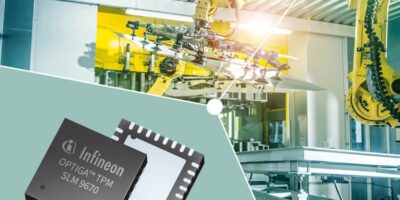
At the Hannover Fair next week, Infineon Technologies will present what it claims is the world’s first Trusted Platform Module (TPM) specifically for industrial applications. The Optiga TPM SLM 9670 protects the integrity and identity of industrial PCs, servers, industrial controllers or edge gateways, explains Infineon. It controls access to sensitive data in key positions in a connected, automated factory as well as at the interface to the cloud.

The TPM protects sensitive data in connected devices and lowers the risk of data and production losses due to cyber attacks. It also shortens time to market and reduces costs, claims Infineon. Using Infineon’s audited and certified TPMs, manufacturers of industrial devices can achieve higher security levels of the IEC 62443 standard and accelerate their certification processes. Infineon says they can also cut costs for maintenance of the devices through secured remote software updates.

The Optiga TPM SLM 9670 meets the TPM 2.0 standard of the Trusted Computing Group and is certified by an independent test lab in accordance with Common Criteria. Service life is 20 years firmware can be updated on the chip to meet long-term security risks that may be encountered in an industrial environment. The Optiga TPM SLM 9670 has an extended temperature range of -40 to +105 degrees C and is qualified according to the industrial JEDEC JESD47 standard.

The Optiga TPM SLM 9670 is manufactured at Infineon’s security-certified facilities in Germany and will be available in large volumes from the second half of 2019.

Infineon offers application-specific solutions for business PCs and routers, connected vehicles, or cloud applications. The Optiga TPM SLM 9670 will be presented for the first time at this year’s Hannover Messe (1 to 4 April). Infineon will run a demonstrator for energy-efficient and secured smart factories at the stand of Amazon Web Services (Hall 6, Stand F46).

http://www.infineon.com

> Read More

Infineon claims industry’s first true 1000A voltage regulator for AI

Adding to its high current system chipset portfolio, Infineon claims to offer the industry’s first 16-phase digital PWM multiphase controller.

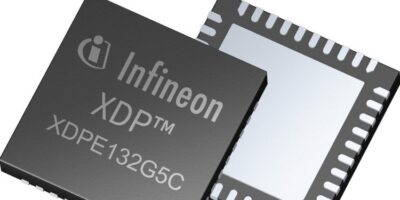
The XDPE132G5C extends the existing portfolio which enables currents of 500 to 1000A and above for next generation CPUs, GPUs, FPGA and ASICs used in artificial intelligence (AI) and 5G datacomms applications.

It has been introduced as CPU current requirements increase to enable next-generation AI and networking workloads, DC/DC voltage regulators to deliver more than 500A to the load. The XDPE132G5C has a true 16-phase digital PWM engine and an improved advanced transient algorithm to address these high phase count requirements, says Infineon. The true active current sharing between phases enables a reliable, compact and cost-saving design, with no need for extra logic doubler ICs.

The XDPE132G5C offers fine V out setting in 0.625mV increments to meet the demands of ASICs and FPGAs of V out control in less than 1mV steps, seen in communication systems today. The XDPE132G5C also supports auto-restart for communications with options to reduce remote site maintenance following power or system glitches.

The XDPE132G5C is packaged in a 7.0 x 7.0mm 56-pin QFN to accommodate 16 phases. It employs a full digital and programmable load line and is PMBus 1.3/AVS-compliant.

Infineon advises that it can be paired with TDA21475, the thermally efficient integrated current sense power stage, to efficiently deliver over 1000A.

The 70A-rated TDA21475 power stage is housed in a 5.0 x 6.0mm package. It provides efficiency of more than 95 per cent. The exposed top significantly reduces the R th(j-top) from 19 degrees C/W in the over-moulded package to 1.6 degrees C/W. This removes heat from the top of the package, for voltage regulator power density and optimal phase count and footprint. The TDA21475 also offers smart over-current and over-voltage protection and delivers temperature and current information to the XDPE132G5C controller.

The company also offers the IR35223 true 10-phase PWM digital controller. This controller provides a cost-effective option for voltage regulation up to 500 A. The IR35223 is housed in a 6.0 x 6.0mm, 48-pin QFN package and provides advanced transient performance and telemetry features including PMBus 1.3/AVS bus compliance.

http://www.infineon.com/next-gen-processors

> Read More

Infineon claims industry’s first true 1000A voltage regulator for AI

Adding to its high current system chipset portfolio, Infineon claims to offer the industry’s first 16-phase digital PWM multiphase controller.

The XDPE132G5C extends the existing portfolio which enables currents of 500 to 1000A and above for next generation CPUs, GPUs, FPGA and ASICs used in artificial intelligence (AI) and 5G datacomms applications.

It has been introduced as CPU current requirements increase to enable next-generation AI and networking workloads, DC/DC voltage regulators to deliver more than 500A to the load. The XDPE132G5C has a true 16-phase digital PWM engine and an improved advanced transient algorithm to address these high phase count requirements, says Infineon. The true active current sharing between phases enables a reliable, compact and cost-saving design, with no need for extra logic doubler ICs.

The XDPE132G5C offers fine V out setting in 0.625mV increments to meet the demands of ASICs and FPGAs of V out control in less than 1mV steps, seen in communication systems today. The XDPE132G5C also supports auto-restart for communications with options to reduce remote site maintenance following power or system glitches.

The XDPE132G5C is packaged in a 7.0 x 7.0mm 56-pin QFN to accommodate 16 phases. It employs a full digital and programmable load line and is PMBus 1.3/AVS-compliant.

Infineon advises that it can be paired with TDA21475, the thermally efficient integrated current sense power stage, to efficiently deliver over 1000A.

The 70A-rated TDA21475 power stage is housed in a 5.0 x 6.0mm package. It provides efficiency of more than 95 per cent. The exposed top significantly reduces the R th(j-top) from 19 degrees C/W in the over-moulded package to 1.6 degrees C/W. This removes heat from the top of the package, for voltage regulator power density and optimal phase count and footprint. The TDA21475 also offers smart over-current and over-voltage protection and delivers temperature and current information to the XDPE132G5C controller.

The company also offers the IR35223 true 10-phase PWM digital controller. This controller provides a cost-effective option for voltage regulation up to 500 A. The IR35223 is housed in a 6.0 x 6.0mm, 48-pin QFN package and provides advanced transient performance and telemetry features including PMBus 1.3/AVS bus compliance.

http://www.infineon.com/next-gen-processors

> Read More

Image recognition SoC includes deep neural network accelerator

An image recognition SoC for automotive applications has been announced by Toshiba Electronics Europe. It implements a deep learning accelerator at 10 times the speed and four times the power efficiency of Toshiba’s earlier heterogeneous multi-core SoC for image recognition which was introduced at the 2015 IEEE International Solid-State Circuits Conference (ISSCC).

It is designed for advanced driver assistance systems (ADAS), such as autonomous emergency braking, which require increasingly advanced capabilities. Implementing them requires an image recognition SoC that can recognise road traffic signs and road situations at high speed with low power consumption.

Deep neural networks (DNN), algorithms modelled after the neural networks of the brain, perform recognition processing more accurately than conventional pattern recognition and machine learning, and is widely expected to be used in automotive applications. However, DNN-based image recognition with conventional processors takes time, as it relies on a huge number of multiply-accumulate (MAC) calculations. DNN with conventional high-speed processors also consumes too much power, adds Toshiba.

 To overcome this, it has developed a DNN accelerator that implements deep learning in hardware. It is defined by three features: parallel MAC units, reduced DRAM access and reduced SRAM access.

The ViscontiTM5 SoC has four processers, each with 256 MAC units to boost DNN processing speed. Conventional SoCs have no local memory to keep temporal data close to the DNN execution unit, they also consume a lot of power accessing local memory and when loading the weight data used for the MAC calculations. In Toshiba’s SoC, SRAM is implemented close to the DNN execution unit, and DNN processing is divided into sub-processing blocks to keep temporal data in the SRAM, reducing DRAM access. Additionally, Toshiba has added a decompression unit to the accelerator. Weight data, compressed and stored in DRAM in advance, are loaded through the decompression unit. This reduces the power consumption involved in loading weight data from DRAM, explains Toshiba.

Finally, conventional deep learning needs to access SRAM after processing each layer of DNN, which consumes too much power. The accelerator has a pipelined layer structure in the DNN execution unit of DNN, allowing a series of DNN calculations to be executed by one SRAM access.

The ViscontiTM5 SoC complies with ISO26262, the global standard for functional safety for automotive applications.

Sample shipments of Toshiba’s image-recognition processor will begin in September 2019.

 http://www.toshiba.semicon-storage.com  

> Read More

About Smart Cities

This news story is brought to you by smartcitieselectronics.com, the specialist site dedicated to delivering information about what’s new in the Smart City Electronics industry, with daily news updates, new products and industry news. To stay up-to-date, register to receive our weekly newsletters and keep yourself informed on the latest technology news and new products from around the globe. Simply click this link to register here: Smart Cities Registration