

ST’ hybrid controller simplifies full-feature implementation of USB-C sink premium applications

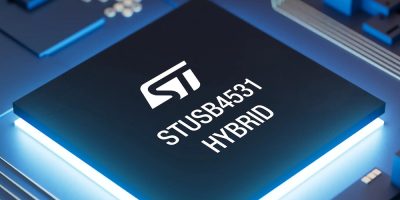
STMicroelectronics’ STUSB4531 USB Power Delivery (PD) sink controller introduces a new, patented hybrid mode that simplifies implementing optional USB PD features for added value in USB-powered and USB-chargeable devices.

The STUSB4531 contains a certified, hardwired USB PD stack that works with ST-proprietary AUTORUN algorithms to enable software-free power negotiation, supervision, and management. These AUTORUN algorithms simplify developing battery-charging and VBUS-powered electronics in equipment such as portable audio devices, wearables, set-top boxes, Wi-Fi access points, healthcare devices, and lighting. The latest updated algorithms can negotiate with AC adapters to ensure the optimum power profile, including adjustable voltage supply (AVS) and high-power charging in dead-battery mode for faster device reactivation.

The new hybrid mode now added to the STUSB4531 lets an external application processor interact with the stack to leverage the protocol layers for USB PD communication. This gives engineers extra flexibility to implement functions such as battery messaging, data role swapping, Alternate modes, and vendor-defined messages (VDM) while also easing software development and accelerating time to market.

Typical applications for charging with USB data include hard disk drives, point-of-sale (POS) terminals, printers, drones, and portable industrial devices. While VR headsets, infotainment devices, portable displays, and gaming consoles often combine USB power with Alternate modes for DisplayPort or Thunderbolt protocols, VDM enhances consumer accessories and medical devices.

By combining hardwired speed and simplicity with software-enabled flexibility, the STUSB4531 facilitates adoption of USB-C for charging and powering devices, mandated by ecodesign norms worldwide conceived to reduce electronic waste. The IC is certified according to the latest USB-C® 2.4 and USB PD 3.2 standards, as well as IEC 62680 confirming EU-conformity.

An extensive ecosystem supports developers using the STUSB4531, including an evaluation board (EVAL-SCS007V1), certified minimalistic reference design (EVAL-SCS006V1), graphical user interface (STSW-STUSB020), and NVM flasher (STSW-STUSB021). An open-source software library (STSW-STUSB022) will be available soon.

www.st.com

> Read More

ROHM develops an ultra-compact MOSFET ideal for fast charging

ROHM has developed a 30V N-channel MOSFET — AW2K21 — in a common-source configuration that achieves an industry-leading ON-resistance of 2.0mΩ (typ.) in a compact 2.0mm × 2.0mm package.

With the rise of compact devices featuring large-capacity batteries, such as smartphones, the need for fast charging functionality to shorten charging times continues to grow. These applications require bidirectional protection to prevent reverse current flow to peripheral ICs and other components when not actively supplying or receiving power. What’s more, fast charging involves high current power transfer, leading smartphone manufacturers to demand stringent specifications for MOSFETs, including a maximum current rating of 20A, breakdown voltage between 28V and 30V, and an ON-resistance of 5mΩ or less.

In response, ROHM developed an ultra-compact low ON-resistance MOSFET optimised for fast high-power charging. The AW2K21 adopts a proprietary structure that enhances cell density while minimising the ON-resistance per unit chip area. Two MOSFETs are integrated into a single package, allowing a single part to support bidirectional protection applications (commonly required in power supply and charging circuits).

The proprietary structure also places the drain terminal on the top surface, unlike on the backside in standard vertical trench MOS structures. This enables the use of a WLCSP, which achieves a larger chip-to-package area ratio that further reduces ON-resistance per unit area. As a result, the new product not only minimises power loss but also supports high current operation, making it ideal for high-power fast charging applications despite its ultra-compact size.

For example, in power supply and charging circuits for compact devices, standard solutions typically require two 3.3mm × 3.3mm MOSFETs. In contrast, the AW2K21 can achieve the same functionality with a single 2.0mm × 2.0mm unit, reducing the footprint and ON-resistance by approximately 81% and 33%, respectively. Even compared to similarly sized GaN HEMTs, ON-resistance is decreased by up to 50%, contributing to lower power consumption and increased space savings across a variety of applications.

The AW2K21 is also suitable for use as a unidirectional protection MOSFET in load switch applications, where it maintains the industry’s lowest ON-resistance. At the same time, ROHM is further pushing the limits of miniaturisation with the development of an even smaller 1.2mm × 1.2mm model.

https://www.rohm.com

> Read More

AKM launches new series of power management ICs for energy harvesting

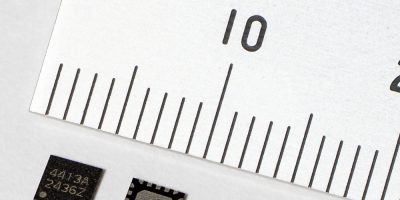
Asahi Kasei Microdevices (AKM) has developed the AP4413, a new series of ultra-low current power management ICs (PMICs) ideal for battery charging systems used in energy harvesting applications. The AP4413 series enables efficient battery charging while consuming an extremely low current of 52 nA and features four variants with voltage threshold characteristics matching several common rechargeable battery types. The AP4413 comes in a tiny 3.0 × 3.0 × 0.37 mm HXQFN package and has been in mass production since February of 2025.

Equipped with AKM’s proprietary ultra-low current voltage monitoring system, the AP4413 series enables autonomous charging of a small rechargeable battery via energy harvesting, which is becoming increasingly common across a wide range of applications such as remote controls, Bluetooth trackers, and IoT sensors, which have traditionally used disposable batteries. This is particularly relevant in Europe, where the transition to rechargeable batteries is being promoted by Regulation (EU) 2023/1542 to evaluate the feasibility of phasing out disposable batteries.

These devices allow system designers to utilise small amounts of ambient environmental energy, such as indoor light and body heat, to operate a variety of electronic devices, many of which are battery-operated. This is especially beneficial for IoT environmental sensors such as CO2 monitors that are installed in locations where line power is not easily accessible, and where battery replacement would be difficult.

Using energy harvesting to charge batteries is challenging, because the harvested voltage and current tend to be small and often unstable. It is therefore essential to minimise the PMIC’s power consumption and prevent excessive charging and discharging. The AP4413 series’ ultra-low 52 nA current consumption has minimal impact on a system’s power budget, and its voltage monitoring system prevents rechargeable batteries from becoming completely discharged, allowing for quick startup and/or recovery. Furthermore, the addition of an inline capacitor allows the AP4413 series PMICs to support system operation even when the battery is completely discharged, while recharging it at the same time.

https://www.akm.com

> Read More

Nexperia enhances Energy Harvesting portfolio with innovative PMIC reducing BOM cost

Nexperia is expanding its energy harvesting portfolio with the NEH71x0 power management IC (PMIC) family. This advanced PMIC line combines performance, cost-efficiency, and versatility, setting a new standard in sustainable design for low power applications. These devices eliminate the need for an external inductor, reducing circuit board space and bill-of-materials (BOM) cost. It is available in a compact 4 mm x 4 mm QFN28 package. Applications include remote controls, key fobs, smart tags, asset trackers, occupancy sensors, environmental monitors, wearables, keyboards, tire pressure monitors, and any number of Internet of Things (IoT) applications.

These new PMICs represent a complete power management solution for energy harvesting: enabling engineers to extend battery life, recharge batteries or supercapacitors, and even eliminate batteries in certain designs, thanks to its cold start feature. With the NEH71x0 (NEH7100BU, NEH7110BU) PMICs, designers can choose from multiple ambient power sources such as light, kinetic/piezo or a temperature gradient. With an input power range from 15μW to 100mW, these high-performance energy harvesting ICs can convert energy with an efficiency of up to 95%. These devices include an on-chip maximum power point tracking (MPPT) adaptive algorithm to optimise the energy harvested, which adapts every 0.5 second, making the PMIC extremely responsive to changing environmental conditions.

The NEH71x0 family integrates a range of power management features to protect batteries and storage elements, including over-voltage protection, low-voltage detection, and over-current protection. The addition of a low dropout (LDO) regulator and USB charging further reduces the BOM cost and simplifies the design process. For greater functionality, the NEH710BU variant includes I2C programmability and measurement readings, giving engineers additional flexibility and control in their designs.

NEH71x0 complements NEH2000, Nexperia’s first energy harvesting power management IC – a compact, low-BOM converter – by adding more advanced energy harvesting features and a new set of power management features, marking the next step in a growing roadmap of innovative inductor-less energy harvesting products.

https://www.nexperia.com/energyharvesting

> Read More

About Smart Cities

This news story is brought to you by smartcitieselectronics.com, the specialist site dedicated to delivering information about what’s new in the Smart City Electronics industry, with daily news updates, new products and industry news. To stay up-to-date, register to receive our weekly newsletters and keep yourself informed on the latest technology news and new products from around the globe. Simply click this link to register here: Smart Cities Registration