


Get started with smart home audio design

Smart home technology has expanded rapidly in recent years. A growing number of households are adopting smart speakers like Amazon Echo and Google Home. Companies that once made simple home appliances now have a demand for high-fidelity audio output. This audio goes beyond the typical beep or tone announcing that the laundry is done; this type of audio technology enables a fridge to read a grocery list aloud, or have a light switch remind someone to turn off the lights before leaving the room.

Adding advanced audio features can be daunting, adding complexities to an engineering team’s already constrained design timeline. In this post, I’ll discuss four challenges related to smart home audio design and how to simplify the process.

1. Project requirements are difficult to define.

The project you’re working on sounds simple enough: make this appliance talk. But many design choices and challenges accompany audio output, and it can be difficult to choose the right amplifier among a sea of options that at first glance all seem very similar.

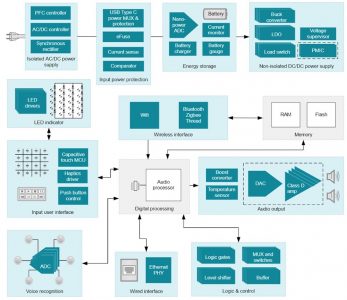
To simplify the amplifier selection process, TI’s interactive block diagrams provide component recommendations for specific smart home applications. For example, the smart speaker block diagram shown in Figure 1 highlights the audio subsystem and various speaker amplifiers with features that address a variety of smart home design requirements. Audio reference designs on the same page provide schematics and companion parts that you can use as a template for your project, increasing system-level knowledge and reducing component selection woes.

Figure 1: Smart speaker block diagram
ti art 2

TI block diagrams are a great first step for starting a design, but the selection of a speaker amplifier will ultimately come down to your project requirements. Two of the most common requirements in smart home products are high efficiency and sleek device profiles.

2. Audio output and advanced features decrease energy efficiency.

Adding extra functionality to a smart home device increases power consumption, and audio is no exception. As tech companies strive to go green and governments add regulations on standby power, it’s become more important to optimize the next generation of products for low power consumption. Inefficient audio systems contribute heavily to wasted power and decrease user satisfaction by raising electricity bills, depleting batteries faster and even making devices hot to the touch.

Audio amplifiers are not always playing, but they must be responsive when users need feedback or a notification; think of a security camera or a smart display in idle mode. On the other hand, a Bluetooth® speaker blasting a summer playlist needs to play music efficiently so that its battery (and the pool party) can last all day.

There are two main aspects of power consumption in audio: efficiency during play and idle mode. A  Bluetooth® speaker blasting a summer playlist needs to play music efficiently so that its battery (and the pool party) can last all day. Whereas, a smart display waiting for a voice-command should not consume an excessive amount of power if it’s not playing audio.

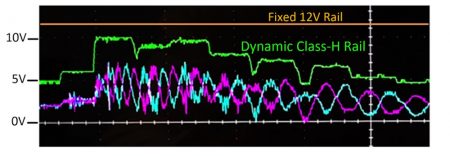
To address diverse applications around the smart home, TI’s latest speaker amplifiers have advanced power-management features built in. A proprietary Hybrid Modulation scheme minimizes idle current losses in >12-V systems. An integrated Class-H control of the supply rail can extend runtime by 50% in battery-powered systems. Figure 2 shows how a Class-H solution dynamically changes the supply rail to reduce power losses.

Figure 2: A dynamic supply rail saves significant power over a fixed rail
tI art 3

Using a device with an integrated boost and Class-H control can save space, overall bill-of-material cost, and power consumption while supporting look-ahead to prevent audio clipping. For applications above 12V, an amplifier with integrated Class-H control and an external boost can still provide significant power savings and look-ahead to prevent clipping. Both solutions save demand on the host processor and reduce software development through integration.

3. Physical constraints limit audio performance.

Electronics are shrinking into sleek, minimalistic designs. The limited form factor in home appliances that were never designed for audio makes it difficult to add extra components such as amplifiers, digital signal processors (DSPs), boost converters and speakers without compromising the overall solution size.

With these constraints in mind, TI’s audio teams have focused on creating amplifiers that integrate more features to reduce external components and optimize the audio subsystem’s footprint.

In a smart speaker that is the center of the smart home ecosystem, high-quality music and virtual assistant feedback are crucial to user satisfaction. Adding an audio DSP to produce high-quality output typically adds cost and increases the printed circuit board (PCB) footprint. TI offers audio amplifiers with integrated processing, enabling speaker tuning to output the clearest virtual assistant response and richest music experience. An external echo-cancellation algorithm can even use the post-processed signal to help a smart speaker more accurately distinguish between audio output and user voice commands.

Electromagnetic interference (EMI) is caused by the high switching frequency of Class-D speaker amplifiers, which adds distortion to an audio signal. This is usually suppressed by several large inductors, but features like spread spectrum and phase optimization suppress EMI without the need for large external inductors, and save both space and cost while producing audio output with ultra-low distortion.

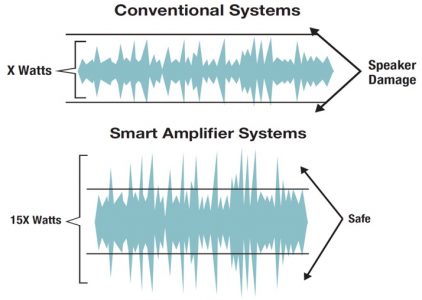
Typically, a speaker’s output power is closely related to its size; if you want louder sound, you’ll need a bigger transducer, which isn’t always an option when designing a space-constrained product. A video doorbell needs to output a homeowner’s voice loud and clear, even in noisy environments, while maintaining a slim profile. Small speakers that fit in these designs tend to output lower power and are more easily damaged by overheating or over excursion. Thanks to TI speaker protection algorithms, smaller speakers can safely output higher volume and better quality than ever before. Hear the difference in this Smart Amp A/B experiment.

As pictured in Figure 3, TI Smart Amps allow engineers to take full advantage of a speaker’s capabilities and output higher average power without compromising the integrity of the transducer. Therefore, in a noisy environment, the increased output means a user can more easily hear from a video doorbell or a smart display. Clear communication is critical in these applications and the two-way audio reference design utilizing TI Smart Amplifiers can help lay the foundation for a successful project.

Figure 3: Speaker protection amplifiers enable speakers to output twice the loudness as traditional amplifiers without damaging them
ti4

In addition to loudness, thermal dissipation is an important design consideration. Heat dissipates poorly in small form factors, posing a problem for ever-shrinking smart home products. Heat damages internal components and creates a poor user experience. Designing with thermal energy in mind means considering PCB layout and copper thickness or implementing features like thermal foldback, which enables speaker amplifiers to reduce heat by adjusting the gain on audio signals on the fly in the event of overheating. Keeping thermal management in mind from the beginning leads to safe and reliable products.

4. Advanced audio amplifier technologies/features require deep expertise and are difficult to implement.

Advanced features solve many problems and sound great on paper, but often are too difficult to implement. To simplify the design of next-generation products, TI has not only integrated advanced features into our amplifiers, but made them easily controllable through a free software tool.

The PurePath™ Console 3 software suite is an easy-to-use graphical user interface that simplifies working with these devices. Using the software, engineers can quickly tune audio output, calibrate settings and characterize speakers. Step-by-step tuning and characterization wizards as well as a library of training resources lower the learning curve associated with using new tools.

Power management, speaker protection and audio equalization are integrated in some TI Audio devices and are easily configurable through PurePath™ Console 3, requiring little to no extra software development effort. This makes it possible to create a power-efficient, high-fidelity audio subsystem that improves user satisfaction with low risk to your overall project timeline.

Additional resources

> Read More

Infineon to acquire Cypress, strengthening and accelerating its path of profitable growth

Infineon Technologies AG and Cypress Semiconductor Corporation today announced that the companies have signed a definitive agreement under which Infineon will acquire Cypress for US$23.85 per share in cash, corresponding to an enterprise value of €9.0 billion.

Reinhard Ploss, CEO of Infineon, said: “The planned acquisition of Cypress is a landmark step in Infineon’s strategic development. We will strengthen and accelerate our profitable growth and put our business on a broader basis. With this transaction, we will be able to offer our customers the most comprehensive portfolio for linking the real with the digital world. This will open up additional growth potential in the automotive, industrial and Internet of Things sectors. This transaction also makes our business model even more resilient. We look forward to welcoming our new colleagues from Cypress to Infineon. Together, we will continue our shared commitments to innovation and focused R&D investments to accelerate technology advancements.”

Hassane El-Khoury, President and CEO of Cypress, said: “The Cypress team is excited to join forces with Infineon to capitalize on the multi-billion dollar opportunities from the massive rise in connectivity and computing requirements of the next technology waves. This announcement is not only a testament to the strength of our team in delivering industry-leading solutions worldwide, but also to what can be realized from uniting our two great companies. Jointly, we will enable more secure, seamless connections, and provide more complete hardware and software sets to strengthen our customers’ products and technologies in their end markets. In addition, the strong fit of our two companies will bring enhanced opportunities for our customers and employees.”

Steve Albrecht, Chairman of the Board of Directors of Cypress, said: “For the past three years, our Cypress 3.0 strategy has delivered tremendous results and restructured the entire organization to focus on markets that matter. After receiving interest from several companies, we entered into a transaction that is a testament to our team’s strategy and hard work. For Cypress shareholders, the combination of continued dividends through closing plus the US$23.85 cash price represents significant value creation. This transaction will create product opportunities that are increasingly important in the competitive automotive, industrial, and consumer markets. As Board members, we are grateful for Cypress’s outstanding management team, led by Hassane El-Khoury.”

More robust positioning in high-growth markets

With the addition of Cypress, Infineon will consequently strengthen its focus on structural growth drivers and serve a broader range of applications. This will accelerate the company’s path of profitable growth of recent years. Cypress has a differentiated portfolio of microcontrollers as well as software and connectivity components that are highly complementary to Infineon’s leading power semiconductors, sensors and security solutions. Combining these technology assets will enable comprehensive advanced solutions for high-growth applications such as electric drives, battery-powered devices and power supplies. The combination of Infineon’s security expertise and Cypress’s connectivity know-how will accelerate entry into new IoT applications in the industrial and consumer segments. In automotive semiconductors, the expanded portfolio of microcontrollers and NOR flash memories will offer great potential, especially in light of their growing importance for advanced driver assistance systems and new electronic architectures in vehicles.

With the addition of Cypress’s strong R&D and geographical presence in the U.S, Infineon not only strengthens its capabilities for its major customers in North America, but also in other important geographical regions. The company adds to its R&D presence in Silicon Valley and gains presence, as well as market share, in the strategically important Japanese market. At the same time, Infineon aims to achieve significant economies of scale, making Infineon’s business model even more resilient. Based on pro forma revenues of €10 billion in FY 2018, the transaction will make Infineon the number eight chip manufacturer in the world. In addition to its already leading position in power semiconductors and security controllers, Infineon will now also become the number one supplier of chips to the automotive market.

Improved financial strength following full integration

The acquisition will also improve Infineon’s financial strength and Infineon shareholders are expected to benefit from earnings accretion beginning in the first full fiscal year after closing. The capital intensity will decrease, resulting in an increasing free cash flow margin. Infineon has validated sales and cost synergies assumptions as part of due diligence. Expected economies of scale will create cost synergies of €180 million per annum by 2022. The complementary portfolios will enable the offering of further chip solutions with a revenue synergies potential of more than €1.5 billion per annum in the long term.

Upon successful integration, Infineon will adapt its target operating model accordingly. Then, the company targets through-cycle revenue growth of 9+ percent and a segment result margin of 19 percent. The investment-to-sales ratio is targeted to decrease to 13 percent.

Transaction details

Under the terms of the agreement, Infineon will offer US$23.85 in cash for all outstanding shares of Cypress. This corresponds to a fully diluted enterprise value for Cypress of €9.0 billion. The offer price represents a 46 percent premium to Cypress’s unaffected 30-day volume-weighted average price during the period from 15 April to 28 May 2019, the last trading day prior to media reports regarding a potential sale of Cypress.

Cypress expects to continue its quarterly cash dividend payments until the transaction closes. This includes Cypress’s previously announced quarterly cash dividend of US$0.11 per share, payable on July 18, 2019 to holders of record of Cypress’s common stock at the close of business on June 27, 2019.

The funding of the acquisition is fully underwritten by a consortium of banks. Infineon is committed to retaining a solid investment grade rating and, consequently, Infineon intends to ultimately finance approximately 30 percent of the total transaction value with equity and the remainder with debt as well as cash on hand. The financial policy to preserve a strategic cash reserve remains in place.

The acquisition is subject to approval by Cypress’s shareholders and the relevant regulatory bodies as well as other customary conditions. The closing is expected by the end of calendar year 2019 or early 2020.

Credit Suisse and J.P. Morgan acted as lead financial advisors to Infineon. Bank of America Merrill Lynch also acted as financial advisor. All three banks acted as structuring banks in addition to providing committed financing for the transaction, Bank of America Merrill Lynch in the lead. Kirkland & Ellis LLP and Freshfields Bruckhaus Deringer LLP are acting as legal advisors to Infineon.

Morgan Stanley is acting as exclusive financial advisor to Cypress, and Simpson Thacher & Bartlett LLP is serving as legal counsel.

> Read More

Harting-Hirose agreement brings Single Pair Ethernet closer

Hirose and Harting Technology Group have entered into an agreement to jointly develop, standardise products and market a connection technology system for Single Pair Ethernet (SPE).

The agreement will mean that Harting and Hirose will monitor standards for single pair cabling and the components required on the device side, as well as the necessary transmission standards such as IEEE802.3 BASE-T1. A complete infrastructure for industrial IoT (IIoT) based on Ethernet can be created with the help of this solid base.

The pair have already collaborating, jointly launching the ix Industrial interface in 2016.

For Single Pair Ethernet, the technology partnership is systematically expanding SPE for an end-to-end infrastructure of connectors, sockets, cables and cable sets. Both companies are also working to position the uniform mating technology in user groups.

The goal of the alliance is a consistent and reliable Single Pair Ethernet infrastructure for the IIoT, encompassing transportation, robotics, energy or industrial automation.

Pictured here (from left to right) are Hiroshi Satoh, division general manager, international business division, Hirose, Philip Harting, CEO Harting Technology Group, Kazunori Ishii, president Hirose and Ralf Klein, managing director, Harting Electronics.

The Harting  Technology Group provides industrial connection technology for data, signal and power. It has 14 production plants and 44 sales companies. It also produces retail checkout systems, electromagnetic actuators for automotive and industrial series use, charging equipment for electric vehicles, as well as hardware and software for customers and applications in automation technology, mechanical and plant engineering, robotics and transportation engineering.

http://www.harting.com

> Read More

What it takes to be a smart city in Southeast Asia

How did Singapore become one of the top smart cities in the world? Read on to find out more about the city-state’s success formula. 

Singapore’s got a case of the smarts.

Medicine-dispensing robots, police patrol drones, driverless cars, and weather sensing lamp posts are now part of the daily lives of its inhabitants.

Armed with smart tech and digital infrastructure, Singapore is marching straight into the future. Recently, the country beat Dubai, Los Angeles, Paris, Beijing, Shanghai, Tokyo and Seoul to emerge first in ABI Research’s Smart Cities Competitive Assessment report of ten global cities in 2018.

 Business benefits of smart cities – where technologies are used to improve performance of urban services – are absolutely tangible, affirms Mr Steffen Sorrell, Principal Analyst at Juniper Research. A smart city “creates a more liveable place for citizens, which in turn creates a more favourable environment for business competitiveness,” translating gains in productivity into bottom lines.

Mr Alex Lau, Chief Executive Officer (CEO) of Singapore-based smart city technology firm Anacle, confirms rising traction: “Governments across the region are increasing budgets for the digital transformation of cities, which encompasses a wide spectrum of technologies, from digitalising information to online platforms to smart offices and housing integrated solutions.”

With compelling benefits for adopters, more cities are looking towards a smarter future.

What it takes to be a smart city

What is behind Singapore’s smart city secret sauce? Mr Sorrell, Mr Lau and Mr Chew Men Leong, Chief Marketing Officer (CMO) of ST Engineering shares the four key ingredients in the city-state’s success formula.

1. Be smart at heart 

It takes more than technology to build a smart city. Singapore’s policies and people create a tech-ready ethos across the nation.

Singapore’s Smart Nation project is one example of its embrace of tech. In 2017 alone, funding for tech amounted S$2.4 billion (US$1.7 billion), financing programmes such as a nation-wide Internet of Things (IoT) Smart Nation Sensor Platform, transforming 110,000 lamp posts into an interconnected network of wireless sensors for smarter mobility and security services through predictive analytics.

Top in Asia Pacific in the Global Talent Competitiveness Index 2019, Singapore’s IT-savvy population stands at the ready to adopt smart technologies. S$70 million (US$50 million) is being spent on deepening talent and skillsets in areas such as data analytics, tech-enabled services, and cybersecurity.

Making technology a way of life has real impact, saving each Singapore inhabitant 125 hours annually, reports Juniper Research. “Singapore is in quite a unique position,” shares Mr Sorrell. “It is the only country in the world which has a nation-wide policy for what a smart city should look like.”

2. Incubate state-of-the-art tech

Named the most innovative country outside Europe in the Global Innovation Index 2018, Singapore boasts a high density of R&D partners, including world-class universities, leading multinational corporations, and startups. The country is home to 13 innovation centres, outnumbering Silicon Valley’s ten, reports Capgemini.

The nation walks the talk in early-mover technology innovation and adoption. The world’s largest fintech hub, Lattice80 was set up here, while trials of the first self-driving taxis started as early as 2016. The country’s open approach to data encourages crowdsourced innovation, shares Mr Sorrell, pointing out how over 100 publicly available land transport authority data sets have been deployed by developers of over 40 mobile apps.

“For companies looking to drive bottom line growth, such environments open opportunities for various industry players to test technology readiness, community adoption and economic viability of smart city solutions. Singapore, being the top global performer in smart cities, is an excellent ‘living lab’ to testbed technologies”, notes Mr Chew.

3. Partner smart 

The right collaboration with smart tech partners gives Singapore an advantage.
Nation-wide initiatives are executed collaboratively with industry partners to accelerate adoption and solve practical problems. Anacle, a smart estate management and energy solutions firm, spearheads the Smart Office Living Lab government initiative, which fast-tracks continuous implementation and evaluation of smart systems in operating environments, creating technology blueprints for implementation across the country.

“Few people know this, but everyone in Singapore has come into contact with Anacle solutions at some point,” shares Mr Lau. “Singapore has a comprehensive, multi-pronged digital roadmap that supports the transformation of the city, allowing new ideas to be implemented quickly.”

Anacle’s Simplicity suite of smart city management solutions are deployed in retail malls, schools, data centres, town councils, and even military camps, providing end-to-end field force automation and data analytics for maintenance, safety and supply chain operations.

4. Grow smart networks 

Singapore’s smart ethos, ecosystem and partners are plugged into global networks, with prospects for synergy, scalability and export beyond its shores.

“Smart cities are really about a collaborative approach — not only in terms of the agencies within the cities themselves, but also between cities themselves — and I think that such collaboration will be one of the driving forces of future smart cities,” shares Mr Sorrell.

SEA’s networked smart cities are only getting smarter. In 2018, the ASEAN Smart Cities Network (ASCN) was launched across 26 pilot cities, creating opportunities to share data and best practices, create open-source tools, and expand business networks.

ST Engineering, a global technology, defence and engineering group headquartered in Singapore, is leveraging such networks. The firm has completed over 500 smart city projects in 70 cities, and is an invited partner in the ASCN network. ST Engineering’s integrated smart city solutions suite, CitySense, tackles mass urbanisation demands such as road congestion, physical and cybersecurity threats, energy inefficiency and utility wastage, key challenges to be solved across SEA.

“Every city has unique demographics, physical, social or economic conditions, and it would not be feasible to expect a one-size-fits-all smart city solution,” says Mr Chew. “Instead, where cities and innovation ecosystem participants can learn from one another and collaborate, we can synergise and speed up the creation of urban solutions.”


For more information – https://www.edb.gov.sg/

> Read More

About Smart Cities

This news story is brought to you by smartcitieselectronics.com, the specialist site dedicated to delivering information about what’s new in the Smart City Electronics industry, with daily news updates, new products and industry news. To stay up-to-date, register to receive our weekly newsletters and keep yourself informed on the latest technology news and new products from around the globe. Simply click this link to register here: Smart Cities Registration