Arrow signs worldwide distribution deal with InvenSense

MEMS sensors from InvenSense are now available from Arrow Electronics, following a global distribution agreement. The deal extends the two companies exisiting arrangement covering Europe, Middle East and Africa (EMEA), extending InvenSense’s MEMS based products available from the distributor to companies in the Americas and Asia-Pacific regions.

InvenSense’s MEMS sensors are used in consumer electronics, automotive, IoT and industrial sectors. The company’s product range includes accelerometers, gyroscopes, compasses, microphones, pressure, as well as ultrasonic 3D-sensing technologies. Arrow offers a range of products and services that assist businesses in transforming their ideas into full production, including industry 4.0, industrial IoT, AI, security, automotive, and the cloud. Arrow offers a range of components, systems on module, and evaluation boards to market-ready solutions.

The support is something that InvenSense is hoping to exploit. “Arrow’s extensive worldwide network of embedded engineers enables InvenSense to expand the served available market for all of our MEMS sensor platform and solutions,” said Scott Deutsch, general manager and vice president of worldwide sales and marketing at InvenSense. “Arrow’s programs – focused on the future of new technologies, new materials and new ideas that help customers, partners and employees merge what’s possible with what’s practical—fits directly in line with InvenSense’s strategies,” he added.

MEMS sensors can be used in smartphones, virtual reality headsets, robotics, automotive design, IoT devices and wearable devices.

InvenSense is a TDK Group company, specialising in MEMS sensor platforms for the consumer electronics and industrial areas markets, offering integrated motion, sound and ultrasonic solutions. In addition to MEMS sensors, it provides ultrasonic 3D-sensing with proprietary algorithms and firmware that intelligently process, synthesise and calibrate the output of sensors.

InvenSense’s motion tracking, ultrasonic, audio, fingerprint, location platforms and services can be found in mobile, wearables, smart home, industrial, automotive and IoT products.

http://www.arrow.com

> Read More

Smoke Alarm System 2.0

Underwriters Laboratories (UL), the author of the U.S. and Canada smoke detection standards, has released a revised specification (8th edition). These new standards are significantly more technically challenging to meet than the current regulations.

New Smoke Detector Tests
One major change to the standards is the introduction of the hamburger nuisance test. In this test, hamburgers are placed in an oven set at a high enough level to eventually burn, and the detectors must not issue an alarm before a certain amount of smoke has been generated. This requirement to not alarm will bound the maximum sensitivity of a detection system. This test is designed to reduce the number of false alarms generated due to cooking events, as residents disconnecting alarms due to high false alarm rates is one of the leading cases of death in fire-related events.

Another addition to the standard is the flaming polyurethane (PU) test, also known as the burning couch cushion test. Due to the optical scattering cross-sections and physics of different smoke types, sensor response from flaming PU is lower than the response from other smokes at a similar obscuration. As such, the ability to detect flaming PU smoke at specified levels will bound the minimum sensitivity of most, if not all, optical detection systems. In practice, the sensor response to the flaming polyurethane smoke can be difficult to separate from the hamburger nuisance test. In the past, setting the pass/fail criteria for a detector was straightforward, at least to minimally meet agency requirements. For the upcoming requirements, the manufacturing and calibration margins are much tighter and may require an increase in algorithmic complexity. The flaming polyurethane and hamburger nuisance tests occur on different time scales and it is straightforward to create a simple algorithm that looks at the slope or rate of change of the smoke to distinguish between the two fires to pass the UL requirements. However, there is a question of how effective this algorithm is in real-world applications.
In fire room tests, the pass criteria are specified in either time passed since the test was initiated or at a defined obscuration level. A typical obscuration sensor is shown in Figure 1, with a light on one end and the photodetector on the other end. For UL tests, the beam is a sodium vapor lamp 4″ diameter and 5′ long. Particles in the path of the beam absorb or scatter light out of the beam path, reducing the amount of light that reaches the detector. For different types of smoke, the relationships between an optical scattering system and an obscuration are different. In the case of the hamburger nuisance test and flaming polyurethane test, a 3× difference in obscuration can be nearly impossible to differentiate in an optical scattering system.

A Typical Smoke Detector
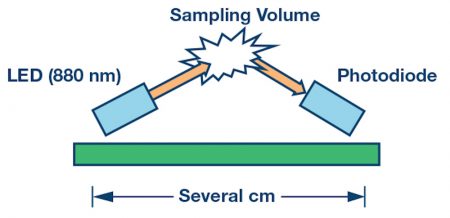
A typical smoke detector is made up of a detector, a microcontroller with an algorithm, and additional components such as loudspeakers, LED indicators, and CO sensors. Photoelectric smoke alarms often use a discrete LED (typically near-infrared, 850 nm or 880 nm) and a discrete photodiode with a typical 135° angle between them and a separation of several cm.

Figure 1. Reference measurement.
LED light of a specific wavelength is scattered by particles onto a photodiode. As shown in Figure 2, the distance between the LED and the photodiode is usually a few centimeters.

Figure 2. Forward scatter system with an infrared LED.
However, both the discrete design of the smoke alarm and the measurement method result in a few disadvantages. The main one is that monochromatic LEDs lead to a higher false alarm rate because they make it harder for different particles to be distinguished from one another. In addition, a discrete implementation is large and associated with a higher power consumption. Laborious calibrations are also necessary. The technology for the optical components has advanced to the point that the LEDs and the photodiodes, along with the optical front end, can be integrated into a small housing.

Addressing the New Challenge
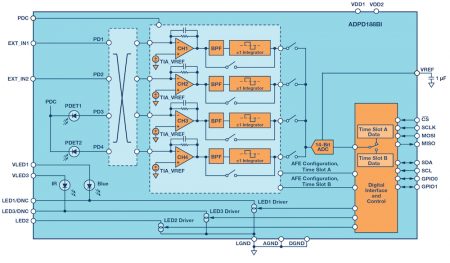
ADI has created a technology to help address these issues: the ADPD188BI. It directly integrates two LEDs (blue and infrared), a photodiode, and an analog front end. Digital output over I²C or SPI enables a connection to a microcontroller. A block diagram of the ADPD188BI is shown in Figure 3. As can be seen in the figure, the complete signal chain is realized in a single 5 mm × 3.8 mm chip.

Figure 3. Block diagram of the ADPD188BI.
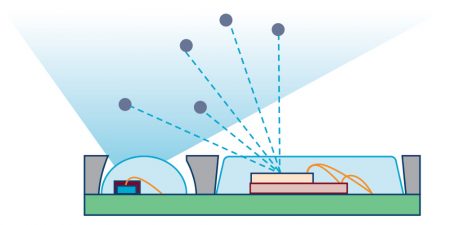
The ADPD188BI works by emitting a short LED pulse of a few microseconds. Some of this light is scattered by the smoke particles back onto the photodiodes (see the cross-section of the ADPD188BI in Figure 4). The analog front end (AFE) includes the transimpedance amplifier, band-pass filter, integrator, ADC, LED drivers, and digital control (see the middle of Figure 3). There are many options inside the AFE to enable optimization for different applications and use cases. The AFE also provides the ability to reject ambient light, such as from lamps or solar radiation at levels up to 80 dB.

Figure 4. Cross-section of the ADPD188BI.
This principle provides many significant advantages. The short distance between the LED and PD results in much more efficient use of light, which reduces the power dissipation of the system for a required sensitivity and results in a longer battery lifetime. Two different LED colors are included in the device. The amount of light scattered by the particles is a function of wavelength. This provides limited use for separating the hamburger and flaming polyurethane smokes, but can be used to distinguish between relatively small smoke particles (100 nm to 300 nm diameter) and much larger smoldering plastic or steam particles (10 μm diameter). The highly configurable AFE inside the ADPD188BI provides for a very high dynamic range that is software configurable and can be adjusted on the fly. The SNR of the system can also be easily adjusted to optimize for power or performance on the fly. One example would be to dynamically increase the sample rate or SNR when smoke has been detected to more accurately differentiate between a nuisance source or a real fire. The integration of the system also enables Analog Devices to calibrate the loop response (LED driver  LED  PD  AFE) of the parts and burn calibration coefficients into the AFE to limit the part-to-part variation to better than ±10%, which reduces or eliminates the need for expensive and time-consuming sensitivity calibrations in smoke tunnels. The ADPD188BI provides the features and capabilities to increase the performance of smoke detectors to more accurately separate nuisance sources from fire events. As well as performance, there are further advantages: the integration of LEDs means separate LED sourcing and stocking is eliminated, and the small form factor allows for integrated smoke detection across intelligent building components.
About the Author
Christoph Kämmerer has worked at Analog Devices in Germany since February 2015. He graduated in 2014 from the Friedrich Alexander University in Erlangen with a master’s in physics. He then worked as an intern in process development at Analog Devices in Limerick. Having completed the trainee program in December 2016, he now works as a field applications engineer at Analog Devices and specializes in emerging applications. He can be reached at christoph.kaemmerer@analog.com.

> Read More

Finally, A 12 V to 12 V Dual Battery Automotive Bidirectional DC-to-DC Controller for Redundancy

The signs are everywhere that the self-driving car revolution is about to shift into full gear. Automotive companies are joining up with tech giants like Google and Uber, as well as prominent start-ups, to develop the next-generation autonomous vehicles that will alter our roads and throughways and lay the framework for future smart cities. They’re harnessing technological advances such as machine learning, the Internet of Things (IoT), and the cloud in order to accelerate this development.
More significantly, autonomous vehicles will advance the industry disruption already set in motion by popular ride-sharing services like Uber and Lyft. The pieces are coming together to create a world where intelligent and driverless vehicles become the future of transportation.

Eventually, all self-driving cars will employ a combination of sensors, cameras, radar, high performance GPS, light detection and ranging (lidar), artificial intelligence (AI), and machine learning to achieve a level of autonomy. Connectivity to secure and scalable IoT, data management, and cloud solutions are also important to the mix, as they provide a resilient and high performance foundation on which to collect, manage, and analyze sensor data.

The rise of the connected vehicle has far-reaching societal implications, from environmental benefits to improved safety. Fewer cars on the road also means a reduction in greenhouse gas emissions, leading to lower energy consumption and better air quality.

For both self-driving cars and smart roadway systems, endpoint telemetry, smart software, and the cloud are essential enablers. The onboard cameras and sensors in autonomous vehicles collect vast amounts of data, which must be processed in real time to keep the vehicle in the right lane and operating safely as it heads to its destination.

Cloud-based networking and connectivity is another important part of the mix. Autonomous vehicles will be outfitted with onboard systems that support machine-to-machine communications, allowing them to learn from other vehicles on the road in order to make adjustments that account for weather changes and shifting road conditions such as detours and in-path debris. Advanced algorithms and deep learning systems are central to ensuring that self-driving cars can quickly and automatically adapt to changing scenarios.

Beyond the specific components, such as scalability of cloud computing infrastructure and intelligent data management, there is a need for redundancy of mission critical systems, including power sources. There are previously released redundant battery solutions available, like the LTC3871 which works with two batteries that have different voltage ratings, such as a 48 V Li-Ion and 12 V lead-acid battery. However, most of these existing solutions do not provide redundancy for same battery voltages, like two 12 V, 24 V, or 48 V batteries. Up until now, that is.

Clearly there is a need for a bidirectional buck-boost dc-to-dc converter that can go between two 12 V batteries. Such a dc-to-dc converter could be used to charge either battery and allow both batteries to supply current to the same load. Furthermore, if one of these batteries should fail, that failure needs to be detected and isolated from the other battery, so that the other battery continues to provide power to the load without any disruption. The recently released LT8708 bidirectional dc-to-dc controller from Analog Devices solves this critical function of allowing two batteries with the same voltage to be hooked up by utilizing the LT8708 controller.
A Single Bidirectional IC Solution

The LT8708 is a 98% efficient bidirectional buck-boost switching regulator controller that can operate between two batteries that have the same voltage, which is ideal for redundancy in self-driving cars. It can operate from an input voltage that can be above, below, or equal to the output voltage, making it well-suited for two 12 V, 24 V, or 48 V batteries commonly found in electric and hybrid vehicles. The LT8708 operates between two batteries and prevents system shutdown should one of the batteries fail. This device can also be used in 48 V/12 V and 48 V/24 V dual battery systems.

The LT8708 uses a single inductor and operates over an input voltage range from 2.8 V to 80 V while producing an output voltage from 1.3 V to 80 V, delivering up to several kilowatts of power depending on the choice of external components and number of phases. It simplifies bidirectional power conversion in battery/capacitor backup systems that need regulation of VOUT, VIN, and/or IOUT, IIN, both in the forward or reverse direction. This device’s six independent forms of regulation allow it to be used in numerous applications.

The LT8708-1 is used in parallel with the LT8708 to add power and phases. The LT8708-1 always operates as a slave to the master LT8708, can be clocked out-of-phase, and has the capability to deliver as much power as the master. Up to 12 slaves can be connected to a single master, proportionally increasing the power and current capabilities of the system.

Forward and reverse current can be monitored and limited for the input and output sides of the converter. All four current limits (forward input, reverse input, forward output, and reverse output) can be set independently using four resistors. In combination with the direction (DIR) pin, the chip can be configured to process power from VIN to VOUT or from VOUT to VIN, ideal for automotive, solar, telecom, and battery-powered systems.

The LT8708 is available in a 5 mm × 8 mm, 40-lead QFN package. Three temperature grades are available, with operation from –40°C to +125°C for the extended and industrial grades and a high temperature automotive range of –40°C to +150°C. Figure 1 shows a simplified LT8708 block diagram.
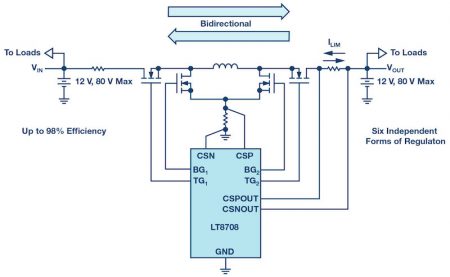
Figure 1. LT8708 simplified bidirectional dual 12 V battery application schematic.

Complete Solution
The block diagram in Figure 2 shows the other parts required to complete the circuit for dual battery redundancy in an automotive application. As shown, the LT8708 works with two LT8708-1 parts to form a 3-phase solution design that can deliver up to 60 A in either direction. Additional LT8708-1 devices can be added for higher power applications up to and exceeding 12 phases. The AD8417 is a bidirectional current sense amplifier that senses the current flowing into and out of the batteries. And when this current exceeds a preset value, the LTC7001 high-side NMOS static switch driver opens the back-to-back MOSFETs to isolate either battery from the circuit.
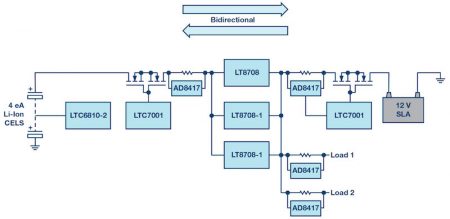
Figure 2. A dual battery redundancy block diagram for a complete solution.

The LTC6810-2 monitors and controls the Li-Ion battery. It accurately measures the battery cells with a total measurement error of less than 1.8 mV. Connecting multiple LTC6810-2 devices in parallel to the host processor will create additional redundancy for monitoring other voltages within the circuit. The LTC6810-2 has an isoSPI™ interface for high speed, RF immune, long distance communications, and it supports bidirectional operation. The device also includes passive balancing with PWM duty cycle control for each cell and the ability to perform redundant cell measurements.

Control Overview
The LT8708 provides an output voltage that can be above, below, or equal to the input voltage. It also provides bidirectional current monitoring and regulation capabilities at both the input and the output. The ADI proprietary control architecture employs an inductor current-sensing resistor in buck, boost, or buck-boost regions of operation. The inductor current is controlled by the voltage on the VC pin, which is the combined output of six internal error amplifiers, EA1 to EA6. These amplifiers can be used to limit or regulate their respective voltages or currents as shown in Table 1.

Table 1. Error Amplifiers (EA1 to EA6)
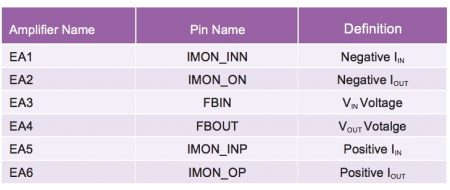
The VC voltage typically has a min-max range of about 1.2 V. The maximum VC voltage commands the most positive inductor current and, thus, commands the most power flow from VIN to VOUT. The minimum VC voltage commands the most negative inductor current and, thus, commands the most power flow from VOUT to VIN.
In a simple example of VOUT regulation, the FBOUT pin receives the VOUT voltage feedback signal, which is compared to the internal reference voltage using EA4. Low VOUT voltage raises VC and, thus, more current flows into VOUT. Conversely, higher VOUT reduces VC, thus, reducing the current into VOUT or even drawing current and power from VOUT.

As previously mentioned, the LT8708 also provides bidirectional current regulation capabilities at both the input and the output. The VOUT current can be regulated or limited in the forward and reverse directions (EA6 and EA2, respectively). The VIN current can also be regulated or limited in the forward direction and reverse directions (EA5 and EA1, respectively).

In a common application, VOUT might be regulated using EA4, while the remaining error amplifiers are monitoring for excessive input or output current, or an input undervoltage condition. In other applications, such as a battery backup system, a battery connected to VOUT might be charged with constant current (EA6) to a maximum voltage (EA4) and can also be reversed, at times, to supply power back to VIN using the other error amplifiers to regulate VIN and limit the maximum current. See the LT8708 data sheet for additional information on this subject.

Conclusion
The LT8708-1 brings a new level of performance, control, and simplification to same voltage dual-battery dc-to-dc automotive systems. Whether using it for energy transfer between two power sources for redundancy, or for backup power in mission critical applications, the LT8708 allows users the ability to operate from two batteries or supercapacitors that have the same voltage. This capability allows automotive systems engineers to help pave the way for new advancements in automotive electronics, enabling cars to be safer and more efficient.

Bruce Haug [bruce.haug@analog.com] received his B.S.E.E. from San Jose State University in 1980. He joined Linear Technology (now a part of Analog Devices) as a product marketing engineer in April 2006. Bruce’s past experience includes stints at Cherokee International, Digital Power, and Ford Aerospace. He is an avid sports participant.


By Bruce Haug – ADI

> Read More

Drammen – The Making of a Smart City

This picturesque riverside city has cleaned its waterways and air pollution, and is becoming a standard for how IoT-enabled communities are conceived, planned and executed in Norway

Drammen, a bustling city in Norway, was historically an industrial complex focused on textiles, paper and lumber production. These industries led to polluted air and waterways. Compounding the problem, traffic congestion and a high population density cramped communal spaces, further eroding quality of life. In recent years, a strong revival is under way, with city leaders replacing former industrial areas with elegant public spaces and chic architecture. This urban renewal has been instrumental in transforming Drammen, attracting new residents and economic opportunities, and poising it to soon become one of the fastest-growing cities in Norway.
The already increasing population, coupled with Drammen’s impending merge with several neighboring municipalities in 2020, is expected to boost the population by 50 percent — and require major thrusts for region-wide digitization. Smart systems that optimize city management and delight citizens with new services for healthier, safer lifestyles can further Drammen’s goal to drive sustainable community growth. To help them on this journey, Drammen established a research and science project together with Arrow Electronics (www.arrow.com).
Taking a long-term perspective, Drammen established a model that is fast becoming the way smart cities are conceived, planned and executed in Norway – one that offers a compelling use case for the Internet of Things (IoT). In an age of ubiquitous connectivity, cities can deliver unprecedented benefits to citizens by harnessing data from various facets of the community infrastructure. While the priorities of each city vary depending on their people, history and the maturity of their technological infrastructure, most smart city initiatives target citizen welfare, economic prosperity and environmental protection.

The vision for transforming Drammen into a smart city was a collaborative effort between Drammen residents, local businesses, city officials and service providers. Arrow partner and local startup Vicotee was the initiating force for the project. City leaders intend to enable the transformation with a three-phase execution plan, working with Arrow on proof-of-concept installations that will be deployed at scale after validation this year and into 2020. To guide decisions and put citizen interests forefront in the implementation, Drammen identified four governing pillars for the smart city ecosystem and technology platform:
• Open data and transparency: The platform will make public information easily accessible online, enabling citizens, officials, companies and investors to gain valuable insights and make informed decisions concerning personal and business situations.
• Technology and innovation: The platform will have an open architecture framework that adapts to new solutions and technology requirements, and that serves as the basis for continued innovation now and well into the future. Service providers will use the platform as a core element of their overall solutions.
• Co-creation: The platform will embrace a collaborative approach where city stakeholders, technology providers and service providers all work together to further the interests of Drammen citizens.

• Resource management: The platform will serve as a critical integrating force to gain insights into the city’s resources, while also supplementing management capabilities, ensuring that the infrastructure and services meet the needs of a growing and aging population.
While allowing the City of Drammen to have full control over data availability, the platform also establishes a consistent ecosystem for data flow within the municipality and out to vendors and citizens. Vendors can also publish and share their data through the platform. And all citizen data and associated metadata captured as part of smart city services is stored in the cloud using the highest data governance standards compliant with the European Union’s General Data Protection Regulation (GDPR) requirements.

ADD QR CODE FOR THE VIDEO: https://www.youtube.com/watch?v=INyzvoaSPPs

While the tenets governing the vision of smart city were sound, Drammen faced significant challenges in selecting the right technology partners to make it a reality. First, the city’s technology personnel did not have the necessary expertise to evaluate a large number of technology choices and providers. Further, the city could not allocate the resources to manage multiple suppliers in a multifaceted technology infrastructure that would require hardware, software, cloud and services vendors. Most important, city stakeholders were seeking a single end-to-end open solution to cover a wide spectrum of needs and use cases.
After discussions with many point solution providers, it was clear to Drammen city technologists that they needed a solution partner with a deep and global track record of bringing together diverse technologies, expertise and services. Arrow was chosen as the lead partner and tasked with discovering, vetting and aggregating the entire environment and all solutions within, ensuring that all the participants adhere to Drammen’s smart city guiding principles.
“Arrow has made Drammen more competent with new capabilities and infrastructure that will shape its future,” commented Frank Baklid, chief digital officer for the city of Drammen. “In less than three months, Arrow was able to architect an open platform that will enable technology partners, local businesses and the city to add new services at scale. Arrow’s breadth of partnerships, know-how and capabilities is exactly what Drammen needs in this project.”
At the very center, the crucial element to achieving the project goals is a robust, scalable and yet flexible technology architecture via a state-of-the-art cloud platform. Arrow brought to bear its longstanding strategic relationship with Microsoft to form the core technology element. Microsoft’s Azure cloud computing platform enables building, deploying, and managing applications in private or hybrid clouds. Azure offers the most comprehensive cloud ecosystem offering:
* Low-cost, massively scalable, tiered backup storage solution
* Hassle-free backup and data archiving
* Policies designed to meet a variety of compliance requirements
In addition, Azure offers a collection of integrated cloud services that developers and IT professionals can use to build, deploy, and manage applications through a global network of data centers. Some services include:
* Azure IoT Edge: A managed service that delivers cloud intelligence locally by deploying Azure services and AI on edge devices
* Azure IoT Hub: Connect, monitor and manage end-points including secure commissioning, decommissioning, remote updates, etc.
* Azure Event Hub: Real-time data ingestion from any data source using any protocol
* Azure Event Grid: Single source to manage all events and route them to any destination
* Time Series Insights: Manage, query or visualize time series data generated by IoT devices
* Power BI: Interactive visualizations and intelligence capabilities with a simple interface for end users to create their own reports and dashboards
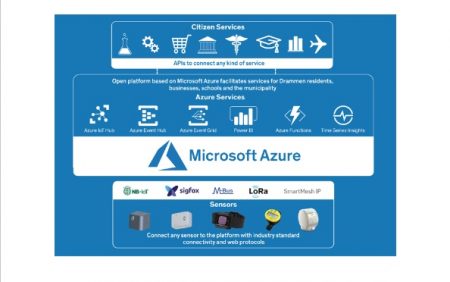
Arrow’s broad global portfolio of partners and technologies, and their experience working on diverse IoT projects, helped bring together a consortium of point solution providers to help Drammen. Arrow identified technology partners for devices, sensors and connectivity – and these providers formed a collaborative partnership to drive key proofs of concept and pull together Drammen’s smart city ecosystem. Figure 1 delineates the key elements of Drammen’s smart city technology platform, with the Microsoft Azure infrastructure as the core element.

Figure 1: Drammen’s smart city technology stack

As a Drammen native and CEO of Vicotee, a key technology partner in the project, Richard Evje Pettersen is convinced of the central role Arrow is playing. “While Vicotee addresses certain parts of the smart city application,” he shared, “Arrow is the only company capable of addressing the complete system architecture and providing a scalable system for the future.”

Proofs of Concept

To assess the viability of smart city projects at scale, Drammen identified several elements of the city as candidates for proof of concept. These were aimed to deliver tangible benefits to citizens and empower them to make decisions to improve the city’s overall quality of life.
Smart Bathing

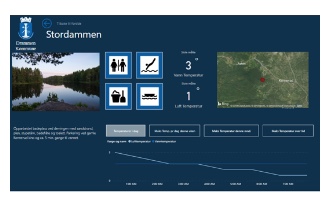
Citizen benefit: Drammen citizens were wary of swimming in the river water not only due to the history of pollution by the paper and textile industries, but also due to the temperature. A handful of locations where selected for initial proof-of-concept testing and have been successfully deployed since August 2017 — residents can get real-time information on water quality and temperature, air temperature and UV radiation levels at select bathing areas. Due to the popularity of this service and demand for more smart bathing spots, Drammen will implement this technology at scale this summer.
Technology solution: Residents can monitor real-time conditions using a mobile phone or PC, as well as through boards with QR codes placed at the bathing areas. Sensors placed in different locations allow water and air temperatures, along with UV indexes, to be read on the city’s website. Vicotee’s AURORA XDLSN3 sensing nodes were employed for measuring water and air temperature data in real-time and transmitting that to the cloud via the low-power Cellular NB-IoT network. Two CR123 1550mA batteries ensure each module will operate for up to 10 years without the need for battery replacement.

Figure 2: Water and air temperatures measured at smart bathing places visualized on a web portal
 Outdoor Air Quality Monitoring

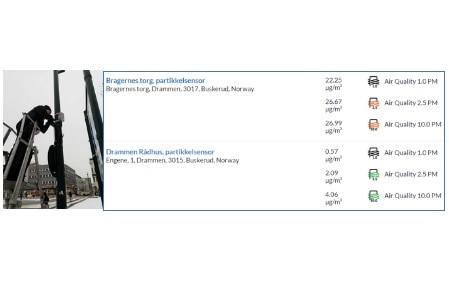
Citizen benefit: Though imperceptible to the naked eye, particulates in the air have a direct and large impact on citizen health. Small particles of less than 10 micrometers in diameter pose the greatest problems as they affect the lungs and heart. Measuring conditions to this degree allows Drammen to alert citizens when air quality is of concern and also enables the city to take proactive measures to minimize pollution.
Technology solution: Vicotee’s AURORA Small Particle Sensors measure particles down to 0.38um. In Drammen, Vicotee utilized NB-IoT communication to connect to the Azure cloud. For added flexibility, the Particle Sensor Module could use LoRa or SmartMesh modes for communication if needed. Data gathered by the sensors is analyzed and shared with citizens via online dashboards and digital signage systems.

Figure 3: Installation of air quality sensors in Drammen
 Smart Drainage and Water Level Sensing

Citizen benefit: Sand, stones and other material in storm drains can cause water levels to rise unexpectedly and quite fast, flooding streets and causing disruptions and the need for unscheduled maintenance. Automated checking of the level of debris and proactive notification on problems with drainage can avoid traffic jams, flash floods, and potential damage to city, business and residential property.
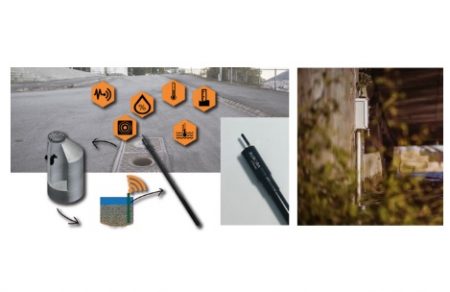
Technology solution: Vicotee’s AURORA Smart Drain Sensors measure fill levels and distinguish between different types of fluids and mediums. Wireless transmission (via NB-IoT or LoRa) allows for real-time monitoring of sand, soil and water in each manhole across the entire city grid. This eliminates the need for time-consuming, large-scale manual inspection by teams of city employees and allows the municipality to fix issues before they cause disruptions.

Figure 4: Smart drainage and water level sensors Smart Water Metering

Citizen benefit: Current water meters installed in Drammen homes measure water consumption information but cannot transmit this data automatically to the city. Monthly invoicing requires citizens to manually check the water meters and send text messages to the municipality. This process is cumbersome and an annoyance when water meters are installed in hard-to-reach places. Digital meters that transmit consumption data automatically take away this hassle for residents and streamline the invoicing process.
Technology solution: A plan to install smart water meters will enable automatic collection and aggregation of water consumption data throughout the city several times a day. Wireless technologies employed in other proof-of-concept implementations (NB-IoT, LoRa) or Wireless M-Bus can be used for transmitting water consumption data. This data provides the municipality an opportunity to automate the invoicing process and understand usage patterns. Valuable insights driven by analytics will enable city officials to reduce waste, minimize leaks and encourage the right consumer behaviors among citizens. While individual household data will not be shared, citizens will be given access to aggregate data that shows trends and overall consumption.

Future Plans

The entire smart city initiative in Drammen is forging new ways for Nordic cities and beyond to enrich their inhabitants’ lives. Having a long-term vision, choosing the right technology partners and deploying a phased, proven solution methodology is serving the community well.
Already, the success of Drammen’s proof-of-concept solutions has seeded several avenues of value. City leaders are busy planning new areas for services across the community to drive further citizen benefit, and the idea is catching on with local residents and businesses. Perhaps most significantly this year, confidence in the new digital infrastructure has enabled the city to plan the impending merger with neighboring municipalities without fears of overwhelming current residents or thinning out resources that must benefit the entire citizen pool.
New initiatives being formulated for the future focus around technologies that can:
1. Drive further economic activity and investment into Drammen
2. Increase engagement between citizens, the local business community, universities and the municipality
3. Enable new services that can easily be added to the current infrastructure
“Arrow is very excited to be involved in the Drammen Smart City Project and to make an impact in improving quality of life and wellbeing for its residents,” added Andrew Bickley, Arrow director of IoT in the EMEA region. “We saw a high degree of synergy between the requirements, engineering competence and technology solutions that Arrow can bring to architect an end-to-end solution. More important, we are executing Drammen’s vision of a scalable open platform, which creates endless possibilities for new services to be deployed by any technology providers, local business owners and the city.”
With a thoughtful eye on the past and a watchful gaze on the horizon, Drammen is carving out a special place in the region’s history as one of its most notable polluters now turned one of its most progressive leaders for clean, connected, responsible living.

> Read More

About Smart Cities

This news story is brought to you by smartcitieselectronics.com, the specialist site dedicated to delivering information about what’s new in the Smart City Electronics industry, with daily news updates, new products and industry news. To stay up-to-date, register to receive our weekly newsletters and keep yourself informed on the latest technology news and new products from around the globe. Simply click this link to register here: Smart Cities Registration