Semtech and AWS Collaborate on AWS IoT Core for LoRaWAN®

Semtech Corporation has announced that they have teamed up with Amazon Web Services (AWS) to integrate the LoRaWAN® protocol on the Network Server with AWS IoT Core, AWS’s managed Cloud service that lets connected devices easily and securely interact with Cloud applications and other devices.

AWS IoT Core for LoRaWAN is a fully managed service that enables enterprise IoT developers to easily connect low power wireless devices over long range, wide-area network (LoRaWAN) based networks to AWS without developing or operating their own LoRaWAN server. This simplifies the development of IoT solutions that leverage the long range, low power and security of Semtech’s LoRa chipsets and the LoRaWAN protocol.

To get started with AWS IoT Core for LoRaWAN, IoT developers can source AWS qualified gateways operating the LoRaWAN protocol from the AWS Partner Device Catalog and select an array of LoRaWAN CertifiedCM devices from the LoRa Alliance website. From within the AWS Management Console, developers can rapidly register gateways with AWS IoT Core for LoRaWAN by providing the service, its unique identifier, and selecting LoRaWAN as the radio frequency. To register devices with LoRa chipsets, developers simply input the device credentials, identifiers and security keys provided by the device vendor on the console and follow guided and easy instructions for specifying device configuration. In addition, AWS IoT Core for LoRaWAN includes a variety of device management capabilities, including security and a plug-and-play for the AWS IoT Analytics.

“Based on our collaboration with Semtech, IoT developers will be able to leverage LoRaWAN to simplify the development process, as well as provide key features to their applications such as long range connectivity, the ability to build devices with low power consumption, and increased security,” said Dirk Didascalou, Vice President of IoT, Amazon Web Services, Inc. “We are delighted to be working with Semtech to accelerate our customers’ adoption of IoT and LoRaWAN allowing them to innovate faster and focus on the main job of creating business value.”

Developers will also be able to access Semtech’s LoRa Cloud, a simple API based service that can be easily integrated with AWS IoT Core for LoRaWAN, providing developers with the ability to locate any LoRaWAN enabled device including devices using Semtech’s recently release low power geolocation platform LoRa Edge.

“AWS IoT Core for LoRaWAN will speed IoT application development by providing a plug-and-play experience for developers,” said Mohan Maheswaran, Semtech’s President and CEO. “In addition, this collaboration with AWS enables enterprise customers using AWS to readily take advantage of the key benefits of LoRaWAN as the protocol continues to have massive adoption in the IoT industry in a variety of verticals ranging from smart home and communities to asset tracking.”

More was discussed at today’s AWS session at re:Invent.

To learn more about Semtech’s IoT solutions, visit the website.

About Semtech’s LoRa® Platform

Semtech’s LoRa device-to-Cloud platform is a globally adopted long range, low power solution for IoT applications, enabling the rapid development and deployment of ultra-low power, cost efficient and long range IoT networks, gateways, sensors, module products, and IoT services worldwide. Semtech’s LoRa devices provide the communication layer for the LoRaWAN® protocol, which is maintained by the LoRa Alliance®, an open IoT alliance for Low Power Wide Area Network (LPWAN) applications that has been used to deploy IoT networks in over 100 countries. Semtech is a founding member of the LoRa Alliance. To learn more about how LoRa enables IoT, visit Semtech’s LoRa site.

> Read More

Infineon spearheads the smart home revolution with leading role in Zigbee Alliance’s Project “Connected Home over IP”

The world’s leading smart home device manufacturers and suppliers have joined forces to develop a global standard that eases smart home implementations. The Zigbee Alliance’s working group “Connected Home over IP”, CHIP for short, aims at increasing compatibility among smart home products, with security as a fundamental design tenet. As a world leading security solutions provider, Infineon Technologies has helped to define security features in CHIP that are both easy to integrate for manufacturers and easy to use for consumers.

“We are convinced that Project CHIP as an industry-wide standardisation effort has the power to boost smart home device manufacturing and deployment”, said Steve Hanna, Senior Principal at Infineon and lead of several security teams within the CHIP Working Group. “Hardware security is second to none when it comes to protecting user’s privacy and data security. We have brought in all our expertise to securely and easily connect domestic life with the internet.”

In the face of the Corona pandemic, private homes have become the centre of working, educating, entertaining and even healthcare. As a result, there is greater demand for a new range of applications and functions ranging from home security to energy-efficient lighting or air conditioning. Aspects such as easy and secure in-home control and device set-up are consequently becoming fundamental for consumers’ buying decisions.

How the smart home standard CHIP works

With CHIP, consumers will experience a new degree of professionalism when adding a new device into their home networks. From design to end of life, a device’s identity can now be stored and updated in hardware-based security. Hardware-based security can eliminate the use of unsecure passwords, maintain device integrity through protected firmware updates and protect private data through state-of-the-art data encryption.

As part of the CHIP working group, Infineon has been a leader in all major security teams, including those covering topics such as cryptographic primitives for encryption, device attestation and integrity, and the requirements for security certification of smart home devices.

Comparable to the TPM standard which raised the bar for PC security, the CHIP standard aims to help smart home device manufacturers to significantly increase the level of security of their products while keeping costs controlled and avoiding needless complexity with easy-to-use hardware based security.

Further information is available at http://www.infineon.com/connectedhome

> Read More

Save Time and Streamline Efficiencies with Digi-Key’s BOM Management Resources

A bill of materials (BOM) is your list of parts and is unique to you. The Digi-Key BOM Manager is designed to ease the process of BOM management and maintenance based on your needs. With features to save and archive revisions, multiply by number of assemblies and collaborate with others, the Digi-Key BOM Manager is truly in a class all its own.

The free BOM Manager can be found in the upper right corner of the Digi-Key website, or under My Tools once you are logged into your My Digi-Key profile. From the link, you can start a new Bill of Materials by uploading a file or by starting a new BOM that can be added to later. At the BOM Manager link there is also a complete virtual product tour with step-by-step instructions for the entire BOM management process as well.

Trying to keep up with the changes that happen with a BOM can be a distraction for many people, and the BOM Manager eases a lot of that distraction by tracking changes, iterations, orders and more. Product control and inventory management folks especially appreciate the ability to see a “tracked changes” history of their BOM.

It’s a fairly self-serve tool on the front end, where customers upload their list, choose their parts, enter their specifications, etc. Then when the customer turns it over to use by requesting a quote, we spend some time manually on the back end to look through parts to make sure they have chosen the best options, there are no obsolete parts, better alternatives, etc. We do a lot of manual work on the backend to keep their BOM up to date and orderable.

The BOM Manager is specific to a customer’s international location, too, so if there are restrictions on parts shipping, those will be reflected in the parts available, and quotes and part pricing will be shown in the customer’s preferred currency.

Overall, the BOM Manager is a huge convenience to our customers and compiles all the information they would want on their BOM into one easy-to-consume format and location. We’ve spent years collecting and refining the data we have available for our BOM Manager, and it offers more than the average, including parametric data and environmental and export compliance information. Having the data behind your BOM is another huge benefit, and we’re always adding to our data collection system and ensuring everything is accurate and up to date.

Digi-Key is committed to supporting our customers in any way that we can, and our free BOM Manager is one more way that we can do that. If you ever need assistance with your BOM, our technical support team is available 24/7, and we’re happy to walk you through the process.


Article by Jeremy Purcell, senior digital product owner, Digi-Key Electronics


> Read More

Selecting the Right Supplies for Powering 5G Base Stations Components

Cellular communications have come a long way since the introduction of analog cellular networks in the early ’80s. Today, as the market migrates from 4G to 5G network solutions, the cellular communications industry is laying the groundwork for a giant leap forward in data transfer speed, lower latency, capacity, user density, and reliability. For example, along with a 100× improvement in data rates and network capacity (10×), 5G also drastically cuts latency to under 1 ms,1 while enabling near ubiquitous connectivity for the billions of connected devices that are part of the growing Internet of Things (IoT). A typical 5G beamforming transmitter comprising digital MIMO, data converters, signal processing components, amplifiers, and antennas is shown in Figure 1.2

Powering FPGAs
In order to fully realize the benefits of 5G, designers require higher frequency radios to tap into the new spectrum needed to meet the future data capacity demand by incorporating more integrated microwave/millimeter wave transceivers, field programmable gate arrays (FPGAs), faster data converters, and high power, low noise power amplifiers (PAs) for smaller cells. Additionally, these 5G cells will also include more integrated antennas to apply the massive multiple input, multiple output (MIMO) techniques for reliable connections. As a result, a variety of state-of-the-art power supplies are required to power 5G base station components.
Modern FPGAs and processors are built using advanced nanometer processes because they often perform calculations at fast speeds using low voltages (<0.9 V) at high current from compact packages. Additionally, new generation FPGAs need lower core voltages to vastly improve computational speeds while requiring higher voltage for I/O interfaces, and they need an additional rail for DDR memory.3,4,5 So, in essence, a single FPGA requires multiple voltages with tight tolerances and different current ratings for optimal operation. What’s more, in order to avoid damage, these voltage rails must be sequenced in the correct order. Such stringent requirements can be met by power supplies built using the latest semiconductor technologies combined with leading-edge circuit topologies and advanced packaging techniques. However, should a designer not properly utilize the right power management solution, the risks range from inefficiencies to thermal complications and other undesired performance-related problems.

Quietly Powering High Speed Data Converters
Likewise, faster running, precision data converters, like analog-to-digital converters (ADCs) and digital-to-analog converters (DACs), also require multiple power rails, such as 1.3 V, 2.5 V, and 3.3 V, with very low noise and dc ripple.6 Normally, these high speed ADCs and DACs are placed on crowded printed circuit boards (PCBs) with limited space. Consequently, power supply sensitivity of the ADC and DAC must be a top consideration when designing the power supply system for these high speed data converters.
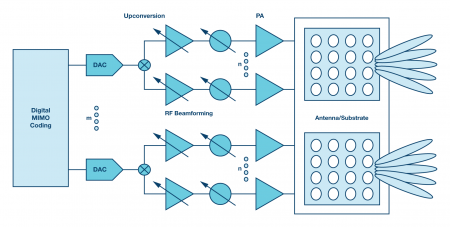

Figure 1. A high level block diagram of a beamforming transmitter for 5G systems.


By combining the benefits of advanced semiconductor and packaging technologies, ADI’s µModule® Silent Switcher® regulators can easily solve this problem, meeting the efficiency, density, and noise performance needs of high speed data converters. A good example is Silent Switcher LTM8065, which can deliver a solution that is quiet, more compact, and more efficient for powering these devices. Unlike a traditional discrete solution, LTM8065 can significantly cut the component count and power supply board real estate without compromising the dynamic performance of the data converter. A single RoHS compliant BGA package integrates a switching controller, power switches, an inductor, and all the supporting components.
In some cases, to maximize power supply rejection ratio (PSRR) performance, linear regulators are used in the power supply path, following a switching regulator. ADP7118 is one such low dropout (LDO), low noise linear regulator that can handle a wide input voltage range with high output accuracy, low noise plus high PSRR, and an excellent line and load transient response. However, there are many more in this product line and they can be correctly selected using ADI’s software tools like LTpowerCAD and LTspice.®

Managing Power for PAs and Transceivers
These next-generation radios that incorporate integrated transceivers and low noise, high power microwave/millimeter wave PAs with wider bandwidths come with digital control and management systems, which requires the use of multiple specialized power-supply technologies. For example, gallium nitride (GaN)-based low noise, high power PAs will require voltages as high as 28 V to 50 V, while FPGA based control and high speed ADCs and DACs will need multiple lower voltages with proper sequencing, monitoring, and protection.7,8 State-of-the-art dc-to-dc converters can deliver the efficiency (>90%), power density, low noise performance, and control demanded by these 5G PAs.

With enormous pressure to deliver next-generation (5G) products that outperform the previous generation (4G), there is little room for compromise. Consequently, a company like ADI, which specializes in all aspects of the base station RF chain and has thorough knowledge of power management tools required for powering these applications, is able to provide the right power resources for today’s 5G based PAs and transceivers. Offering the industry’s broadest portfolio of high performance Power by Linear™ products ranging from high efficiency, high density dc-to-dc converter modules to power management ICs (PMICs) and ultralow noise linear regulators, including power sequencing, monitoring, and protection, ADI can provide a more holistic approach to powering the 5G signal chain.

ADI’s µModule regulators and Silent Switcher services are complete power system-in-package solutions that can deliver precise voltage with the highest efficiency (>95%) and power density from a miniature package with high reliability and the lowest EMI and noise. These solutions are specially designed to power high performance RF systems with the highest power conversion efficiency and density without adding noise or interference to the radio signal of interest, thus ensuring the best performance out of these RF PAs and other such RF circuits.

Likewise, to address the challenges of power supply sequencing in circuits where multiple rails are needed, ADI has built a family of sequencers ranging from sequencing of two supplies (ADM6819/ADM6820) to 17 channels (ADM1266). To ensure that a system is operating correctly, efficiently, and safely, monitoring device voltage, current, or temperature is crucial. For that, ADI offers parts like LTC2990.

In summary, ADI’s Power by Linear product portfolio comprises low noise LDO regulators, low EMI, highly integrated multirail dc-to-dc converter µModule devices, Silent Switcher technology, and other power management ICs, including supply sequencers, monitors, and protection circuits – all of which position ADI to offer the broadest line of power products in the industry. It includes everything needed to power 5G base station components, including software design and simulation tools like LTpowerCAD and LTspice. These tools simplify the task of selecting the right power management solutions for these devices and, thereby, provide an optimal power solution for 5G base stations components.

By James Wong and Tony Armstrong, Analog Devices Inc.

References
1 Kyungmin Park. “How 5G Reduces Data Transmission Latency.” EDN Network, May 14, 2018.
2 Thomas Cameron. “5G—The Microwave Perspective.” Analog Devices, Inc., December 2015.
3 Nathan Enger. “Care and Feeding of FPGA Power Supplies: A How And Why Guide To Success.” Analog Dialogue, November 2018.
4 Frederik Dostal. “Power Management for FPGAs.” Analog Dialogue, March 2018.
5 Afshin Odabaee. “Powering Altera Arria 10 FPGA and Arria 10 SoC: Tested and Verified Power Management Solutions.” Analog Devices, Inc.
6 Aldrick Limjoco, Patrick Pasaquian, and Jefferson Eco. “Silent Switcher µModule Regulators Quietly Power GSPS Sampling ADC in Half the Space.” Analog Devices, Inc., October 2018.
7 David Bennett and Richard DiAngelo. “Power Supply Management of GaN MMIC Power Amplifiers for Pulsed Radar.” Analog Devices, Inc., October 2017.
8 Keith Benson. “GaN Breaks Barriers—RF Power Amplifiers Go Wide and High.” Analog Dialogue, September 2017


> Read More

About Smart Cities

This news story is brought to you by smartcitieselectronics.com, the specialist site dedicated to delivering information about what’s new in the Smart City Electronics industry, with daily news updates, new products and industry news. To stay up-to-date, register to receive our weekly newsletters and keep yourself informed on the latest technology news and new products from around the globe. Simply click this link to register here: Smart Cities Registration