

Farnell launches ‘How To’ content series to support engineers in their IoT and IIoT journey

Farnell, an Avnet Company has expanded the Technical Resources Hub to include new exclusive resources offering a deep dive into Industry 4.0, Internet of Things (IoT) design and wide-ranging hot topics for electronic development engineers. The Technical Resources Hub is designed to provide engineers with comprehensive advice and training to support every stage of new product design. 

Innovation in IoT and Industrial IoT technologies is accelerating rapidly as the push toward greater automation and interconnectivity becomes a focal point for many critical industries. Engineers can now drill deeper into the different areas of IoT design and Industry 4.0 on the Technical Resources Hub with the addition of a ‘How To’ content series covering all stages of designing and implementing systems through to enabling integration via the cloud.

The ‘How To’ series features several short, instructional articles, teaching engineers how to design-in specific technologies and develop skills associated with implementing Industry 4.0 as well as more general IoT based designs. Instructional articles recently added to the Technical Resources Hub cover topics from ‘How to Implement different types of edge computing for Smart Factory applications’ to ‘How to establish control access to shop floor systems via gateways’ and much more.

Cliff Ortmeyer, Global Head of Technical Marketing, Farnell said: “Our new Technical Resources Hub is designed to share inspiration and knowledge, support component selection and enable upskilling with essential learning modules and resources. We are committed to providing maximum support to our customers through our online tools that accelerate the design process to bring products to market much faster.” 

The Farnell Technical Resources Hub features a comprehensive range of technical articles and application notes, whitepapers, webinars and podcasts, projects and training modules, videos and eBooks. Visitors can access innovative information on a number of technologies and applications along with valuable calculators, conversion charts and online component selection tools.

For easy navigation, the hub also includes pages focused on specific technologies, such as wireless, sensing, power management, motor control, lighting and display; alongside complementary application pages covering the IoT, transportation, medical, maintenance, safety and more.

Farnell stocks more than 950,000 products in its global online catalogue. Technical support is offered 24/5 to ensure customers can take advantage of the latest technology innovations for experiments and design. Farnell can also support customers as they take ideas from specification through to production with end-to-end product development solutions offered via the Avnet group and element14 Community. 

Brand new IoT and IIoT content, as well as a suite of additional resources, is available on the Technical Resources Hub now from Farnell in EMEA, element14 in APAC and Newark in North America. 

> Read More

Passive balancing allows all cells to appear to have the same capacity

In the automotive and transportation marketplace, large battery stacks provide high output power without producing harmful emissions (that is, carbon monoxide and hydrocarbons) associated with gasoline-powered combustion engines. Ideally, each individual battery in the stack equally contributes to the system. However, when it comes to batteries, all batteries are not created equally. Even batteries of the same chemistry with the same physical size and shape can have different total capacities, different internal resistances, different self-discharge rates, etc. In addition, they can age differently, adding another variable in the battery life equation.

A battery stack is limited in performance by the lowest capacity cell in the stack; once the weakest cell is depleted, the entire stack is effectively depleted. The health of each individual battery cell in the stack is determined based on its state of charge (SoC) measurement, which measures the ratio of its remaining charge to its cell capacity. SoC uses battery measurements such as voltage, integrated charge and discharge currents, and temperature to determine the charge remaining in the battery. Precision single-chip and multichip battery management systems (BMS) combine battery monitoring (including SoC measurements) with passive or active cell balancing to improve battery stack performance. These measurements result in:

X Healthy battery state of charge independent of the cell capacity

X Minimised cell-to-cell state of charge mismatch

X Minimised effects of cell ageing (ageing results in lost capacity)

Passive and active cell balancing offer different advantages to the battery stack and Analog Devices offers solutions in our battery management product portfolio for both methods. Let’s first examine passive balancing.

Passive Balancing Allows All Cells to Appear to Have the Same Capacity

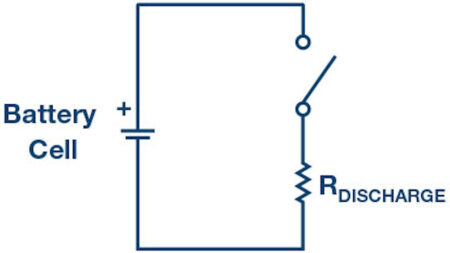
Initially, a battery stack may have fairly well matched cells. But over time, the cell matching degrades due to charge/discharge cycles, elevated temperature, and general ageing. A weak battery cell will charge and discharge faster than stronger or higher capacity cells and thus it becomes the limiting factor in the run-time of a system. Passive balancing allows the stack to look like every cell has the same capacity as the weakest cell. Using a relatively low current, it drains a small amount of energy from high SoC cells during the charging cycle so that all cells charge to their maximum SoC. This is accomplished by using a switch and bleed resistor in parallel with each battery cell.

Figure 1. Passive cell balancer with bleed resistor.

The high SoC cell is bled off (power is dissipated in the resistor) so that charging can continue until all cells are fully charged.

Passive balancing allows all batteries to have the same SoC, but it does not improve the run-time of a battery-powered system. It provides a fairly low cost method for balancing the cells, but it wastes energy in the process due to the discharge resistor. Passive balancing can also correct for long-term mismatch in self discharge current from cell to cell.

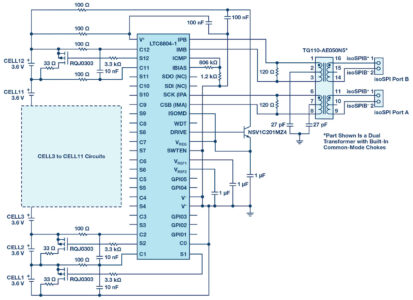
Figure 2. LTC6804 application circuit with external passive balancing.

Multicell Battery Monitors with Passive Balancing

Analog Devices has a family of multicell battery monitors that include passive cell balancing. These devices feature a stackable architecture, allowing hundreds of cells to be monitored. Each device measures up to 12 series of connected battery cells with a total measurement error of less than 1.2 mV. The 0 V to 5 V per cell measurement range makes them suitable for most battery chemistries. The LTC6804 is shown in Figure 2.

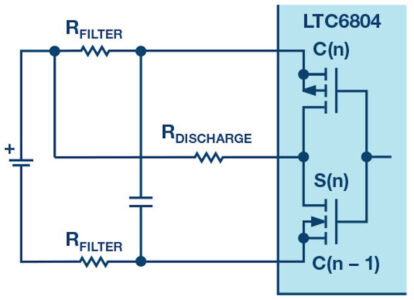
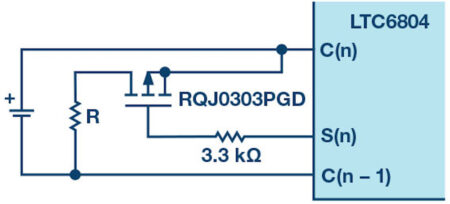
The LTC6804 features internal passive balancing (Figure 3) and can also be configured with external MOSFETs if desired (Figure 4). It also has an optional programmable passive balancing discharge timer that allows the user more system configuration flexibility.

Figure 3. Passive balancing with internal discharge switch.

Figure 4. Passive balancing with external discharge switch.

For customers that wish to maximise system run-time and charge more efficiently, active balancing is the best option. With active cell balancing, energy is not wasted, but rather redistributed to other cells in the stack while both charging and discharging. When discharging, the weaker cells are replenished by the stronger cells, extending the time for a cell to reach its fully depleted state. For more on active balancing, see the technical article “Active Battery Cell Balancing.”

About the Authors

Sam Nork has worked for Analog Devices’ Power Products Business Unit (previously Linear Technology) since 1988. As a general manager and design director, Sam leads a development team of over 120 engineers focused on battery charger, ASSP, PMIC, and consumer power products. He has personally designed and released numerous portable power management integrated circuits, and is inventor/co-inventor on 11 issued patents. Prior to joining Linear Technology, Sam worked for Analog Devices in Wilmington, MA as a product/test development engineer. He received A.B. and B.E. degrees from Dartmouth College. He can be reached at sam.nork@analog.com.

Kevin Scott works as a product marketing manager for the Power Products Group at Analog Devices, where he manages boost, buck-boost, and isolated converters, as well as drivers and linear regulators. He previously worked as a senior strategic marketing engineer, creating technical training content, training sales engineers, and writing numerous website articles about the technical advantages of the company’s broad product offering. He has been in the semiconductor industry for 26 years in applications, business management, and marketing roles.

Kevin graduated from Stanford University in 1987 with a B.S. in electrical engineering and started his engineering career after a brief stint in the NFL. He can be reached at kevin.scott@analog.com.

> Read More

Infineon and Rainforest Connection create real-time monitoring system to detect wildfires in some of the world’s most vulnerable forests

Infineon Technologies has announced a collaboration with Rainforest Connection (RFCx), a non-profit organisation that uses acoustic technology, Big Data and Artificial Intelligence / Machine Learning to save the rainforests and monitor biodiversity. In this joint collaboration, RFCx will explore the use of Infineon’s gas sensing technologies to elevate and expand upon the capabilities of their current acoustic listening devices used to monitor and protect vulnerable rainforest ecosystems. This includes monitoring primates, birds, frogs, insects, bats and other organisms, and protecting against threats ranging from illegal logging to what can now also be forest fires with this collaboration.

“Infineon will enable us to better track rainforest ecosystems in various locations regardless of weather conditions and environmental concerns,” said Topher White, CEO and Founder, Rainforest Connection. “Our mission is to develop and leverage conservation technology to empower our partners and protect threatened ecosystems. With this new technology partnership with Infineon, we are thrilled to bring new levels of technology to help protect the rainforests. I am excited to keynote at their annual OktoberTech Americas event.”

RFCx’s scalable, real-time monitoring system protects and studies remote ecosystems through an approach using acoustic sensors – which will soon include Infineon’s gas sensing technologies at select locations – and AI / Machine Learning to empower partners on the ground to take action. Additional monitoring of the ecosystem soundscape at select locations with Infineon’s gas sensors will allow RFCx and its partners to detect fires in real-time, along with other potential threats. The platform streams data within the natural and remote regions of the world to local partners on the ground which may soon include local fire authorities.

“Infineon’s mission is to make the world an easier, safer and greener place,” said Bob LeFort, President of Infineon Americas. “This collaboration exemplifies our mission by leveraging Infineon technology and expertise to improve monitor activities in the rainforest to help prevent illegal deforestation, halt animal poaching and now explore gas and forest health monitoring in very remote areas. We are committed to using our technology to help fight climate change and protect natural resources.”

About Rainforest Connection

Rainforest Connection (RFCx) uses technology and big data to enable on-the-ground partners to save the world’s most threatened rainforests and habitats. Saving rainforests isn’t only the key to halting climate change, it is also vital to supporting many of the world’s poorest communities who rely on rainforests for food, shelter and livelihood.

About OktoberTech

At Infineon’s annual OktoberTech conferences, corporate innovators, start-ups, academics, investors and policymakers from across the ecosystem come together to discuss the latest technological advancements and industry transformations. Hosted by members of the Infineon management board, this year’s series is OktoberTech Americas on 21 October, followed by OkoberTech Japan on 26 October, and OktoberTech Asia Pacific on 27 October.

About Infineon

Infineon Technologies AG is a world leader in semiconductor solutions that make life easier, safer and greener. Microelectronics from Infineon are the key to a better future. In the 2020 fiscal year (ending 30 September), Infineon reported revenue of more than €8.6 billion with a workforce of some 46,700 people worldwide. Following the acquisition of the US company Cypress Semiconductor Corporation in April 2020, Infineon is now a global top 10 semiconductor company.

> Read More

Infineon introduces software support for the Matter smart home standard to accelerate new products

Infineon Technologies has announced software support for the newest emerging smart home standard: Matter. Many leading smart home products use Infineon’s AIROC™ Wi-Fi®, AIROC Bluetooth®, and PSoC™ 6 MCU products. In this regard, support for Matter in Infineon’s ModusToolbox™ Software and Tools is an important milestone for the adoption of the emerging standard and expected to accelerate the deployment of Matter products.

Interoperability has been a barrier to the broad adoption of smart home products. According to Parks Associates, 75 percent of customers purchasing a new smart home device want it to work with the existing devices in their home. Matter – the new smart home standard from the Connectivity Standards Alliance (CSA) – promises interoperable, secure connectivity for the future of the smart home. Several of today’s smart home market key ecosystem players – including Apple, Amazon, Google and Comcast – joined together in 2019 to develop and promote this new standard.

Many of the 320 million smart speakers in today’s homes are likely to be updated over-the-air to support Matter, after the Matter specification has been finalised. In general, it takes years for a new standard to be impactful; new infrastructure has to be rolled out and customers have to adopt it. The ability for smart speakers and other devices installed in consumer’s homes to be updated over-the-air will accelerate the deployment of Matter gateways to weeks or months, rather than years. This will potentially enable hundreds of millions of homes with these devices. The rapid deployment will create a new, large-scale opportunity for companies making Matter products.

Infineon’s software support for Matter helps two sets of companies. First, companies already using Infineon’s AIROC Wi-Fi or Bluetooth and PSoC 6 MCUs, in many cases, can leverage the new software to add Matter capability to existing products. Next, product companies can take advantage of this new high-growth market by quickly bringing Matter-compliant products to market using Infineon’s software and broad portfolio of AIROC Wi-Fi, AIROC Bluetooth and PSoC 6 MCUs.

Infineon’s unique combination of software support for Matter, ModusToolbox software and tools, broad family of AIROC connectivity chips and PSoC 6 MCUs, and its involvement in Matter open-source development puts it in a strong position to help companies quickly bring Matter products to market. This will help accelerate the adoption of this new smart home standard.

About Infineon’s PSoC 6 MCUs

The PSoC 6 family is the perfect solution for secure, low-power, feature-rich IoT products. The family is built on an ultra-low-power architecture, including advanced low-power design techniques to extend battery life up to a full week for battery powered applications. The dual-core Arm® Cortex®-M4 and Cortex-M0+ architecture lets developers optimise for power and performance simultaneously. Using its dual cores combined with configurable memory and peripheral protection units, PSoC 6 enables Platform Security Architecture (PSA) level 2 certified MCUs.

Designers can use the MCU’s rich analog and digital peripherals to create custom analog front-ends (AFEs) or digital interfaces for innovative system components such as MEMS sensors, electronic-ink displays. Through comprehensive software support available in ModusToolbox, PSoC 6 MCUs, pair seamlessly with Infineon’s AIROC Wi-Fi, AIROC Bluetooth, or AIROC combos radio modules. The PSoC 6 MCUs feature the latest generation of industry-leading CapSense™ capacitive-sensing technology, enabling modern touch and gesture-based interfaces that are robust and reliable.

About Infineon’s AIROC Wi-Fi and Bluetooth devices

Infineon’s AIROC wireless products, including Wi-Fi, Bluetooth, Bluetooth Low Energy and Wi-Fi and Bluetooth combos, have shipped more than a billion devices and are the go-to choice for IoT solutions. The broad portfolio includes high-performing, reliable, ultra-low-power products that deliver robust industry-leading performance.

AIROC products leverage a common software framework across Android, Linux, RTOS platforms and are pre-integrated with Infineon’s ModusToolbox software and tools, allowing developers to deliver high-quality, differentiated products to market on time and on budget.

About Infineon’s ModusToolbox Software and Tools

Infineon’s ModusToolbox Software and Tools brings best-in-class connectivity, computing, security, and sensing together in a single platform. It combines the rich design resources of Infineon’s wireless libraries and the analog and digital peripheral libraries of its PSoC microcontrollers with an open-source, Eclipse-based IDE. Purpose-built hardware, multi-vendor RTOS support, and standards-based security solutions provide a solid foundation, that is validated by various cloud services. ModusToolbox unifies Infineon’s offerings, providing open access to third-party solutions, and freeing engineers to focus on delivering high-value, differentiated products. ModusToolbox is available for download.

Availability

Infineon has a broad family of PSoC MCUs and AIROC Wi-Fi and Bluetooth products available today. Infineon’s software support for Matter is in the open-source Matter repository, and additional Matter-specific capabilities will be added to ModusToolbox in future releases. The latest version of ModusToolbox is available now for downloadLearn more about Infineon’s support for Matter.

Infineon makes the IoT work

Microelectronics make up the core of every IoT solution. Infineon’s sensors, actuators, microcontrollers, communication modules, and security components underpin every device. The company is a one-stop technology partner for realising smart, energy-efficient, and secure IoT applications with development boards, evaluation kits, and design tools additionally supporting manufacturers. More information about Infineon’s contribution to IoT: www.infineon.io.

> Read More

About Smart Cities

This news story is brought to you by smartcitieselectronics.com, the specialist site dedicated to delivering information about what’s new in the Smart City Electronics industry, with daily news updates, new products and industry news. To stay up-to-date, register to receive our weekly newsletters and keep yourself informed on the latest technology news and new products from around the globe. Simply click this link to register here: Smart Cities Registration