

40V Input, 3.5A Silent Switcher µModule Regulator for Automotive and Industrial Applications

Low Noise Silent Switcher Architecture Simplifies EMI Design

Automotive, transportation, and industrial applications are noise sensitive and demand low EMI power solutions. Traditional approaches control EMI with slowed down switching edges or lower switching frequency. Both have undesired effects, such as reducing efficiency, increasing minimum on- and off-times, and requiring a large solution. Alternative solutions such as an EMI filter or metal shielding add significant costs in required board space, components, and assembly, while complicating thermal management and testing.

Our low noise μModule® technology offers a breakthrough in switching regulator design. The LTM8003 regulator within the µModule package uses a proprietary Silent Switcher® architecture to minimise EMI emissions while delivering high efficiency at high switching frequencies. The architecture of the regulator and the internal layout of the µModule device are designed so that the input loop of the regulator is minimised. This significantly reduces the switching node ringing and the associated energy stored in the hot loop, even with very fast switching edges. This quiet switching offers excellent EMI performance while minimising the ac switching losses, allowing the regulator to operate at high switching frequencies without significant efficiency loss.

This architecture, combined with spread spectrum frequency operation, greatly simplifies the EMI filter design and layout, which is ideal for noise sensitive environments. Figure 1 shows a simple EMI filter on the input side, enabling the demo circuit to pass the CISPR 25 Class 5 standard with plenty of margin, as shown in Figure 2.
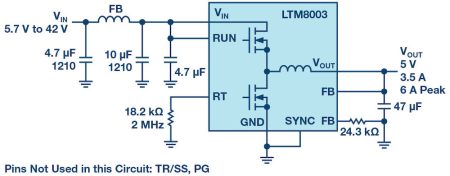
 

Figure 1. A 5V converter with a simple EMI filter at the input passes CISPR 25 Class 5.

Figure 2. DC2416A demonstration circuit passes radiated EMI spectrum CISPR 25 Class 5.

Continuous 3.5A with Peak Current Capability 6A

The internal regulator is capable of safely delivering up to 6A of peak output current, and no extra thermal management – airflow or heat sink – is required for the LTM8003 to continuously support a 3.5A load at 3.3V or 5V from a nominal 12V input. This meets the needs of the battery-powered applications in industrial robotics, factory automation, and automotive systems.

Wide Operation Temperature Range from –40°C to +150°C

Automotive, industrial, and military applications require power supply circuits to operate continuously and safely in ambient temperatures over 105°C or require significant headroom for a thermal rise. The LTM8003H is designed to meet specifications over a –40°C to +150°C internal operating temperature range. The internal over-temperature protection (OTP) monitors the junction temperature and stops switching when the junction temperature is too hot.

Figure 3a shows a 3.5A, 5V solution that operates from a wide-ranging 7V to 40V input. The thermal performance at a nominal 12V input is shown in Figure 3b. The typical efficiency is above 92% with a 12V input and 2A load.
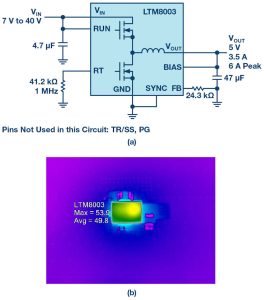
Figure 3. A 5V, 3.5A solution for 7V to 40V inputs using the H-grade version. Thermal imaging shows no need for bulky heat mitigation components.


Negative Output –5V from +3.5V to +35V Input

Figure 4 shows a solution for a –5V, 4A output from a nominal 12V input, with a maximum of 35V input. The BIAS pin should be connected to GND.
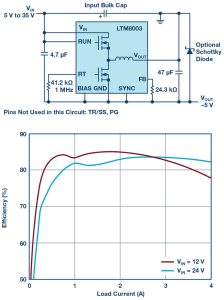
Figure 4. A –5V supply from a +5V to +35V input delivers current up to 4A.

Conclusion

The LTM8003 is a wide input and output range, low noise, 3.5A step-down µModule regulator featuring the Silent Switcher architecture. Inputs from 3.4V to 40V can produce outputs from 0.97V to 18V, eliminating the need for intermediate regulation from batteries or industrial supplies. The pinout is specifically designed to be FMEA compliant, so the output stays at or below the regulation voltage during adjacent pin shorts, single-pin shorts to ground, or pins left floating. Redundant pins enhance electrical connections in the event a solder joint weakens or opens due to vibration, aging, or wide temperature variations, such as in automotive and transportation applications.

A complete solution fits a compact space not much larger than the 6.25mm × 9mm × 3.32mm, BGA footprint of the LTM8003, including the input and output capacitors. The quiescent current of typically 25µA and wide temperature operation from –40°C to +150°C (H-grade) make it ideal for circumstances where space is tight, the operational environment is harsh, and low quiescent current and high reliability are mandatory. Its features help minimise design effort and meet the stringent standards for industrial robotics, factory automation, avionics, and automotive systems.
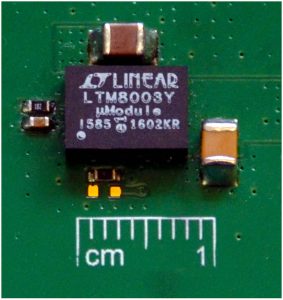
Figure 5. A complete step-down solution is barely larger than the 6.25mm × 9mm footprint of the LTM8003 µModule regulator.


About the Author

Zhongming Ye is a senior applications engineer for power products at Analog Devices, Inc., in Milpitas, California. He has been working at Linear Technology (now part of ADI) since 2009 to provide application support on various products including buck, boost, flyback, and forward converters. His interests in power management include high performance power converters and regulators of high efficiency, high power density, and low EMI for automotive, medical, and industrial applications. Prior to this, he worked at Intersil for three years on PWM controllers for isolated power products. He obtained a Ph.D. in electrical engineering from Queen’s University, Kingston, Canada. Zhongming was a senior member of IEEE Power Electronics Society. He can be reached at zhongming.ye@analog.com.


> Read More

A bright future for sustainable smart street lighting

Street lighting is undergoing a significant change. As lighting systems are updated with low power LED lighting to reduce energy consumption, there is a key opportunity to add additional sensors that enable the growth and management of smart cities.

Low Power Wide Area Networking (LPWAN) platforms such as Semtech’s LoRa® are central to this shift. For example, street lights can not only be monitored and managed more efficiently to control energy use, but sensors using LoRa can also provide an extensive range of data for use in traffic control, CO2 emission monitoring, city planning and many other data-driven applications.

The data gathered can positively impact city budgets and provide insights informing Smart City expansion and redevelopment as well as utility management.

For example, smart lighting system developer CITiLight1, has been using a wireless network at sub-GHz frequency bands to connect over one million street lights in 100 cities in India, saving up to 1.29 billion kilowatt-hours (kWh) of energy.

The Velociti LMS lighting management system uses LoRa transceivers from Semtech and the LoRaWAN® standard for real-time, automated monitoring. Any command directed to the street lights such as changes to lighting schedule or light intensity can be executed within seconds as the system offers less than five second command latency and 0.5-1% accuracy on metered data. 

Human presence sensors can automatically switch off unneeded lights and also provide feedback on system reliability and accuracy. Predictive maintenance can highlight failing lighting units and automatically schedule repairs before a light fails. Reliable lighting infrastructure makes cities safer. 

Real-time analytics are boosting smart city growth, adding intelligence, sensing and networking to street lighting systems. The data can be transmitted via a gateway that can manage hundreds of lights across an entire city. 

From its inception, LoRaWAN was designed as a robust low-power, long-range technology in the 868MHz and 920MHz bands for The Internet of Things (IoT), which enables the connection of hundreds of street lights, either in proprietary networks or via the growing number of LoRaWAN network providers. Once that capability has been installed, the network is also available to other sensors, essentially for free. 

An example is IoT solutions provider Wellness TechGroup, which specialises in public utility digitisation projects. Wellness TechGroup created a software platform called WeLight, which manages and regulates energy consumption in order to maximise the potential of lighting infrastructure. 

This system utilises the LoRaWAN standard, chosen as the most convenient wireless connectivity option due to its low cost and ease of use in smart city applications. A city using the system then benefits from convenient access to the same LoRaWAN network for all of its smart utility and smart metering applications.

Additional sensors can be employed to tap into the same network, whether placed on lamp posts alongside smart lighting infrastructure or in other strategic areas across the city. With a wireless network already established and available, other battery-powered sensors can be quickly and easily installed to provide actionable insights into city operations. This can entail sensors which measure roadside air particles, or the amount of carbon dioxide generated at selected sites. Traffic monitoring sensors in particular can help assess detailed patterns of activity so that city planning decisions can be based on robust data.

The availability of this data establishes opportunities for digital twin models. These models utilise sensor data and build a digital twin of the smart city. A smart city’s digital twin can be used for real time monitoring and control but can also be used to test different management approaches. Changes can be made to traffic flows or other features in the model, and the consequences evaluated before they are implemented in the real world.

 To accomplish this, WeLight, for example, equips the lighting infrastructure with both intelligence and connectivity. Each lighting unit is converted into a data server, so lighting units become nodes in the wider IoT ecosystem.

LoRa also enables smarter lighting and sensing in areas that do not have electrical infrastructure in place. Using photovoltaic cells and local battery storage, smart lighting systems act as a gateway for multiple sensors. This data can be transmitted to the Cloud in the absence of a network by connecting directly to satellites in Low Earth Orbit (LEO). The latest version of LoRa devices add robust protocols that allow for this direct connection, and several network operators are utilising LoRa chipsets when launching constellations of satellites to provide worldwide access to lighting controls and data. 

More broadly, smarter management and monitoring leads to cost and energy savings, which are critical issues for today’s cities. Using low-cost wireless networks to control and monitor smart street lights makes possible new opportunities for a wide range of sensors to collect relevant data, generating more sophisticated insights into the operation of a living, breathing smart city. 

Semtech, the Semtech logo and LoRa are registered trademarks or service marks of Semtech Corporation or its affiliates.

By Marc Pegulu, Vice President of IoT Product Marketing and Strategy for Semtech’s Wireless and Sensing Products Group 

Semtech and CITiLIGHT Transform Smart City Street Lighting With LoRaWAN® 

> Read More

Ensuring Data Integrity with the Internet of Things

Given the explosive growth in the number of things in the Internet of Things, it’s imperative to examine the internet that will connect and enable communication among all the things. Creating reliable wireless connectivity among these devices is proving to be one of the great challenges in IoT. The reliability of the communications system can be defined by the performance of two critical components: a radio transceiver and communications microcontroller. This article discusses how components and solutions from Analog Devices can maximize system-level reliability, enabling high impact applications where the quality, integrity of data, and insights are mission critical.

What’s Good Now Is Not Good Enough

Existing wireless connectivity technologies for consumer devices do not always satisfy the performance demands of industrial and healthcare systems. The different priorities in these systems—including safety, accuracy, and time sensitivity—heighten the need for increased reliability. Cellular systems come close to this but are often unsuitable in terms of battery, cost, and data throughput requirements. Extremely reliable systems exist today for niche industrial and military applications. However, these are designed with reliability being the top priority, and cost appearing further down the list. With industrial IoT, the challenge becomes delivering the same high level of reliability at a much lower system cost.

Let’s consider some scenarios where wireless capability has been added to enhance the effectiveness of a system, and where reliability of connectivity can be mission critical.

Smart Factory: Production Process Control for Industry 4.0

A key attraction of connected devices in manufacturing includes the potential for yield improvements. To achieve this, it is often necessary to gain remote control of various devices in the production chain to implement adjustments. An example is a control valve for a boiler operating in a chemical production process. Immediate, autonomous control of this valve can make real-time adjustments, based on feedback from other stages in the process, leading to more optimized overall efficiency.

Smart Healthcare: Vital Signs Monitoring

Hospitals and care centers are looking to wireless connectivity to monitor patient vital signs. Clunky wired solutions can be replaced with wireless sensor patches connected through a local gateway. Such systems enable more effective patient monitoring while reducing the burden on healthcare staff.

Smart City: Event Sensing for Emergency Response

With advanced image and acoustic sensing and processing methods, systems mounted in public spaces, such as on lamp posts, can detect events such as vehicle accidents and criminal activity with a high degree of confidence. This information can be relayed via wireless communications to the appropriate agency or unit, along with the location information to enable faster emergency response.

Key Challenges in Building Reliable Wireless Connectivity in Complex Environments

RF Obstacles Cause Missed Packets

Each of the examples previously mentioned are subject to distinct environmental challenges that can negatively impact wireless communication. The steel construction and thick walls of factories create large obstacles that can degrade the power of an RF signal to the point where it cannot be received by the target device. The receiver sensitivity of the radio used in the target device will determine how much signal degradation can be tolerated. As little as 2 dB change in sensitivity could be the difference between the successful or unsuccessful reception of a signal. Communication system designers must pay close attention to receiver sensitivity when selecting a radio.

Crowded Frequency Bands Cause Missed Packets 

Connected devices will typically operate in the relevant ISM band for that region. ISM bands are license free and can be used for a wide range of applications requiring wireless connectivity. 2.4 GHz is standardized globally and is widely used by Wi-Fi and Bluetooth® devices. There is also ISM spectrum available in sub-1 GHz bands. These bands are commonly used for IoT applications. The band is centered at 868 MHz in Europe and 915 MHz in the U.S. A challenge arises when multiple devices located in close proximity are sharing the same ISM band. Transmitting devices can interfere with nearby receiving devices, such as in public hospitals, where there are a wide variety of machines sharing the same ISM band. The ability of a radio to operate in the presence of such interferers is measured by the blocking specification. The challenge extends beyond devices operating within the ISM band. Without sufficient blocking capability, mobile phones or tablets operating nearby could cause a loss of communication in the system. In military and aerospace applications, very costly components are used to mitigate the effect of interferers. Radios being used for mission critical data, such as the applications previously mentioned, must achieve similar performance to military and aerospace without incurring the high cost of additional external components. Such radios will continue to receive messages with multiple interferers operating nearby.

Environmental Effects Degrade Performance

Radio transceivers are built on processes that are prone to variations in performance, depending on the environment in which they’re operating. Some variations include temperature changes, voltage supply reductions as batteries discharge, and silicon manufacturing variations across devices. These real life events can cause changes in the operating stability of the device. Let’s look at an event sensing emergency response system operating on a street light. Cold winter temperatures could cause the output power of a device to vary or the receiver sensitivity to degrade. This can cause loss of communication under certain conditions. While this is less of a concern for a consumer device, which is rarely used in such extreme conditions, it would be unacceptable for an emergency response system. At best, the cost is reputational damage to the end product and a service call to replace the faulty device. System designers must ensure that the components selected for the sensing and communication system are robust over changing environmental conditions.

Corrupted Memory Can Lead to Unexpected Outcomes 

Reliability is also a concern on the communications microcontroller. Although extremely reliable, both flash and nonvolatile memory can occasionally become corrupted. This can occur as a result of unintended effects caused by the operating environment or intentionally through malicious hardware hacking. Regardless of the mechanism, it is imperative that microcontrollers are equipped with the necessary integrity features to identify when a device has been corrupted. Once identified, the microcontroller can either correct the error or shut the device down, appropriately ensuring that the security of the wider system is not breached.

Technologies developed by Analog Devices inhabit every stage of the IoT signal chain from sensing and measuring, to interpreting and connecting the data. Ensuring the quality and integrity of the information created through this chain is a core design principle and is a fundamental requirement to fulfill the true potential of the IoT.

About the Author

Michael Dalton is a product marketing manager in the IoT Group at Analog Devices. Previously, Michael worked for five years in the RF Applications team supporting ADI’s ultralow power RF transceivers. He graduated from University College Dublin with a B.E in electronic engineering in 2007.

> Read More

IAR Systems enables leading telecommunications company NTT DOCOMO to innovate smart agriculture platform

IAR Systems® have announced that the complete development toolchain IAR Embedded Workbench® for Arm® has been used by NTT DOCOMO, a leading telecommunications company in Japan, for the development of its smart agriculture support platform Farm Assist.

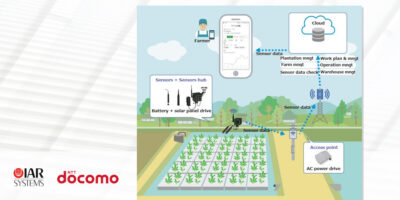
NTT DOCOMO’s Farm Assist service was launched in 2019 and collects data obtained from sensors installed in a farm via access points to a company’s cloud, enabling users to check and manage farm conditions using smartphones and PCs. The system enables users to manage daily farm work records and future production plans, streamlining various farm work as well as contributing to the realisation of highly productive and strategic farm management.

The quality of the code in this agriculture support platform is essential for NTT DOCOMO. IAR Embedded Workbench for Arm was evaluated for its extremely fast compiling and checking features, which is essential to ensure the quality of the code. In addition, considering the future demands for security implementation and multi-vendor capability, it was necessary for NTT DOCOMO to select an integrated development environment with high scalability.

“We selected IAR Embedded Workbench for Arm for two reasons: The first reason is that IAR Systems’ embedded development tools have proficient compiler features,” stated Masaru Ozeki, senior manager of the Smart-life Planning Department at NTT DOCOMO. “The other reason is that IAR Systems has built relationships with customers for a wide range of applications, so they have a lot of know-how. Technology development requires excellent tools, and the synergy between the two companies’ technical capabilities led to success.”

“IoT services are rapidly going into practical use stages, and at the same time, high performance and high reliability are required,” said Kazuhisa Harabe, Country Manager of IAR Systems Japan. “We are proud that IAR Systems’ tools, which have been used by companies for many years in Japan and worldwide, have been considered important by NTT DOCOMO for the construction of its advanced connected services. We will continue to support NTT DOCOMO in accelerating the integration of embedded devices and IT as well as in contributing to the continuously growing digital transformation and IoT.”

To read the complete customer story of how NTT DOCOMO has been using IAR Embedded Workbench, please go to www.iar.com/customer-docomo.

> Read More

About Smart Cities

This news story is brought to you by smartcitieselectronics.com, the specialist site dedicated to delivering information about what’s new in the Smart City Electronics industry, with daily news updates, new products and industry news. To stay up-to-date, register to receive our weekly newsletters and keep yourself informed on the latest technology news and new products from around the globe. Simply click this link to register here: Smart Cities Registration