


IC eases the design of 48V/12V dual battery automotive systems

The future of 48V/12V battery systems in automobiles is just around the corner. Most of the major automobile manufacturers across the globe have been working on proving out their systems for the past few years and it is evident that their implementation will be relatively near term. This is a necessary and crucial step in the long and arduous journey to the fully autonomous passenger vehicle that does not require a human at the controls and has true autonomous driving. Nevertheless, this doesn’t mean the 12V battery is going away; there are far too many legacy systems in the installed vehicle base for this to occur. This means that autonomous cars will have both a 12V battery and a 48V battery.

This fact means that the vehicles’ internal systems will either run off the 48V lithium-ion (Li-Ion) battery or the 12V sealed lead-acid (SLA) battery – but not both. Nevertheless, in addition to having two separate charging circuits for these individual batteries due to their respective chemistries, there must also be a mechanism that allows charge to move between them without causing any damage to the batteries or any of the systems within the vehicle. Moreover, having two batteries also allows for redundancy should one of them fail during operation.

While this certainly complicates the design of the various electrical subsystems within the vehicles, there are some advantages to be gained. According to some auto manufacturers, a 48V-based electric system results in a 10% to 15% gain in fuel economy for internal combustion engine vehicles, thereby reducing CO2 emissions. Moreover, future vehicles that use a dual 48V/12V system will enable engineers to integrate electrical booster technology that operates independently of the engine load, thereby improving acceleration performance. Such compressors are already in the advanced stages of development and will be placed between the induction system and the intercooler, using the 48V rail to spin-up the turbos.

Globally, fuel economy regulations have been tightening, while autonomous driving capability with connectivity continues to proliferate in new automobiles. Accordingly, the 12V automobile electric system has reached its usable power limit. Simultaneously, as if these changes are not already enough, there has been a significant increase in automotive electronic systems. These changes, coupled with related demands for power, have created a new spectrum of engineering opportunities. Clearly, the 12V lead-acid battery automotive system with its 3kW power limit must be supplemented.

Furthermore, there are new automobile standards that impact how these systems need to work. The automotive standard, known as LV 148, combines a secondary 48V bus with the existing automotive 12V system. The 48V rail includes an integrated starter generator (ISG) or belt start generator, a 48V Li-Ion battery, and a bidirectional dc-to-dc converter, which can deliver tens of kilowatts of available energy from the 48V and 12V batteries. This technology is targeted at conventional, internal combustion automobiles, as well as hybrid electric and mild hybrid vehicles, as auto manufacturers strive to meet increasingly stringent CO2 emission targets.

Figure 1. Next-generation cars will be powered by a 12 V and a 48 V battery.

New Power Solution for 48V/12V Battery Systems

This new standard requires the 12V bus to continuously power the ignition, lighting, infotainment, and audio systems. Whereas, the 48V bus will power active chassis systems, air conditioning compressors, adjustable suspensions, electric superchargers, turbos, and even regenerative braking.

The implementation of an additional 48V supply network into vehicles is not without significant impact. Electronic control units (ECUs) will be affected and will need to adjust their operational range to the higher voltage. This will necessitate that manufacturers of dc-to-dc converters will also need to introduce specialised ICs to enable this high power transfer.

Accordingly, Analog Devices’ has designed and developed a few dc-to-dc converters that can enable this energy transfer with very high efficiency to conserve energy while simultaneously minimising the thermal design aspects.

The need for a bidirectional step-down and step-up dc-to-dc converter that goes between the 12V and 48V batteries is clearly required. Such converters could be used to charge either of the batteries while simultaneously allowing both batteries to supply current to the same load if required in the system. From a legacy perspective, these initial 48V/12V, dual battery, dc-to-dc converter designs used different power components to step-up and step-down the voltage.

Analog Device’s LT8228 is a bidirectional dc-to-dc controller that uses the same external power components for step-up conversion as it does for step-down conversion. 
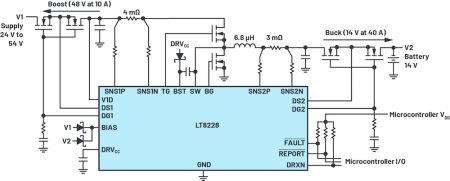
Figure 2. LT8228 configured in a simplified, bidirectional battery backup system.

The LT8228, as shown in Figure 2, is a 100V bidirectional constant-current or constant-voltage synchronous buck or boost controller with independent compensation networks. The direction of the power flow is automatically determined by the LT8228 or is externally controlled. The input and output protection MOSFETs protect against negative voltages, control inrush currents, and provide isolation between terminals under fault conditions such as switching MOSFET shorts. In step-down mode, the protection MOSFETs at the V1 terminal prevents reverse current. In step-up mode, the same MOSFETs regulate the output inrush current and protect themselves with an adjustable timer circuit breaker.

Furthermore, the LT8228 offers a bidirectional input and output current limit as well as independent current monitoring. Masterless, fault-tolerant current sharing allows any LT8228 in parallel to be added or subtracted while maintaining current sharing accuracy. Internal and external fault diagnostics and reporting are available via the fault and report pins. The LT8228 uses a 38-lead TSSOP package.

The LT8228 is a 100V, bidirectional, peak current-mode synchronous controller with protection MOSFETs. The controller provides a step-down output voltage, V2, from an input voltage, V1, when in buck mode or a step-up output voltage, V1, from an input voltage, V2, when in boost mode. The input and output voltage can be set as high as 100V. The mode of operation is externally controlled through the DRXN pin or automatically selected. In addition, the LT8228 has protection MOSFETs for the V1 and V2 terminals. The protection MOSFETs provide negative voltage protection, isolation between the input and output terminals during an internal or external fault, reverse current protection, and inrush current control. In applications such as battery backup systems, the bidirectional feature allows the battery to be charged from either a higher or lower voltage supply. When the supply is unavailable, the battery boosts or bucks power back to the supply.

To optimise transient response, the LT8228 has two error amplifiers: EA1 in boost mode and EA2 in buck mode with separate compensation pins VC1 and VC2, respectively. The controller operates in discontinuous conduction mode when reverse inductor current is detected for conditions such as light load operation. The LT8228 provides input and output current limit programming in buck and boost mode operation using four pins: ISET1P, ISET1N, ISET2P, and ISET2N. The controller also provides independent input and output current monitoring using the IMON1 and IMON2 pins. Current limit programming and monitoring is functional for the entire input and output voltage range of 0V to 100V.

Furthermore, the LT8228 provides masterless, fault-tolerant output current sharing among multiple LT8228s in parallel, enabling higher load current, better heat management, and redundancy. Each LT8228 regulates to the average output current eliminating the need for a master controller. When an individual LT8228 is disabled or in a fault condition, it stops contributing to the average bus, making the current-sharing scheme fault tolerant.

Additional features include:

u  Feedback voltage tolerance: ±0.5% over temperature

u  Bidirectional programmable current regulation and monitoring

u  Extensive self-test, diagnostics, and fault reporting

u  Programmable fixed or synchronisable switching frequency: 80kHz to 600kHz

u  Programmable soft start and dynamic current limit

u  Masterless, fault-tolerant current sharing

Conclusion

The LT8228 brings a new level of performance, control, and simplification to 48V/12V, dual battery, dc-to-dc automotive systems by allowing the same external power components to be used for step-down and step-up purposes. It operates on demand in buck mode from the 48V bus to the 12V bus or in boost mode from 12V to 48V. When starting the car or when additional power is required, the LT8228 allows both batteries to supply energy simultaneously to the same load. This gives power conversion designers a feature rich, bidirectional converter that can easily configure 12V and 48V battery systems, which will be required for the fully autonomous vehicles of the near future.

> Read More

Farnell supports developers with predictive maintenance 

Predictive maintenance from Farnell now includes over 80,000 available industrial products from over 42 industrial manufacturers including Schneider Electric, Honeywell, Siemens, ABB, Omron and Omega. 

Farnell’s line card includes a range of industrial components that can monitor facilities’ power, drives and motors to provide alerts when automated systems are at risk. Farnell also provides technical resources to help customers stay informed in the changing maintenance landscape.

Cliff Ortmeyer, global head of technical marketing from Farnell, believed the latest products offer advances in the industrial IoT (IIoT) to help reduce the cost, time and effort required to implement predictive maintenance solutions.

The distributor has recently added Siemens’ Simatic series HMI touch screens. They are designed for the implementation of high performance visualisation applications on the machine level. They feature high performance, functionality and numerous integrated interfaces, said Farnell.

Another new addition is OsiSense XS series  of inductive proximity sensors from Schneider Electric. These contributes to machine performance and machine compactness with a wide adjustment range.

Fluid level controllers from Omron are another addition. They detect a variety of conductive liquids and are designed for a wide range of industrial applications including semiconductor, food, chemical and pharmaceutical industries.

Farnell also provides technical resources to help keep manufacturers informed of the latest best practices around predictive maintenance. Some of the instructional offerings from Farnell include a whitepaper on predictive maintenance with Industrial IoT and the new e-Techjournal Industrial automation – all the power & control, there is also a webinar recording on predictive maintenance and IIoT. 

Farnell has over 80 years’ experience in the high service distribution of technology products and solutions for electronic system design, production, maintenance and repair. It supports its broad customer base, from hobbyists to engineers, maintenance engineers and buyers, and works with leading brands and start-ups to develop new products for market.  

Farnell trades as Farnell in Europe, Newark in North America and element14 throughout Asia Pacific and sells direct to consumers through a network of resellers and its CPC business in the UK.

Farnell is a business unit of Avnet. Avnet has an extensive ecosystem that delivers design, product, marketing and supply chain expertise for customers at every stage of the product lifecycle. 

http://www.farnell.com

> Read More

NXP MatterTM development platforms simplify and accelerate use of new Matter standard

NXP Semiconductors has announced new MatterTM-enabled development platforms to simplify and accelerate the creation of Matter devices for smart homes and buildings. These new Matter development platforms enable designers to easily leverage the breadth of NXP’s portfolio across processing, connectivity and security solutions to create a wide variety of IoT devices ranging from battery-operated devices like sensors and actuators to complex gateways with Thread Border Router and Matter Controller capabilities. 

With the recently announced Matter certification program and ratified standard, the smart home is on the cusp of a rapid expansion. The new Matter standard, designed within the Connectivity Standards Alliance (CSA) by a consortium of industry leaders, including NXP, brings with it a new era of interoperability across the IoT, reducing limitations on how devices communicate. This will give smart home and building end users the flexibility to select a mix of smart devices from different vendors and control them from multiple platforms or ecosystems, without concerns about compatibility.

“Matter is the first industry standard that enables multi-device, multi-vendor and multi-ecosystem interoperability for smart home products from major consumer electronics manufacturers. Matter removes barriers to deploying IoT at scale while creating new opportunities for product innovation,” said Bill Curtis, Analyst in Residence for IoT and Edge at Moor Insights & Strategy. “NXP’s secure, Matter-enabled development platforms let product teams create value-added features immediately without wasting time on undifferentiated platform software.” 

“Our vision of the intelligent smart home is one that more accurately anticipates and automates our daily routines and needs. The interoperability Matter provides is crucial to delivering on that promise,” said Rafael Sotomayor, Executive Vice President and General Manager, Edge Processing and Connectivity & Security at NXP. “These platforms simplify and accelerate the development of a wide range of Matter devices by delivering a seamless combination of the foundational technologies developers need to bring the vision of the truly intelligent smart home one step closer to reality.”

Matter-Enabled Development Platforms 

NXP’s Matter-enabled development platforms, shipping now, leverage commercially available evaluation boards and tools to ease, speed and de-risk IoT development with downloadable software, Getting Started guides, application notes, schematics, training videos and the Connectivity Support community. These platforms are currently awaiting confirmation of Matter Certification from the Connectivity Standards Alliance. NXP is also working with Apple, Amazon, Google and SmartThings and participating in Matter Early Access programs where available to enable NXP customer products to work with these and other ecosystems.

The development platforms offer dedicated EdgeLock® secure element and secure authenticator to provide full, turnkey Matter security, including Matter device certificate and credential provisioning. 

Matter Development Platform

Matter Function

Wi-Fi

Thread

Availability

i.MX 8M Mini (Linux® applications processor)

IW612 Tri-radio (Wi-Fi 6, Bluetooth LE, 802.15.4)

Matter Controller & Device

(Border Router)

Pre-production

i.MX 8M Mini (Linux applications processor)

88W8987 (Wi-Fi 5, Bluetooth LE)

K32W0x (RTOS MCU, Thread, Bluetooth LE)

Matter Controller &  Device

(Border Router)

Production

i.MX RT1060 (RTOS crossover MCU)

IW416 (Wi-Fi 4, Bluetooth LE)

K32W0x (RTOS MCU, Thread, Bluetooth LE)

Matter   Device

Production

K32W0x (RTOS MCU, Thread, Bluetooth LE)

Matter Device

Production

88MW320 (RTOS MCU, Wi-Fi)

Matter  Device

Production


Security at the Heart of Matter

The NXP development platforms offer dedicated EdgeLock® SE05x secure element and EdgeLock A5000 secure authenticator to provide full, turnkey Matter security. These Plug & Trust security components, which can be connected to any type of processor using a standard I2C interface, take care of provisioning Matter attestation keys and certificates to the device and provide hardware-accelerated execution of Matter authentication protocols. With this, OEMs can simplify and accelerate manufacturing and compliance to Matter security specifications, in particular the generation and injection of attestation and commissioning credential, as well as security logistics associated with Matter ecosystem. In addition, OEMs can further leverage NXP EdgeLock secure element and secure authenticator, which are Common Criteria EAL6+ certified, to protect user data and user privacy, integrity of devices, and secure connections to multiple clouds, including software update servers.

 Expanding the Platform Portfolio

NXP continues to drive expanded capabilities and integration to enable innovation for the smart home and building markets. The IW612, the industry’s first secure tri-radio device to support the Wi-Fi 6, Bluetooth 5.3 and 802.15.4 protocols, enables Matter Innovation across a range of MCUs and MPUs. In addition, NXP will be launching new fully integrated multi-protocol and tri-radio MCUs optimized for Matter (including Thread, Zigbee, Bluetooth Low-Energy) starting in early 2023.

For more information on the new Matter development platforms, please visit NXP.com/Matter or contact NXP Sales worldwide. 


NXP’s Matter Portfolio
Matter, developed by the Connectivity Standards Alliance, is the industry-unifying standard creating more connections between more objects, simplifying development for manufacturers and increasing compatibility for consumers. As an active board member of the Connectivity Standards Alliance and a global contributor to the Matter specification, NXP is helping to define, implement and deploy the Matter standard. From connectivity and security to processing and software, NXP offers complete end-to-end solutions for enabling Matter devices. For more information, please visit NXP.com/Matter 

About NXP Semiconductors

NXP Semiconductors N.V. (NASDAQ: NXPI) enables a smarter, safer and more sustainable world through innovation. As a world leader in secure connectivity solutions for embedded applications, NXP is pushing boundaries in the automotive, industrial & IoT, mobile, and communication infrastructure markets. Built on more than 60 years of combined experience and expertise, the company has approximately 31,000 employees in more than 30 countries and posted revenue of $11.06 billion in 2021. Find out more at www.nxp.com.

NXP, the NXP logo and EdgeLock are trademarks of NXP B.V. All other product or service names are the property of their respective owners. All rights reserved. © 2022 NXP B.V.

> Read More

Analog Devices engineers a sustainable future at electronica 2022

Analog Devices, Inc. will showcase its innovative technology and solutions for industrial automation and instrumentation, automotive, healthcare, consumer and communications applications at electronica 2022 from November 15-18 (Munich, Germany in hall C4, booth 125.) 

With over 30 demos, keynote speeches, and technical presentations from ADI experts, visitors will discover how ADI is working to engineer a sustainable future through areas such as intelligent factory and building automation, smart robotics and autonomous machines, automotive electrification, immersive in-cabin experiences, sustainable energy and grid stabilisation, 5G and next-generation connectivity, intelligent and safe consumer devices, and preventive digital healthcare.

Demo Highlights:

Industrial Automation and Instrumentation 

Industrial and building automation systems are rapidly digitising, combining sensing, connectivity, and analytics to enable a new level of energy efficiency to unlock key insights and deliver personalised outcomes. Demonstrations featuring advanced intelligent motion control, asset health monitoring, seamlessly connected intelligent edge devices, and efficient power management showcase just some of the ways ADI’s technologies are building a more sustainable industrial future. Examples include communications technology to unlock the intelligent edge in the digital factory, advanced optical sensing for controlling robots with pinpoint accuracy, and integrated systems for intelligent building automation.

Automotive

ADI’s technologies are helping automotive manufacturers transform the in-cabin environment with audio, voice, Ethernet, and display solutions, as well as advanced battery solutions for electric vehicles. Through ADI’s technology, the automotive industry can offer more immersive, personalised in-cabin experiences. Demonstrations include a complete battery management system for lithium-ion energy storage, the ADI LISTN™ platform allowing the concurrent operation of two independent voice assistants inside the cabin, and Gigabit Multimedia Serial Link™ (GMSL)-based SerDes solutions enabling automotive OEMs to deploy high resolution sensors in tomorrow´s software-defined vehicles. 

Healthcare

ADI is working with customers to shape the future of digitised and decentralised healthcare, helping to make care more accessible and affordable for all. Smart sensors, precision analogue, high-performance signal processing, and advanced algorithms are at the heart of ADI’s healthcare solutions. Featured demos include a non-contact health monitoring system, an industry-first vital signs monitoring module placed on or inside a patient’s mattress or pillow, and an exercise bike with a low-cost power meter which also supports an ADI biometric sensor platform for activity tracker wristbands. ADI’s Health Sensor Platform 4.0, an open-source reference design for a chest patch providing 24/7 vital signs monitoring, will also be featured.

Consumer and Communications

A display wall will highlight innovative consumer devices developed by customers and supported by ADI’s digital signal processing, audio, video, power, and software solutions. Products will include low power wireless headphones and best-in-class soundbars as well as next-generation consumer devices creating highly immersive interactions between people and technology. Communications solutions on display will include a high-speed wireless data interconnect system and optimised power designs for 5G RF signal chains.

For more information on conference presentations and demo details, visit the ADI electronica 2022 website.

About Analog Devices

Analog Devices, Inc. (NASDAQ: ADI) operates at the centre of the modern digital economy, converting real-world phenomena into actionable insight with its comprehensive suite of analogue and mixed signal, power management, radio frequency (RF), and digital and sensor technologies. ADI serves 125,000 customers worldwide with more than 75,000 products in the industrial, communications, automotive, and consumer markets. ADI is headquartered in Wilmington, MA. Visit https://www.analog.com.

> Read More

About Smart Cities

This news story is brought to you by smartcitieselectronics.com, the specialist site dedicated to delivering information about what’s new in the Smart City Electronics industry, with daily news updates, new products and industry news. To stay up-to-date, register to receive our weekly newsletters and keep yourself informed on the latest technology news and new products from around the globe. Simply click this link to register here: Smart Cities Registration