Safety first at the Munich Security Conference with Rohde & Schwarz security scanners

The 59th Munich Security Conference (MSC) took place in Munich with more than 450 international participants and over 50 events. Rohde & Schwarz provided six of its R&S QPS Walk2000 security scanners, one at each entrance. With more than 20,000 scans, the company contributed to a safe environment for the MSC 2023.

Munich, April 17, 2023 — The R&S QPS Walk2000 is a unique 360° walk-through security scanner for fast and touchless people screening that detects items of any material, overcoming the limitations of traditional walk-through metal detectors. Designed to allow multiple layers of clothing and natural walking posture, it takes security screening to a new level, providing a highly convenient, efficient and reliable security solution for exclusive events.

The system operates with non-invasive, extremely low radiation for excellent penetration of clothing, making the time-consuming removal of outer garments unnecessary. AI based detection software automatically identifies objects of any material. The results are precisely displayed in real time on a gender-neutral avatar and with LED stripes, keeping secondary screening to a minimum and providing utmost protection of privacy.

Rohde & Schwarz
The Rohde & Schwarz technology group is among the trailblazers when it comes to paving the way for a safer and connected world with its leading solutions in test & measurement, technology systems, and networks & cybersecurity. Founded nearly 90 years ago, the group is a reliable partner for industry and government customers around the globe. On June 30, 2022, Rohde & Schwarz had around 13,000 employees worldwide. The independent group achieved a net revenue of EUR 2.53 billion in the 2021/2022 fiscal year (July to June). The company is headquartered in Munich, Germany.

R&S® is a registered trademark of Rohde & Schwarz GmbH & Co. KG.

> Read More

Accelerating the Path to Industry 4.0

Analog Devices’ Marco La Ciacera, regional sales manager, and Brendan O’Dowd, general manager, are interviewed about industrial automation, Industry 4.0, and how to prepare for the factory of the future.

What does it mean for Analog Devices to face the emerging scenario of the Industrial Internet of Things? 

The implementation of the Industrial Internet of Things (IIoT) is not a question of making existing systems and processes faster, more efficient, or more accurate: it calls for the adoption of completely new and different technologies. Functions such as condition-based monitoring (CbM) and systems such as autonomous vehicles and cobots were never before found in factories, but are core elements of the IIoT.

By digitising and connecting factory operations, the IIoT has also given rise to new requirements for safety equipment and processes and for data security that were never needed before.

For Analog Devices’ entire existence – it was founded in 1965 – we have been dedicated to the development of analogue-to-digital capabilities: to sense, measure, interpret, connect, power, and secure. These capabilities are an ideal match for the requirements of customers that are implementing the IIoT.

How can ADI contribute to the creation of a new generation of industrial automation infrastructure inspired by the IIoT paradigm?

Analog Devices is not a typical semiconductor company: we push beyond the boundaries of silicon technology, investing heavily in software, systems expertise, and domain knowledge within our key markets. This enables us to address our customers’ challenges at the system level and to help them find the best way to achieve successful outcomes.

This capability is reflected in the unusual structure of Analog Devices. It is not organised along traditional product lines. Instead, everyone involved with customers is in one of two types of division:

u  Technology divisions have world-class expertise in technologies such as signal processing, sensing, and power management.

u  Market divisions take a system-level view of the customers’ requirement in applications, such as CbM or robotics, and help customers integrate products and systems from Analog Devices and our partners into an effective solution.

This means that Analog Devices can lead companies that are working to implement the IIoT through the development and implementation of an application such as condition-based monitoring of industrial machines or the replacement of driver-operated forklift trucks with autonomous vehicles. We can also help these industrial companies make proper provisions for the safety of factory workers and for the security of networked data – safeguards which go hand-in-hand with the introduction of new IIoT technologies.

What is the vision and strategy for this industry sector? 

The idea behind the IIoT is to improve productivity through the digitisation of the entire chain of industrial operations and to develop insights based on digital data. New technological capabilities are also helping manufacturers gain more value from expenditure on factory automation equipment.

A proliferation of miniature, high performance semiconductor sensors alongside pervasive connectedness are creating a deluge of data on machine and process performance. There is now more potential than ever for rich, new applications of data analytics, such as machine health monitoring and preventive maintenance. At the same time, the increasing use of programmable hardware and software-defined electronics functions enable rapid reconfigurations of factory processes and tools.

This means that the factory of tomorrow will be:

u  More productive and automated

u  More agile and responsive to demand

u  Safer

u  More secure

Analog Devices will support these developments by providing technologies in domains such as sensing, high speed connectivity, software-defined I/O, data security, and safety systems, and help its customers integrate them into complete system solutions.

Which is the new intelligence that could be brought to the level of industrial Ethernet network?

The proliferation of sensors throughout factories and process plants is generating vast flows of real-time data. Legacy communication protocols between sensor nodes and programmable logic controllers (PLCs), such as 4mA to 20mA control loops, are giving way to ultrafast industrial variants of the Ethernet protocol, enabling increasing integration of operational technology (OT) infrastructure in the factory with information technology (IT) in the enterprise.

In responding to this new demand for high speed data transfer in the factory, OEMs need to future-proof their system implementations, so that they support not only industrial Ethernet protocols in use today, such as PROFINET® and EtherCAT, but also the emerging time-sensitive networking (TSN) variant of Ethernet.

We expect the future backbone of connectivity in factories to be TSN. While a mix of Industrial Ethernet protocols are in use today, there are huge industry benefits in standardising on the TSN Ethernet protocol. Manufacturers should be specifying TSN-ready solutions with a roadmap of other enhancements if they are to ensure their network investments are part of a longer-term plan.

To support the transition to Industrial Ethernet – and ultimately to TSN – Analog Devices provides an Ethernet platform which enables systems to swap from one Ethernet protocol to another without the need for hardware redesign, giving industrial equipment manufacturers flexibility to meet the requirements of different customers with a single-platform product.

On top of this, Analog Devices products already include TSN features and are regularly upgraded to support new provisions in the draft TSN standard as they are introduced.

Industrial companies should also think carefully about data security alongside any introduction of Ethernet networking in the factory. The vulnerability of an Industrial Ethernet network is very different from that of legacy 4mA to 20mA systems: an attack on a 4mA to 20mA node only exposes the device immediately connected to that node. By contrast, an attack on an Ethernet node potentially exposes the entire factory network to the threat of malware or intrusion. Robust data security technologies can ensure that factories gain the benefits of high speed connectivity without any increased risk to business continuity or integrity.

Optimising security requires a system-level approach instead of thinking about the requirements of any particular device or end point. Security can be delivered in a variety of ways throughout the system – within edge devices, controllers, gateways, or further up the stack. Before focusing on the how at any given point in the network, systems specifiers should focus on questions of where and how much.

This should both consider the threat level at each point, as well as the cost of countering the threat, with a view to adding effective security with the fewest trade-offs in power, performance, and latency. A layered approach will result in a superior overall security posture.

Manufacturers would be wise to invest time and resources, either organically or by choosing a partner such as Analog Devices, in a system-level approach that expands security expertise beyond the machine level.

Condition-based monitoring: what technology can be used to ensure nonstop operation?

The goal of CbM should in fact not just be nonstop operation – it should be to achieve nonstop operation continuously at maximum efficiency.

To achieve this, MEMS sensor technology is of crucial importance: it is enabling the development of new sensor types that are small, robust, and able to precisely measure vibration and motion. For instance, low noise, wide bandwidth accelerometers offer the high precision and accuracy required to identify subtle changes in the vibration signature of a machine. Coupled with sensor analytics software, these devices enable equipment operators to pinpoint the source of a potential failure long before it occurs, and to apply preventive maintenance measures in good time.

Machine health monitoring is not confined to conventional factory settings. Mobile or remote industrial equipment may use a wireless connection to report diagnostic information and operating status to a central controller. Running on battery power or intermittent power sources such as solar energy requires a very low power sensing solution – technology which Analog Devices can provide.

About the Authors

Marco La Ciacera is a regional sales manager for Italy, Israel, and Turkey. Marco joined ADI from Rohm Semiconductor, where he spent 2 years as a country manager, responsible for business (mainly automotive and industrial) in Italy, Israel, and Turkey. Before that, Marco worked for 4 years at Vicor Corporation as a regional sales manager for South Europe. He also has a technical background coming from 10 years as a project leader at Maxim for industrial applications and as an IC designer for power management solutions at STMicroelectronics. Marco has an electronics engineering degree from the Politecnico di Milano and an Executive Master of Business Administration from SDA Bocconi University in Milan. He can be reached at marco.laciacera@analog.com.

Brendan O’Dowd has over 30 years experience in the industry working for companies like Tellabs, Apple, and Analog Devices. He is currently the general manager of Analog Devices’ industrial automation business. He can be reached at brendan.odowd@analog.com.




> Read More

Renesas is first to support public building air quality standards in environmental sensors

Renesas Electronics today announced new firmware for its industry-leading ZMOD digital air quality sensors. The latest firmware lets engineers configure the sensors to support various green air quality standards for Commercial & Public buildings, making them the first sensors in the industry to conform to the requirements of multiple global air quality standards. As commercial HVAC systems move towards autonomous monitoring of our air quality, these systems can now monitor and detect harmful gasses in indoor spaces. Support for environmental standards increases the value of end products and reduces the effort needed to qualify manufacturers for government incentives.

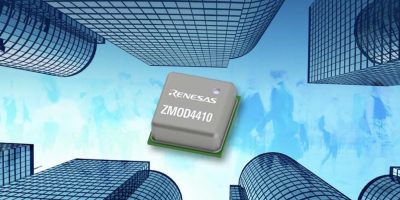
Renesas offers support for the Commercial & Public standards, as well as other environmental standards, through its ZMOD digital gas sensors. Both the ZMOD4410 indoor air quality sensor and the ZMOD4510 outdoor air quality sensor offer compliance with the standards. The ZMOD sensors offer customers the ability to configure the sensors through firmware with cloud-based connections. This enables both new and existing ZMOD customers to implement support for the building standards around the globe. A wide range of products can take advantage of this support, including HVAC systems, thermostats, smart appliances and smoke detectors.

“We are excited to see Renesas designing and producing sensors that align with green and healthy building standards,” said Stanton Wong, President, RESET International Standard, an organisation promoting data collection and continuous monitoring for buildings via standardisation. “As awareness of the health impact of environmental factors continues to grow, monitoring the performance of a building via sensors is the best way to understand and optimise for health in indoor spaces. We look forward to the technological innovations Renesas will bring to the industry.”

“Environmental sensors are a vital tool for ensuring the health and safety of occupants in public and commercial buildings,” said DK Singh, Sr. Director of the Sensor Solutions Business at Renesas. “By using our AI-enabled hardware and firmware platform, customers can easily implement advanced sensors that comply with various building air quality standards to provide a safer and healthier environment for people around the world.”

 Key Features of the ZMOD Digital Gas Sensors

  • Support for multiple standards for both indoor and outdoor air quality
  • Firmware configurable for unique flexibility with cloud connectivity
  • Artificial intelligence enables training of sensors
  • JEDEC JESD47 qualification ensures 10-year product life
  • Compensation engines support low-level part per billion (PPB) standard requirements
  • Senses TVOC (Total Volatile Organic Compounds), Ozone and Nitrogen Dioxide

Winning Combinations

Renesas has combined the sensors with other compatible devices from its portfolio, including MCUs, power devices, and wireless connectivity solutions to create multiple Winning Combinations, including the Gas Sensor with Cloud Connection for Industrial Applications. Winning Combinations are technically vetted system architectures from mutually compatible devices that work together seamlessly to bring an optimised, low-risk design for faster time to market. Renesas offers more than 300 Winning Combinations with a wide range of products from the Renesas portfolio to enable customers to speed up the design process and bring their products to market more quickly. All Renesas sensors are part of Renesas’ Quick-Connect development environments to ensure rapid prototyping with minimal coding.

Availability

Both the ZMOD4410 and ZMOD4510 sensors are available today, along with Commercial & Public firmware. The ZMOD4410-EVK and ZMOD4510-EVK evaluation kits are also available.

About Renesas Electronics Corporation

Renesas Electronics Corporation (TSE: 6723) empowers a safer, smarter and more sustainable future where technology helps make our lives easier. A leading global provider of microcontrollers, Renesas combines our expertise in embedded processing, analog, power and connectivity to deliver complete semiconductor solutions. These Winning Combinations accelerate time to market for automotive, industrial, infrastructure and IoT applications, enabling billions of connected, intelligent devices that enhance the way people work and live. Learn more at renesas.com. Follow us on LinkedIn, Facebook, Twitter, YouTube and Instagram.

> Read More

Socionext Introduces New 7nm ADC and DAC for 5G Direct RF Transmitters and Receivers

Socionext, a global leader in providing innovative custom System-on-Chip solutions for various applications including data center and networking,

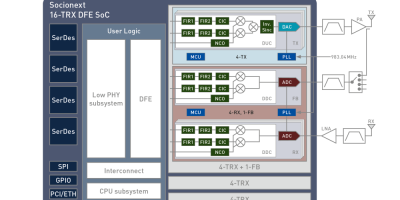
launches a new high-speed Direct RF data converter PHY solution. This is the latest in a series of IP offerings driving advanced transceiver systems for 3GPP 5GNR/LTE and Wi-Fi network infrastructure in the FR1 and FR2 (mmWave with external mixers) bands.

The IPs were developed in TSMC 7nm FinFET (N7) process technology to allow straightforward integration for 32TRX and 64TRX single-die solutions and lower power consumption compared to discrete solutions currently available in the market.

Both ADC and DAC have 12-bit resolution and analog bandwidth up to 7.2GHz. The ADC sampling rate is 24GS/s and 32GS/s for the DAC, enabling 5GNR FR1 frequency in the first Nyquist data converter frequency range.

This Direct RF IP product family delivers the full sub-6GHz instantaneous band with an internal capability to allocate up to 1.6GHz of channel bandwidth featuring carrier aggregation.  The maximum is 16 channels of 100MHz (FR1) each or 4 channels of 400MHz (FR2). Furthermore, by using the multiple DDC/DUC available in the macros, it is possible to target low-, mid- and high-range bands (e.g., n28, n40 and n78) simultaneously, without dedicated external filtering components. The result is a significantly reduced BOM.

Yutaka Hayashi, Corporate Senior Vice President and Head of BU (Data Center & Networking Business Unit) said: “Socionext’s new 7nm Direct RF silicon IPs are available for new product designs and mass production with a guaranteed short time-to-market made possible by Socionext’s global solid post-silicon supply chain. The Direct RF test chip and evaluation board are now sampling to select customers. A dedicated application board with full ADC/DAC and real-time streaming will be available in Q3, 2023”.

SoC Integration

The complete Socionext SoC solution includes a foundation of IP building blocks such as short, medium and long reach SerDes up to 112/224Gbps, PCIe Gen4/5/6 PHY, eFPGA, DDR and several standards-based, die-to-die interconnect technologies for managing data flow across the data infrastructure and chiplets on MCM.

This 7nm data-converter development follows numerous successful 16nm and 28nm designs using Socionext’s high-performance ADC and DAC design expertise for networking applications.

Socionext integrates these IPs into other solutions such as 5G CPE, satellite communications, software-defined radio, microwave radio, test & measurement equipment and early 6G research. In a market that requires high levels of system integration, small package size and low power design, Socionext’s Solutions are key differentiators for telecommunication and connectivity customers and for the most demanding environments utilizing expertise in leading-edge silicon technology and design methodology.

A Paper on the Direct RF ADC (Analog-to-Digital) converter was presented at the ISSCC in San Francisco. https://www.isscc.org – “A 750mW 24GS/s 12b Time-interleaved ADC for Direct RF Sampling in Modern Wireless Systems”.

About Socionext Europe GmbH

Socionext Europe (SNEU) plays a major role in the worldwide activities of Socionext Inc., one of the world’s leading fabless SoC suppliers. Its Headquarters is in Frankfurt, Germany with offices in Munich, Germany and Maidenhead, UK. The Munich Design and Support Center, a leader in embedded graphic solutions, specializes in hardware and software product development for the automotive sector. Maidenhead supports Socionext’s IP Development & Engineering Center with a focus on ultra-high speed data conversion IP. Socionext Europe offers customers a range of innovative Custom SoC solutions for today’s state-of-the-art applications with total support from start to finish. For more information please visit our website, email: info@eu.socionext.com or connect with us on Facebook, LinkedIn, Twitter and YouTube.

> Read More

About Smart Cities

This news story is brought to you by smartcitieselectronics.com, the specialist site dedicated to delivering information about what’s new in the Smart City Electronics industry, with daily news updates, new products and industry news. To stay up-to-date, register to receive our weekly newsletters and keep yourself informed on the latest technology news and new products from around the globe. Simply click this link to register here: Smart Cities Registration