Rutronik introduces Cinterion’s complete product range to its offerings in the EMEA region. The strategic move enhances Rutronik’s capability to deliver a diverse selection of cutting-edge components, including mobile communication, Wi-Fi, Bluetooth, GNSS positioning modules, SIM solutions, and various cloud services, to meet individual customer requirements more effectively.
After Telit became Telit Cinterion on January 1, 2023, the company expanded its range of secure IoT solutions in the area of modules and mobile connectivity. The additional product portfolio is now added to Rutronik’s linecard. The family-owned company was already the largest distribution partner in the EMEA region and the additional components will further expand this successful partnership. Among other products, components like the compact 5G modem card MV32-W, the IoT module PLS83-W, and the wireless IoT module TX62 are now included.
“Rutronik’s dedication to maintaining substantial stock levels not only solidifies their position as a dependable distribution partner but also underlines their reliability in meeting the diverse and dynamic demands of the market,” said Rene Heckeler, Sales Director of Global Distribution, Telit Cinterion. “Together, we are poised to continue our joint journey, pushing the boundaries of IoT technology and further enriching the constantly evolving landscape of IoT solutions within the region.”
Tailor-made customer solutions thanks to highly innovative components and expertise
A key component of success is the combination of highly innovative products and expert knowledge. Rutronik’s Field Application Engineers (FAE) work hand in hand with the experts from Telit Cinterion to ensure an excellent consulting service. “Together, Rutronik and Telit Cinterion have committed to pooling their expertise at both the technology- and employee-level to transform the wireless IoT market in EMEA,” said Jens Rook, Senior Sales Director, Telit Cinterion. “Through continuous investment in training and skill development, we ensure that our teams offer the latest technological innovations and provide the highest level of service and support to our valued customers across the region.”
Daniel Barth, Senior Manager Product Marketing Wireless at Rutronik, adds: “Our aim is always to act in the interests of our customers and to offer the best solutions that are precisely tailored to their needs. With the combination of highly innovative components from Telit Cinterion, our expertise, and our services, we achieve exactly that. We are convinced that by expanding our product portfolio, we will continue to write our success story by offering our customers a comprehensive range of first-class wireless hardware, mobile contracts, and cloud services.”
The latest edition of the popular digital magazine e-TechJournal, entitled Fuelling the Future, is now available to download for free from Farnell.
Farnell, a fast and reliable distributor of products and technology for electronic and industrial system design, maintenance and repair, is inviting readers on a journey towards sustainable mobility by offering in-depth insights into advancements in EV charging technology, from automotive traction inverters to battery management.
Edition 6 of e-TechJournal includes articles exploring:
· Current Market and Technological Developments in Automotive Traction Inverter Systems
· EV Charging and Battery Management – Ensuring Optimal Performance and Lifespan
· EV Charging and Renewable Energy: Maximising Sustainability in Transportation
· Bring on the electric revolution – Enable fast, low-cost and sustainable charging everywhere
· The Advantages and Challenges of Electric Vehicles
· EV Charging Standards: Ensuring Compatibility and Safety in the Charging Process
· Powering Up with Safety and Ease: The Art of EV Charger Design
Cliff Ortmeyer, Global Head of Technical Marketing at Farnell, and Editor of e-TechJournal, said: “EVs are driving sustainable transportation, undoubtedly marking a profound transformation in the automotive landscape. In this instalment of e-TechJournal, we embark on an electrifying journey into the world of Electric Vehicles and explore cutting-edge technological developments shaping sustainable mobility.
“By downloading the latest edition, our loyal readers can uncover how renewable energy integration and emerging technologies like wireless charging revolutionise the EV charging experience and join us in our quest for seamless, safe, and user-friendly EV chargers as we head together towards a greener future.”
Issued quarterly, e-TechJournal provides in-depth technical insight into the latest technologies, along with analysis and explanations from supplier partners, industry experts, and Farnell engineers on key new trends shaping today’s electronics industry. In each edition, a different essential technology is the challenge’s focus.
Knowing the pH value of a liquid is essential in many industries. Nearly every industry that handles liquids needs a measurement system for pH. Obviously, it is important for waste water systems and waste water plants, but did you know that the water from a brewery needs to have a special pH value before it reaches the sewage water system? This design tip is intended to help adding high precision isolation to water treatment systems.
This article discusses the addition of high precision isolation to a system. This is essential for monitoring water pH that is located far from the system, monitoring differing ground levels, or for protecting a system from high voltage when an error occurs.
The pH value is a measure of the acidity or basicity of an aqueous solution. It is a unitless number and is defined as the negative common logarithm of the hydrogen ion activity according to the following equation:
Precision isolation is a critical part of water and pH monitoring systems.
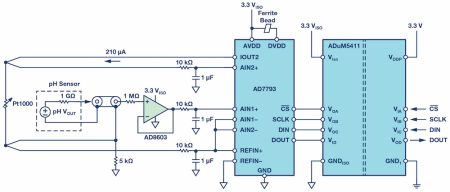
Pure water is defined as having a pH value of 7, while acids have values of less than 7 and bases have values above 7. So-called indicators that change colour according to the pH value are often used for measuring the pH. However, this measurement only provides a rough estimate. The circuit shown in Figure 1 is intended for evaluation of combined glass electrodes. It has an accuracy of 0.5% for the pH range from 0 to 14 and is temperature compensated. The circuit supports a large range of pH sensors, which can have high impedance values from 1MΩ to a few GΩ.
Figure 1. pH sensor circuit with combined electrode (simplified).
The pH Electrode
The pH probe consists of a measuring electrode and a reference electrode, which is comparable to a battery. If the probe is dipped into a test solution, the measurement electrode generates a voltage depending on the hydrogen ion activity. A typical output value is 59.14mV per unit of pH at 25°C. Due to the temperature dependency, this value can rise to 70mV/pH. This voltage is compared with the reference electrode. If the test solution is acidic (low pH), the potential at the probe output is greater than 0; for a basic solution, it is less than 0. The output value can be calculated using the following equation:
where:
E is the output voltage of the probe.
E0 is the standard electrode potential (typically 0V), dependent on the probe. R is the universal gas constant. R = 8.31447 J mol−1 K−1.
T is the temperature in Kelvin.
n is the number of transferred electrons (or equivalent number). F is the Faraday constant. F = 96485.34 C mol−1.
pH is the hydrogen ion concentration of unknown solution. pHREF = 7, reference value of reference electrode.
The Circuit
The three main elements of the circuit are the buffer for the probe, the ADC, and the isolator with the voltage transmission. The buffer op amp AD8603 was selected because it has low power consumption, low noise, and extremely low input bias current. The low input bias current of typically 200fA ensures that the voltage drop due to current flow across the internal resistor of the probe is minimised. Another important component is the ADC, represented here by the AD7793, a 24-bit ∑-Δ converter with an integrated power source and programmable amplifier. The integrated current source generates the current that flows through the Pt1000. With this, the temperature measurement needed for compensation in the processor is performed. The same current also flows through the 5kΩ resistor (0.1% tolerance), which thereby generates the reference voltage of 1.05V. As a second function, the resistor boosts the common-mode voltage. Through this and through selection of the reference voltage, the input range of the ADC is fully utilised: the probe outputs ±414mV – a maximum ±490mV. The isolator is the ADuM5411, an isolated dc-to-dc converter that simultaneously provides for isolation of the SPI interface of the ADC.
Circuit Characteristics
To achieve high accuracy, the op amp was selected with a typical input bias current of 200fA, which leads to a maximum voltage offset of 0.2mV at the probe impedance of 1GΩ. This corresponds to an error of 0.0037 units of pH at 25°C. Even with a maximum input bias current of 1pA, the maximum offset error is very low, at 1mV. In order not to give away this good starting position, it is advisable to take suitable layout measurements by using, for example, a guard ring, shielding, and other techniques that are not affected by very low currents. At the selected data rate of 16.7Hz and a gain of 1, the noise generated by the ADC is approximately 2µVrms. If the calculation is done with a peak-to-peak noise of 13µV, the accuracy of the pH value is 0.00022 units of pH. If the noise from the amplifier and the noise from the ADC are taken together, this yields 0.00053 units of pH – and, hence, the offset error is much more significant.
Conclusion
The circuit shown here is a simple, very precise, and power-saving variant for pH sensor readings. Once the circuit has been calibrated, an accuracy of 0.5%, corresponding to 0.005 units of pH can be achieved. Thanks to the isolation, it is suitable for numerous applications.
About the Author
Thomas Tzscheetzsch joined Analog Devices in 2010, working as a senior field applications engineer. From 2010 to 2012, he covered the regional customer base in the middle of Germany and, since 2012, has been working in a key account team with a smaller customer base. After the reorganisation in 2017, he’s leading a team of FAEs in the IHC cluster in CE countries as FAE manager. He can be reached at thomas.tzscheetzsch@analog.com.
CEA-Leti has announced a new R&D initiative to contribute to a higher level of vehicle automation and cooperation by expanding the latest developments in vehicular wireless communications that improve reaction time, pedestrian detection and overall vehicle performance.
Combining learnings from its participation in three EU H2020 projects, CEA-Leti scientists have consolidated the institute’s expertise in vehicle-to-everything (V2X) communication technologies and standards. Their focus includes evaluating and demonstrating connected and cooperative vehicular systems to improve automation and help ensure the safety of vulnerable road users, such as pedestrians, workers and cyclists.
“The ultimate goal of our ongoing work is to help our partners in the automotive and related industries understand and adopt the benefits of V2X cooperative communications for improved safety, efficiency and automation performance,” said Benoît Denis, research scientist on radio localisation and project manager at CEA-Leti.
The H2020 studies included integrating a dedicated simulation flow for system-level evaluation of different short- and long-range radio technologies, such as IEEE802.11.p/bd, C-V2X sidelink or 5G-NR. They also investigated different architecture and infrastructure options, including roadside units, 5G base stations and MEC servers.
“Most important, a simulation tool the team developed was used to measure the actual impact of observed communication network performance in terms of latency, link reliability, coverage and load, on the critical vehicular applications,” explained Valérian Mannoni, research scientist on communication protocol and project manager at CEA-Leti. “These include service availability and continuity, level of automation allowed, time to collision and other primary key parameters.”
Denis said that while V2X communication technologies and protocols were initially developed to improve road safety through cooperation, the growing use of autonomous fleets of collaborative robots and drones raises similar research questions and challenges in a variety of complex mobile operating contexts.
“The cooperative communication approaches developed for vehicles could therefore also be used for collision avoidance and cooperative manoeuvres by autonomous robots in smart factories,” he said.
Mannoni said that as a result CEA-Leti also is exploring possible extensions of these H2020 studies in application fields for which standardisation is still in its infancy, notably in connection with 6G, which could include cooperative robotics and digital twinning in factories of the future.
About CEA-Leti (France)
CEA-Leti, a technology research institute at CEA, is a global leader in miniaturisation technologies enabling smart, energy-efficient and secure solutions for industry. Founded in 1967, CEA-Leti pioneers micro-& nanotechnologies, tailoring differentiating applicative solutions for global companies, SMEs and startups. CEA-Leti tackles critical challenges in healthcare, energy and digital migration. From sensors to data processing and computing solutions, CEA-Leti’s multidisciplinary teams deliver solid expertise, leveraging world-class pre-industrialization facilities. With a staff of more than 2,000 talents, a portfolio of 3,200 patents, 11,000 sq. meters of cleanroom space and a clear IP policy, the institute is based in Grenoble, France, and has offices in Silicon Valley, Brussels and Tokyo. CEA-Leti has launched 75 startups and is a member of the Carnot Institutes network. Follow us on www.leti-cea.com and @CEA_Leti.
Technological expertise
CEA has a key role in transferring scientific knowledge and innovation from research to industry. This high-level technological research is carried out in particular in electronic and integrated systems, from microscale to nanoscale. It has a wide range of industrial applications in the fields of transport, health, safety and telecommunications, contributing to the creation of high-quality and competitive products.
This news story is brought to you by smartcitieselectronics.com, the specialist site dedicated to delivering information about what’s new in the Smart City Electronics industry, with daily news updates, new products and industry news.
To stay up-to-date, register to receive our weekly newsletters and keep yourself informed on the latest technology news and new products from around the globe. Simply click this link to register here: Smart Cities Registration
This website uses cookies to improve your experience. We'll assume you're ok with this, but you can opt-out if you wish.AcceptRead More
Privacy & Cookies Policy
Privacy Overview
This website uses cookies to improve your experience while you navigate through the website. Out of these, the cookies that are categorized as necessary are stored on your browser as they are essential for the working of basic functionalities of the website. We also use third-party cookies that help us analyze and understand how you use this website. These cookies will be stored in your browser only with your consent. You also have the option to opt-out of these cookies. But opting out of some of these cookies may affect your browsing experience.
Necessary cookies are absolutely essential for the website to function properly. This category only includes cookies that ensures basic functionalities and security features of the website. These cookies do not store any personal information.
Any cookies that may not be particularly necessary for the website to function and is used specifically to collect user personal data via analytics, ads, other embedded contents are termed as non-necessary cookies. It is mandatory to procure user consent prior to running these cookies on your website.