Arrow Electronics launches robotics solutions resources

Arrow Electronics has developed and launched a set of resources to help members of the electronics community better understand the advancements in the rapidly evolving robotics landscape.

Arrow has created a robotics playbook containing insights and component recommendations to help companies get products to market faster, as well as a series of webinars that will be taking place over the coming weeks. The Robotics Solutions landing page also allows users to dive into supplier offerings and discover the solutions that best fit their needs.

Robots and autonomous machines are transforming industries by enhancing efficiency, improving safety and reducing costs across a wide range of applications. Arrow works with leading suppliers to provide innovative robotic technologies, including autonomous mobile robots with AI-driven navigation, collaborative robots (cobots) designed to safely work alongside humans and drones for tasks, such as aerial surveillance and delivery.

Two webinars are currently available on demand. The first, ‘Industrial Evolution: How to Leverage the Power of AI/ML and Robotics’ presented by Arrow and Microchip, explores how Microchip’s cutting edge technologies in secure authentication, predictive maintenance, smart embedded vision and multi-axis motor control are revolutionising design processes.

The second, ‘Advance Edge AI and Robotics Development with NVIDIA Full-Stack Accelerated Computing Platform’ presented by Arrow and NVIDIA, demonstrates how NVIDIA’s Jetson platform, foundational AI models and Isaac ROS workflows are transforming robotics with edge AI. It also shares practical frameworks for building autonomous systems and explores real-world case studies showcasing rapid development.

Arrow will also be hosting two further webinars, the first on the 19th March with Qualcomm, and the second on the 25th March with NXP .

https://www.arrow.com

> Read More

Article from Analog Devices: Generation of low noise voltages

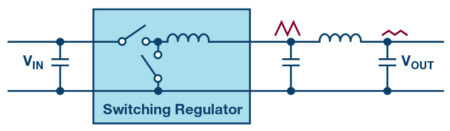
Linear regulators are outstanding for filtering voltages generated by switching regulators. Switching regulators always have a certain amount of output voltage ripple. In many applications in which very small signals are processed, this ripple can cause interference. Passive components are regularly used to filter the output voltage of a switching regulator, but passive filters such as LC filters (see Figure 1) have a few disadvantages. Depending on the required cutoff frequency of the filter, the space requirements can sometimes be quite considerable, and inductors can be costly. However, the biggest disadvantage of a passive filter is that the filter adds certain losses and output voltages (as with VOUT in Figure 1) that vary based on the operating current. The dc regulation accuracy of the generated voltage is hence quite low.


Figure 1. A passive filter at the output of a switching regulator.

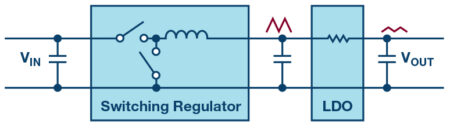
Linear regulators are often used instead of passive LC filters for cleaning up the voltages generated by switching regulators. They frequently have very high power supply rejection ratios (PSRRs). This means that the input ripple of the linear regulator is – for the most part – blocked so that the output ripple of the linear regulator is very low. In addition, the output voltage of a linear regulator has its own closed loop and is hence well regulated and highly accurate.
Linear regulators also differ in terms of a very important specification, the noise that they generate themselves through their internal reference voltages and their internal error amplifiers. In applications that require low interference (low noise), the interference generated by the linear regulator plays a major role. Ultralow noise linear regulators are available for this.

Figure 2. A linear regulator as an active filter at the output of a switching regulator.

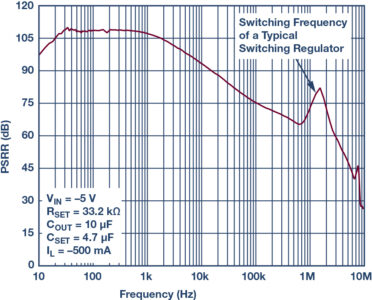
The concept of filtering a voltage generated by a switching regulator with a linear regulator is shown in Figure 2. This scheme not only works for positive voltages but also for negative voltages. A typical use case is a circuit in which a bipolar signal between –5V and +5V must be very accurately measured and digitised with an analogue-to-digital converter. The input stage of the signal path requires a low noise bipolar supply with a positive and a negative voltage. For the positive voltage, there are many linear regulators offering high PSRRs and quite low interference on the market. Especially for highly critical applications, Analog Devices offers numerous solutions. For negative voltages, however, there are only a few linear regulators for such an application. For example, the new LT3094 can be used to filter negative voltages at a very high PSRR and features extremely low noise levels important for applications that respond sensitively to interference coming from the power supply. Figure 3 shows the PSRR of the LT3094 at different frequencies. For a switching regulator with a switching frequency of 1MHz, the LT3094 linear regulator offers a PSRR of about 75dB. The noise level of the LT3094 lies at just 0.8μV rms between 10Hz and 100kHz.

Figure 3. Power supply rejection ratio of the LT3094 linear regulator for negative voltages.

Linear regulators can filter out power supply ripple for both positive and negative output voltages. This type of filtering is also very useful for the negative voltage range. Due to the limited offering of special low noise types for negative voltages, it is difficult to find a suitable part. With the release of the new Power by Linear™ LT3094 from Analog Devices, a very low noise option with an exceptionally high PSRR is now available.

Article by Frederik Dostal, Field Applications Engineer, Analog Devices
Frederik Dostal can be reached at frederik.dostal@analog.com.

> Read More

DigiKey and Qorvo announce global distribution agreement

DigiKey and Qorvo has announced a worldwide distribution agreement. This collaboration will further enhance the awareness, availability and speed of delivery of Qorvo’s high-performance solutions to customers around the world.

The collaboration with DigiKey further extends Qorvo’s product reach across North America, EMEA and APAC regions, ensuring rapid delivery and additional support for customers in markets such as IoT, defence, aerospace, automotive, power and wireless infrastructure.

“For Qorvo, delivering innovative, high-performance solutions to our customers is a top priority, and our agreement with DigiKey reinforces that commitment,” said Corbin Graham, senior director of global distribution at Qorvo. “This collaboration expands global access to our products, ensuring our customers receive the advanced technologies they need with exceptional efficiency and support.”

DigiKey’s expansive product offering enables Qorvo’s customers to easily order entire bills of materials in one place and receive orders quickly and efficiently. This minimizes lead times and enhances project timelines.

“We are excited to partner with Qorvo to bring their innovative RF and power semiconductor solutions to our customers around the globe,” said Ken Paxton, director of advanced semiconductors at DigiKey. “By making Qorvo’s extensive portfolio easily accessible to engineers and innovators worldwide, we can propel industries like wireless, smart living, power, defense technology and automotive into the future.”

https://www.digikey.com/

> Read More

Infineon launches support for Apple Find My network accessories in ModusToolbox

Infineon has announced the availability of its Apple Find My network accessory support for the AIROC CYW20829, PSOC 63 Bluetooth microcontroller (MCU), AIROC CYW5591x Wi-Fi/BT connected MCU and AIROC CYW5551x within its ModusToolbox. The feature enables customers to easily build Find My network capable Bluetooth Low Energy (Bluetooth LE) devices that maximize battery performance.

The Apple Find My network — made up of over a billion Apple devices — provides an easy, secure way to locate compatible personal items using the Find My app on iPhone, iPad, Mac, or using the Find Items app on Apple Watch. The Find My network accessory program enables third-party companies to build finding capabilities into their products, letting users access Apple’s Find My app to locate and keep track of important items, even when they’re not nearby. The Find My network is anonymous and uses advanced encryption, meaning that no one else – not even Apple, Infineon, or Find My Network accessory manufacturers, can view a device’s location or information.

Infineon Technologies has added Apple Find My network functionality to its CYW20829, PSOC 63 Bluetooth MCU, CYW5591x Wi-Fi/BT connected MCU and CYW5551x via ModusToolbox. This enables customers who certify through the Apple Find My network accessory program to add Find My functionality to Bluetooth-enabled end-products, such as an e-bike, power tool, fitness tracker, key fob, smart watch, voice recorders, smart glasses, camera, etc.

“Apple Find My opens up a completely new feature for all Bluetooth IoT devices – the ability to locate them with your iPhone, iPad, Mac, or Apple Watch. We are excited to be part of this program with our Bluetooth and Wi-Fi connected MCUs,” said Shantanu Bhalerao, VP of Wireless Product Line at Infineon.

The CYW20829 MCU has a high-level of integration leading to a reduced bill-of-material (BOM) cost. It integrates a powerful 96 MHz Arm® Cortex®-M33 MCU and a secondary Arm Cortex-M33 dedicated for the Bluetooth controller. CYW20829 comes with 256 KB of application SRAM, an XIP capable Quad SPI interface to allow a flexible selection of external Flash, and a diverse range of peripherals, including CAN FD, PDM, I2S, ADC, timers.

The PSOC 63 MCU with AIROC Bluetooth Low Energy (LE) has dual-core 150-MHz Arm Cortex-M4 and 100-MHz Arm Cortex-M0+ processors, offering industry’s highest compute capability, optimised for AI/ML Edge applications. It integrates programmable analog front ends, industry-leading CAPSENSE touch sensing user interface, and Bluetooth LE radio. The PSOC 63 supports rich configurable MCU peripherals with 84 programmable GPIOs and six overvoltage-tolerant capable pins, making it suitable for a wide range of IoT applications.

The CYW5591x, ultra-low power single-chip Wi-Fi/BT connected MCU, 1×1, single/dual/tri-band Wi-Fi 6E, Bluetooth® Low-Energy 5.4, ARM TrustZone, PSA Level 2 certifiable and matter IC, has the low-power MCU delivers secure, reliable connectivity. The device is optimised for IoT including smart home, industrial, and portable devices, and can be used by itself or to offload connectivity from a host processor.

The CYW5551x, 1×1, single/dual/tri-band Wi-Fi 6/6E and Bluetooth/Bluetooth Low-Energy 6.0 Combo IC, has the high-performance, low-power single-chip combo delivers secure, reliable connectivity that goes beyond wireless standards. This optimized, power-efficient design is made for smart home, wearables, and small form-factor applications. It offers a cost-effective balance of advanced Wi-Fi 6/6E and Bluetooth/BLE features with performance and power savings for IoT connectivity needs.

AIROC products leverage a common software framework across Android, Linux, RTOS platforms and are pre-integrated with Infineon’s ModusToolbox software and tools, allowing developers to deliver high-quality, differentiated products to market on-time and on-budget.

https://www.infineon.com/Apple-Find-My

> Read More

About Smart Cities

This news story is brought to you by smartcitieselectronics.com, the specialist site dedicated to delivering information about what’s new in the Smart City Electronics industry, with daily news updates, new products and industry news. To stay up-to-date, register to receive our weekly newsletters and keep yourself informed on the latest technology news and new products from around the globe. Simply click this link to register here: Smart Cities Registration