Renesas Electronics’ PLC enables voice communication over power lines

Renesas Electronics’ PLC enables voice communication over power lines

> Read More

Bluetooth low energy module streamline development of connected smart objects

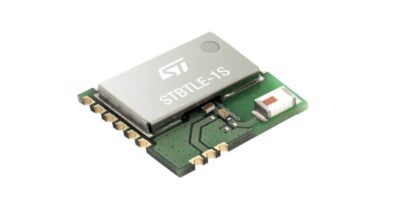
To help engineers and design teams streamline prototyping and development of connected smart objects, STMicroelectronics has created the SPBTLE-1S. It is a ready-to-use Bluetooth low energy module that integrates all the components needed to complete the radio subsystem, says STMicroelectronics. The SPBTLE-1S module integrates ST’s BlueNRG-1 application processor system on chip (SoC) and balun, high-frequency oscillators, and a chip antenna.

Developers can use this module to bypass hardware design and RF-circuit layout challenges, claims ST. The SPBTLE-1S is BQE-approved. Bluetooth Qualification Expert is a member of the Bluetooth Special Interest Group (SIG) qualified to verify product compliance and provide compliance-related services. It is also FCC, IC, and CE-RED (Radio Equipment Directive) -certified to simplify end-product approval for North America and EU markets.

ST’s Bluetooth 4.2 certified Bluetooth low energy protocol stack is included, and the supporting software development kit (SDK) contains a range of Bluetooth profiles and sample application code.

The module has a space-efficient 11.5 x 13.5mm outline. The supply voltage range is 1.7 to 3.6V, making the SPBTLE-1S module suitable for small, battery-operated objects powered by a primary button cell or rechargeable Li-ion battery, for example. High RF output power of +5dBm and good receiver sensitivity help to maximise communication range and reliability, adds ST.

The BlueNRG-1 SoC at the heart of the SPBTLE-1S implements the complete Bluetooth low energy physical layer (PHY), link layer, and network/application processing engine comprising a low power ARM Cortex-M0 core with 160kbyte flash, 24kbyte RAM with data retention, and a security co-processor.

The SoC also implements smart power management, with a DC/DC converter capable of powering the SPBTLE-1S module to ensure optimum energy efficiency. Users can leverage an extensive set of interfaces, including a UART, two I²C ports, SPI port, single-wire debug, and 14 GPIOs, as well as peripherals including two multifunction timers, a 10-bit ADC, watchdog timer and real-time clock, a DMA controller, and a PDM stream processor interface, which can be used for developing voice-controlled applications.

The SPBTLE-1S module is in production and available now.

Evaluation kits containing the SPBTLE-1S are also available. The STEVAL-IDB007V1M combines the module with MEMS pressure and temperature sensors, LEDs, push-buttons, and programming interface to run the provided demonstration software out-of-the-box. An Arduino-compatible connector is also featured on-board, which allows development of more complex applications by adding extra expansion boards. This evaluation board is firmware-, software- and hardware-compatible with the existing STEVAL-IDB007V1 platform based on the BlueNRG-1 SoC.

The STEVAL-BLUEMIC-1 small form factor evaluation board features a MEMS microphone and an inertial module containing a MEMS 3D accelerometer and gyroscope.

http://www.st.com

> Read More

LA, New York, and Chicago are the Smartest Cities in North America

Most U.S. States Are Embracing Digital Transformation to Shape Smart Cities

Los Angeles, New York, Chicago are the smartest cities in the United States based on a new ABI Research report on Smart Cities in North America. Cities were evaluated across various metrics such as deployment of LED streetlights, smart meters, renewable energy, electric mobility, smart parking, mobility-as-a-service (MaaS), vehicle-to-everything (V2X) technologies, smart waste, and first responder communications.

“New York is the leading city with the highest deployment of LED streetlights in the U.S., followed closely by Los Angeles,” says Raquel Artes, Industry Analyst at ABI Research. Chicago will have the highest upgrade of current legacy streetlights as the local government is targeting to replace 270,000 legacy streetlights with energy-efficient LED lights by 2021. SilverSpring Networks, Telensa, Philips, and GE are the key stakeholders in this space.

Additionally, Florida, New York, Miami, and Michigan are the leading cities that would likely have the highest deployment of V2X technologies due to government initiatives to boost road safety and accelerate the development of autonomous vehicles. Meanwhile, New York leads in the replacement of existing legacy pay phones with state-of-the-art kiosks called Links. Chicago and Kansas City have recently trial-launched smart Wi-fi kiosks. And, smart sanitation bins are gaining traction in Los Angeles, New York, Chicago, Tampa City, Philadelphia, San Diego, San Francisco and Texas.

While larger cities are focusing on large-scale deployment of smart city projects and experimental technologies, their smaller counterparts tend to prioritize projects based on more immediate tangible benefits such as cost savings, reduction of carbon footprint, and the overall improvement of quality of life.

Top smart city projects that aim to reduce carbon emissions and air pollution are:

  • Electric Mobility. Overall, Los Angeles, San Francisco and New York have the highest deployment of electric vehicles (EV) and EV charging stations in the U.S. Among medium-sized states, Oregon ranked first, followed by Colorado and Maryland. Among small area population states, Hawaii ranked first, followed by Vermont and Hampshire. This is driven by government mandates such as zero emission vehicle (ZEV) programs and Clean Energy Acts.
  • Solar PV. Los Angeles ranked first, followed by San Diego, and Phoenix with the highest deployments of solar PV technologies. Among mid-sized cities, Honolulu ranked first, followed by Albuquerque and New Orleans. Among smaller cities, Newark ranked first, followed by Cincinnati. 
  • Smart Meter. Among large states, California, Texas, and Florida were the leading states with the highest deployments of smart meters in the United States in 2016. Among medium-sized states, Maryland ranked first, followed by Alabama and Oklahoma. Among smaller states, Maine ranked first, followed by Idaho and Delaware.

These findings are from ABI Research’s Smart Cities in North America report. This report is part of the company’s Smart Cities & Smart Spacesresearch service, which includes research, data, and analyst insights


  • photo credit: ddpavumba
> Read More

Toshiba announces 256Gbyte microSD UHS-I card

The latest M203 microSD card available from Toshiba Electronics Europe offers premium features for mainstream users, including a 256Gbyte memory.   

The microSD UHS-I card has a read speed of up to R100Mbyte per second, claimed to be the highest speed rate reached in this entry level category in the Toshiba memory card portfolio. The microSD M203 card is shockproof, water resistant and x-ray proof, based on Toshiba Memory Corporation’s test results. The IPX7 standard involves the product being submerged in static tap water at room temperature to a depth of one metre, left for 30minutes and still being able to function when taken out of the water. Toshiba also reports that the card can function after carrying out the gravity fall from a height of five meters.

Available in memory capacities from 16 to 256Gbyte, it is targeted at the mainstream customer with a cost-effective entry-level design in the UHS-I category, explains Toshiba. The microSD M203 offers mobile users faster transfer speed and the ability to add 256Gbyte of memory to smartphones, allowing users to download more apps and carry large amount of contents on their devices without concern about storage limitations. The ability to combine greater capacity is due to Toshiba 3D Flash Memory (BiCS FLASH) architecture, says the company.

The ultra-high-speed (UHS) microSD M203 can be obtained in three different blister-pack versions with an adapter for mobile phone, camera or PC use as well as a version without an adapter for phone use only. The shock- and waterproof card will also be offered as a mobile bundle, including the card and a mobile phone either with or without an adapter.

The microSD M203 will make its European debut at the IFA exhibition in Berlin running from 1-6 September 2017.Visit Toshiba in Hall 17, Stand 104.

Card shipments to distributors and retailers will commence in January 2018.


http://www.toshiba.semicon-storage.com

> Read More

About Smart Cities

This news story is brought to you by smartcitieselectronics.com, the specialist site dedicated to delivering information about what’s new in the Smart City Electronics industry, with daily news updates, new products and industry news. To stay up-to-date, register to receive our weekly newsletters and keep yourself informed on the latest technology news and new products from around the globe. Simply click this link to register here: Smart Cities Registration