
Xiaomi Selects Bluetooth Mesh Technology from Silicon Labs for New Smart Home Products

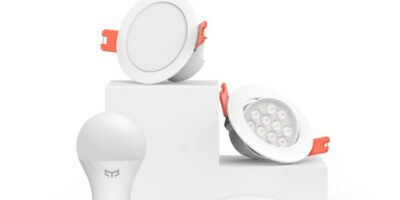
Xiaomi launches new smart home products using Bluetooth mesh networking technology from Silicon Labs. The new products from Mi Ecosystem partners include smart LED light bulbs, candle bulbs, downlights and spotlights. The voice-assistant XiaoAi smart alarm clock serves as a gateway to control smart Bluetooth mesh lights through voice commands.

“Silicon Labs is a valued technology partner providing best-in-class wireless hardware and software, development tools and local engineering support for Mi Ecosystem partners in the China market,” said Yanlu Zhang, RD Director of Xiaomi IoT platform. “Silicon Labs’ Wireless Gecko platform provides the connectivity options, design flexibility, ease of use and security features our ecosystem partners need to simplify smart product design and accelerate time.”

The new Xiaomi smart home products use EFR32BG Wireless Gecko system-on-chip (SoC) devices running Silicon Labs’ Bluetooth mesh protocol stack. Wireless Gecko SoCs offer an optimal combination of features and capabilities including high transmit power and a +125 oC temperature rating for Xiaomi’s application requirements.

“We are seeing increasing deployment of Bluetooth mesh in China’s fast-growing smart home market, and Xiaomi is poised to ship mesh-enabled smart home products at scale, driving further adoption of this versatile, ubiquitous wireless technology,” said Matt Johnson, Senior Vice President and General Manager of IoT products at Silicon Labs. “We look forward to collaborating with Xiaomi and Mi Ecosystem developers on future products leveraging our Wireless Gecko hardware and software platform.”

Silicon Labs is a leader in Bluetooth innovation, delivering ultra-small Bluetooth SiP modules, multiprotocol SoCs supporting Bluetooth commissioning, and software tools and stacks to simplify Bluetooth development. Silicon Labs is also the leading supplier of silicon and software for mesh networking applications. The company has shipped more than 150 million mesh networking SoCs and modules and has more than 15 years of experience in developing standards-based mesh networking solutions for customers worldwide.

https://www.silabs.com
> Read More

CUI includes digital and analogue MEMS microphones for portable devices

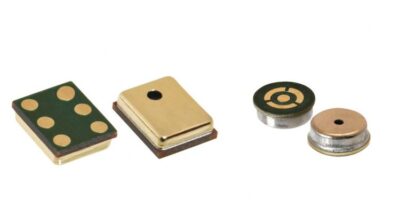
MEMS microphones from CUI are designed for portable devices. The CMM series has been added to CUI’s Audio Product group. They are compact, with a low profile and measure just 2.75 x 1.85 x 0.95mm.

The reflow solder compatible components can be used where surface mount assembly is required, such as audio recording and voice capture in smart phones, tablets, smart home devices and wearables.

The MEMS microphones are omni-directional and available in analogue or digital pulse density modulation (PDM) output types with top or bottom port locations. Offering round or rectangular form factors, the CMM series models carry sensitivity ratings from -44 up to -26dB and signal to noise ratios from 57 up to 65dBA. The MEMS microphones are also claimed to deliver reduced vibration sensitivity, low current draw down to 80 microA, and operating temperature ranges from -40 up to +105 degrees C. Sensitivity tolerances are as low as ±1.0dB, making the CMM series particularly suitable for performing functions such as beam forming and noise cancellation.

The inner chamber construction provides a stable performance, claims CUI, and protects the silicon-based microphones against moisture and dust.

The CMM series is available immediately.

https://www.cui.com

> Read More

Osram and GaN Systems develop fast laser driver for lidar

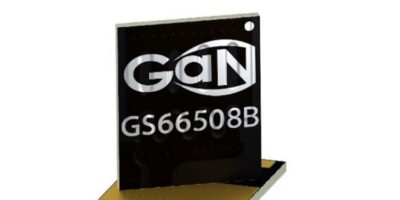
Optoelectronics specialist, Osram Opto Semiconductors, and GaN power semiconductor manufacturer, GaN Systems have collaborated on laser driver technology that enables longer range and higher resolution lidar architectures.

Osram’s laser portfolio for lidar includes the SPL DS90A_3 with a peak power of 120W at 40A. The company plans to release a four-channel SMT laser in 2019. The additional channels increase the field of view (FoV) and total peak power, with each channel being capable of generating 120W.

One of the issues with lidar technology has been its inability to transmit lasers at short pulses, while maintaining high peak power, which is necessary to ensure that the lidar with a long range and high resolution is safe to the human eye. To address this need, the two companies have developed a laser driver with a one nanosecond pulse rise time, while driving all four channels at 40A each to deliver 480W peak power. This peak power can be modulated at low-duty cycles to produce high resolution 3D cloud points at long range for new lidar designs.

Scanning lidar is used in advanced driver assistance systems (ADAS). Devices react instantly to potential collisions without wasting precious seconds of reaction time. Scanning lidar creates high-resolution 3D images of a car’s surroundings and registers obstacles early enough for ADAS, or self-driving cars, to initiate the appropriate driving manoeuvres, such as braking.

http://www.osram-os.com

> Read More

Solid-state lidar improves detection distance for vehicles

At this week’s CES 2019 (8 to 12 January) in Las Vegas, USA, RoboSense will demonstrate an upgraded version of its MEMS solid-state lidar, an automotive grade version designed for the mass production of autonomous vehicles. The RS-LiDAR-M1 has patented MEMS technology and offers vehicle intelligence awareness to a level that fully supports Level 5 driverless automated driving. The company also claims a breakthrough on the measurement range limit based on 905nm lidar with a detection distance to 200m. As a result, says the company, the upgraded optical system and signal processing technology can now clearly recognise even small objects, such as railings and fences.

The first generation MEMS solid-state lidar RS-LiDAR-M1Pre was launched at last year’s CES and was loaded on the Cainiao unmanned logistics vehicle in May 2018. This year the company will be showcasing the potential of its MEMS optomechanical system design, with improvements in detection distance, resolution, field of view (FoV) and reliability.

The RS-LiDAR-M1 MEMS optomechanical lidar provides an increased horizontal field of view compared to the previous generation, reaching 120 degrees FoV; only a few RS-LiDAR-M1s are needed to cover the 360 degrees field of view. It also means that with only five RS-LiDAR-M1s, there is no blind zone around the car with dual lidar sensing redundancy provided in front of the car for a Level 5, i.e. full driverless – driving.

The company believes that the battle between 1550 and 905nm lidar is about cost and performance. When aiming for a low-cost 905nm lidar, it is necessary to overcome the technical difficulties of achieving sufficient measurement range. The RS-LiDAR-M1 achieves what the Robosense describes as a breakthrough on the measurement range limit based on the 905nm lidar, with a detection distance to 200m.

The final output point cloud effect means that the RS-LiDAR-M1 has improved detection capability via the upgraded optical system and signal processing technology, which can now clearly recognise even small objects, such as railings and fences.

http://www.robosense.ai

> Read More

About Smart Cities

This news story is brought to you by smartcitieselectronics.com, the specialist site dedicated to delivering information about what’s new in the Smart City Electronics industry, with daily news updates, new products and industry news. To stay up-to-date, register to receive our weekly newsletters and keep yourself informed on the latest technology news and new products from around the globe. Simply click this link to register here: Smart Cities Registration