
Farnell element14 offers Arm-based dev board to accelerate AI design

Availability of the Ultra96 development board has been announced by distributor, Farnell element14. The Arm-based Ultra96 development board was jointly created by Avnet, Xilinx, and 96Boards and is based on the Linaro 96Boards Consumer Edition specification. It features the Zynq UltraScale+ MPSoC with 2Gbit (512M x32) LPDDR4 RAM from Micron, 802.11b/g/n Wi-Fi and Bluetooth 4.2, one USB 3.0 Type Micro-B upstream port (for a device) and two USB 3.0 and one USB 2.0 Type A downstream ports (for hosts).

According to Farnell, it provides developers with a powerful environment to simplify machine learning. The 96Boards’ specifications are open and define a standard board layout for development platforms.

The Ultra96 is designed to offer a range of peripherals and has programmable logic acceleration engines for ‘complexity with simplicity’ according to the company. The Ultra96 allows software developers to accelerate the development process for applications that require intense processing and high performance in areas such as artificial intelligence (AI), machine learning, virtual reality, the IoT and industrial control.

Cliff Ortmeyer, global head of solutions development for Premier Farnell and Farnell element14 said: “The Ultra96 board combines Arm processing with programmable logic in a convenient, low-cost and expandable board which showcases a wide range of potential peripherals and acceleration engines that will help design engineers counter software bottlenecks.”

The Ultra96 boots from the industrial rated Delkin 16GB MicroSD card (supplied with the Ultra96 board), and is preloaded with Embedded Linux. Design engineers can connect to the Ultra96 through a web server using its integrated wireless access point capability, or use the pre-loaded Embedded Linux plus Enlightenment Desktop via integrated Mini DisplayPort video output. Multiple application examples and on-board development options are provided as examples.

The board includes four user-controllable LEDs. Design engineers can also interact with the board through the 96Boards-compatible low-speed and high-speed expansion connectors by adding peripheral accessories such as those included in Seeed Studio’s Grove Starter Kit for 96Boards.

The Ultra96 development board is available from Farnell element14 in EMEA, Newark element14 in North America and element14 in Asia Pacific.

http://www.premierfarnell.com

> Read More

Infineon supports AI startups at the NVIDIA Inception Awards

Applications and systems infused with artificial intelligence (AI) are key technologies of the future and open up enormous business potential. As a sponsor of the NVIDIA Inception Awards, Infineon Technologies AG  supports Europe’s best startups in the area of AI, and thus the development of innovative deep learning applications. The awards will take place at the GPU Technology Conference (GTC) Europe on October 10, 2018 in Munich.

The German semiconductor company is working with Silicon Valley AI specialist NVIDIA to select the finalists from over 130 startups who have entered the Inception Awards. In the course of several preliminary rounds, fledgling entrepreneurs from around the world have presented their business models to a jury whose members include AI experts from Infineon. Finalists will compete in an exciting live pitch in front of a judging panel at GTC Europe in Munich.

“As one of the world’s leading providers of sensing technology, Infineon naturally empowers the application of AI by enabling things to see, hear and understand their environment,” said Oliver Henning, Head of Partnership Management in the Power Management & Multimarket Division of Infineon. “Our sensors precisely capture the data processed by learning AI networks. Therefore our sensors such as MEMS microphones and radar are the ears and eyes of the neural network.”

Deep learning systems, in which large amounts of data are used to train machines to perform a specific task, have become reality thanks to the availability of big data, improvements in algorithms, and advancements in computing power. The more effectively such systems are able to acquire and process data from sensors, the better they become at their assigned task.

This requires powerful computing capabilities, backed by reliable and efficient power supplies for servers and critical infrastructures, such as 5G for the ever-increasing volume of data. With its XENSIV TM sensors, power semiconductors or OPTIGA™ hardware-based security solutions, Infineon provides intelligent, energy-efficient and secure IoT solutions – for autonomous driving, smart cities and devices, and Industry 4.0.

About the competition

Together with NVIDIA, Infineon whittled down over 130 applicants to reach a shortlist of the 60 most promising startups. These companies then presented at a number of pitch events held in London, Paris and Munich. The judges, including Infineon representatives, met the founders in person and familiarised themselves with the business models of each company. Ten finalists will be selected to present at GTC Europe in October, and the winner will be chosen by a specialist jury of investors and GPU Venture experts to receive $100,000 and a DGX Station personal AI supercomputer.

> Read More

H-bridge motor driver IC meets demand for low voltage, high current drive

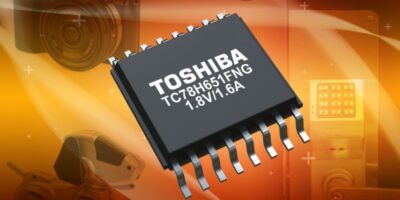
For DC brushed motors and stepping motors, the TC78H651FNG is a dual H-bridge driver IC announced by Toshiba Electronics Europe.

The TC78H651FNG delivers performance at a low voltage (down to 1.8V) and high current (up to 1.6A) for equipment powered by dry-cell batteries. It is suitable for motor applications such as cameras and compact printers using 3.7V lithium-ion batteries, toys and home appliances, smart meters, and electronic locks using two 1.5V dry batteries, and devices using 5V USB power supplies.

IoT advances and wireless technologies are driving demand for applications that can be remotely controlled by smartphones and tablets, in turn stimulating demand for battery-powered motor control, argues Toshiba. Existing H-bridge driver ICs use bipolar technology which is stable at low voltage. However, the associated high levels of current consumption shorten battery life and increase losses leading to reduced motor torque.

The TC78H651FNG uses Toshiba’s DMOS process that is suitable for low voltage drives to reduce losses and current consumption, ICC is around 0.6mA in operating mode and virtually zero when in standby mode, claims Toshiba. This achieves a longer battery life and stable low voltage operation. The reduced on resistance of 0.22 Ohm for the high and low sides combined reduces IC losses and improves torque in the motor, even when powered at 1.8V.

The device is housed in a 5.0 x 6.4mm, 0.65mm pitch TSSOP16 package and supports forward, reverse and stop rotation modes. Inbuilt error detection functions for over-current protection, thermal shutdown and under-voltage lockout all contribute to ensuring a safe system.

http://toshiba.semicon-storage.com

> Read More

Akida architecture SoC places AI at the edge

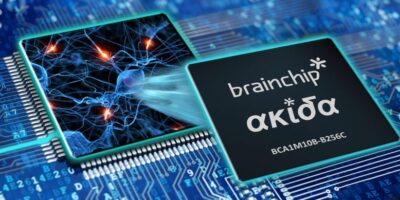
Claiming to be the first company to bring a production spiking neural network architecture, the Akida Neuromorphic system-on-chip (NSoC), to market, BrainChip describes the NSoC as suitable for edge applications such as advanced driver assistance systems (ADAS), autonomous vehicles, drones, vision-guided robotics, surveillance and machine vision systems.   

The Akida NSoC is small, low cost and low power, adds the company. It is scalable, allowing users to network many Akida devices together to perform complex neural network training and inferencing for many markets including cybersecurity, financial technology and agricultural technology.

“The artificial intelligence acceleration chipset marketplace is expected to surpass US$60 billion by 2025,” said Aditya Kaul, research director at Tractica. He added: “Neuromorphic computing holds significant promise to accelerate AI, especially for low-power applications. As many of the technical hurdles are resolved, the industry will see the deployment of a new class of AI-optimised hardware over the next few years.”

The Akida NSoC uses a pure CMOS logic process, ensuring high yields and low cost. Spiking neural networks (SNNs) are inherently lower power than traditional convolutional neural networks (CNNs), as they replace the math-intensive convolutions and back-propagation training methods with biologically inspired neuron functions and feed-forward training methodologies.

BrainChip’s research has determined the optimal neuron model and training methods, bringing unprecedented efficiency and accuracy. Each Akida NSoC has effectively 1.2 million neurons and 10 billion synapses, representing 100 times better efficiency than neuromorphic test chips from Intel and IBM. Comparisons to leading CNN accelerator devices show similar performance gains of an order of magnitude better images/second/watt running industry standard benchmarks such as CIFAR-10 with comparable accuracy.

The Akida NSoC is designed for use as a standalone embedded accelerator or as a co-processor. It includes sensor interfaces for traditional pixel-based imaging, dynamic vision sensors (DVS), Lidar, audio, and analogue signals. It also has high-speed data interfaces such as PCI-Express, USB, and Ethernet. Embedded in the NSoC are data-to-spike converters designed to optimally convert popular data formats into spikes to train and be processed by the Akida Neuron fabric.

Spiking neural networks are inherently feed-forward dataflows, for both training and inference. Ingrained within the Akida neuron model are innovative training methodologies for supervised and unsupervised training. In the supervised mode, the initial layers of the network train themselves autonomously, while in the final fully-connected layers, labels can be applied, enabling these networks to function as classification networks. The Akida NSoC is designed to allow off-chip training in the Akida development environment, or on-chip training. An on-chip CPU is used to control the configuration of the Akida Neuron Fabric as well as off-chip communication of metadata.

The Akida development environment is available now for early access customers to begin the creation, training, and testing of spiking neural networks targeting the Akida NSoC. The Akida NSoC is expected to begin sampling in Q3 2019.

http://www.brainchip.com.

> Read More

About Smart Cities

This news story is brought to you by smartcitieselectronics.com, the specialist site dedicated to delivering information about what’s new in the Smart City Electronics industry, with daily news updates, new products and industry news. To stay up-to-date, register to receive our weekly newsletters and keep yourself informed on the latest technology news and new products from around the globe. Simply click this link to register here: Smart Cities Registration