

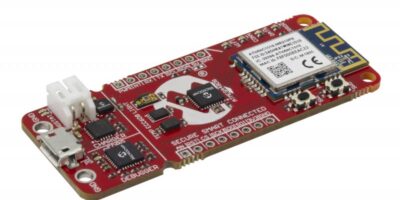
RS Components ships Microchip’s AVR Google Cloud development board

Distributor RS Components has announced the availability of Microchip’s AVR microcontroller IoT development board for Google Cloud. It is designed to enable engineers to achieve the fast prototyping of cloud-connected devices within minutes, adds the company.

Microchip’s AVR-IoT WG development board integrates the ATmega4808 AVR-based microcontroller, with a secure-element IC and a fully certified Wi-Fi network controller. The board works in conjunction with Google Cloud IoT Core, which offers an artificial intelligence and machine learning-based infrastructure in which is collects, processes and analyses data.

Developers can add cloud connectivity to a device via a free online portal at http://www.AVR-IoT.com. Microchip’s AVR devices are supported in the MPLAB X integrated development environment (IDE), meaning that once an IoT device is connected to Google Cloud, engineers can develop and debug their application in the cloud using rapid development tools such as Microchip’s MPLAB Code Configurator (MCC) or Atmel Start.

The AVR-IoT development board’s ATmega4808 processor is an eight-bit microcontroller that features core independent peripherals (CIPs) designed to deliver low power consumption. Sensing and actuation features make the board suitable fro real-time sensing and control applications.

An ATECC608A crypto-authentication IC delivers a trusted and protected identity for secure authentication of devices for the board. The crypto-authentication IC is delivered pre-registered on Google Cloud IoT Core and is ready for use with zero touch provisioning, claims Microchip. There is also a fully certified IEEE802.11-b/g/n IoT network controller, the ATWINC1510, which connects via an SPI.

Developers can use the board to create cloud-connected applications without requiring expertise in communications protocols, security or hardware compatibility, explains RS Components. In addition, they do not have to deal with security vulnerabilities or face the challenges generated with the use of large software frameworks and real time operating systems (RTOS).

The AVR-IoT WG development board (AC164160) is shipping from RS in the EMEA and Asia Pacific regions.

http://www.rs-online.com

> Read More

Secure virtualisation for NXP i.MX 8 and 8X processors protects critical systems

Green Hills Software has announced availability of its Integrity Multivisor secure virtualisation for NXP Semiconductors’ i.MX 8 and 8X applications processors. Using the certified separation architecture of the Integrity real-time operating system (RTOS) and its Multivisor secure virtualisation technology, manufacturers of critical automotive and industrial systems can, for the first time, run consumer operating systems in secure partitions alongside critical software applications on the same i.MX 8 processor, says Green Hills.

Manufacturers can consolidate Linux, Android and AUTOSAR with critical software on the same i.MX 8-based platform to design a scalable, mixed-criticality platform and with low, mid and high-end feature sets. The consolidation reduces hardware costs and simplifies software complexity, adds Green Hills.

Integrity and Integrity Multivisor are integrated with Green Hills Software’s advanced ASIL D/SIL 4 qualified development tools featuring the industry-leading C/C++ compilers, Multi integrated development environment, TimeMachine backward execution trace debugger, and MISRA C Adherence Checker. Software developers can use advanced tools to extract maximum performance from the i.MX 8 processors and reduce the time and cost to debug and test software. For example, the Multi debugger provides the programmer a time-synchronised and unified view and control of the many execution levels in a consolidated Linux system: Linux applications, Linux kernel and drivers, real-time applications, RTOS kernel and virtual machine monitor. In contrast, says Green Hills, competing debuggers require a patchwork of different and disconnected debugging setups from several different vendors.

The Integrity RTOS and Multivisor platform for NXP i.MX 8 and 8X families of applications processors includes support for secure virtualisation and separation technology. This allows ISO 26262 and IEC 61508-certified applications to co-exist with general-purpose code or guest operating systems. It also allows accelerated hardware virtualisation leveraging the Arm architecture virtualisation extension.

It also supports accelerated 3D graphics using i.MX 8 graphics processing unit (GPU), and the capability to share the GPU between the host RTOS and multiple guest operating systems, while ensuring the RTOS graphics applications have priority for meeting functional safety requirements.

Integrity and its set of integrated software and hardware tools for the NXP i.MX 8 and 8X families are used by customers today. Integrity Multivisor for the i.MX 8 and 8X is available today to early access customers.

http://www.ghs.com

> Read More

Low-power microcontrollers secure the IoT

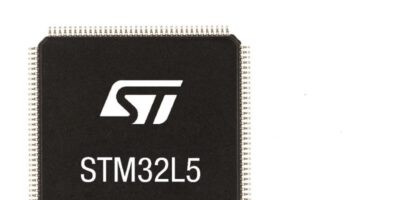
Building on Arm TrustZone hardware-based cyber protection for resource-constrained connected devices, the STM32L5 microcontroller has an Arm Cortex-M33 core.

The Cortex-M33 boosts protection for small devices by integrating Arm’s TrustZone hardware-based security, explains ST. The STM32L5-series microcontrollers add further enhancements including software isolation, secure boot, key storage, and hardware cryptographic accelerators. They also provide rich functionality, says the company, and long run-times powered by coin cells or energy harvesting.

They consume as little as 33nA in shutdown mode and achieving 402 ULPMark-CP in the EEMBC ULPBench. The microcontrollers also integrate low power techniques such as adaptive voltage scaling, real-time acceleration, power gating, and multiple reduced-power operating modes.

Integrated digital and analogue peripherals, and consumer and industrial interfaces such as CAN FD, USB Type-C, and USB Power Delivery, the STM32L5 microcontrollers can be used for products such as industrial sensors or controls, home-automation devices, smart meters, fitness trackers, smart watches, medical pumps or meters.

The TrustZone IP integrated in the STM32L5 series microcontrollers implements trusted-computing principles for authenticating devices connected to a network. There is the freedom to include or exclude each I/O, peripheral, or area of flash or SRAM from TrustZone protection, allowing sensitive workloads to be fully isolated for maximum security. ST has engineered TrustZone to ensure support for secure boot, special read-out and write protection for integrated SRAM and flash, and cryptographic acceleration including AES 128/256-bit key hardware acceleration, private key acceleration (PKA), and AES-128 On-The-Fly Decryption (OTFDEC) to protect external code or data. Active tamper detection and support for secure firmware install are also included.

In addition to the flexible power-saving operating modes and ST’s low-power technologies, the STM32L5 series also features a switched-mode step-down regulator that improves low-power performance when the VDD voltage is high enough and can be powered up or down on-the-fly.

The microcontrollers achieve up to 165 DMIPS/427 CoreMark using the ST ART Accelerator at 110MHz. The ST ART Accelerator now supports both internal flash and external memory with an 8kbyte instruction cache for greater efficiency in case the software runs out of external memory.

512kbyte dual-bank flash allows read-while-write operation to aid device management and ensures a high level of safety by supporting error correction code (ECC) with diagnostics. There is also a 256kbyte-SRAM and features to support high-speed external memory including single, dual, quad, or octal SPI and Hyperbus Flash or SRAM, and an interface for SRAM, PSRAM, NOR, NAND or FRAM.

The STM32L5 series also introduces new digital peripherals including USB Full Speed with dedicated supply allowing customers to keep USB communication even when the system is powered at 1.8V. There is also a UCPD controller compliant with USB Type-C Rev. 1.2 and USB Power Delivery Rev. 3.0 specifications.

Analog features include an ADC, two power-gated DACs, two low-power comparators, and two operational amplifiers with external or internal follower routing and programmable-gain amplifier (PGA) capability.

The STM32L5 series is available in standard temperature grade for consumer and commercial applications, or high-temperature grade specified from -40 to +125 degree C.

STM32L5-series microcontrollers are sampling now and scheduled to begin production in Q2 2019.

http://www.st.com/stm32l5

> Read More

Temperature sensors boast ‘smallest five-channel’ model

Five 1.8V temperature sensors released by Microchip include what the company claims is the industry’s smallest five-channel temperature sensor with standard lead spacing.

The EMC181x temperature sensor family also introduces system temperature rate-of-change reporting, a feature that provides advanced warning on how the temperature of a system is fluctuating.

The temperature sensors enable designers to reduce power consumption and lower system voltage in applications such as the internet of things (IoT) and personal computing devices in which temperature measurement is central to functionality.

The ability to monitor temperature at multiple locations with a single, integrated temperature sensor reduces board complexity and simplifies design. The EMC181x temperature sensor family offers a variety of remote channels at 1.8V operation to fit different design needs, ranging from two to five channels. The family is suitable for applications migrating from 3.3V systems to lower voltage rails, such as battery-operated IoT applications, personal computing devices, field programmable gate arrays (FPGAs) and graphics processing units (GPUs). The EMC181x family is register- and voltage-compatible with Microchip’s popular 3.3V EMC14xx temperature sensors for migration to 1.8V. The three-channel sensor is available in an eight-pin 2.0 x 2.0mm footprint and the five-channel in a 10-pin 2.0 x 2.5mm footprint. The sensors can also reduce the number of devices needed for remote temperature monitoring.

The sensors can measure the system temperature rate-of-change, making the EMC181x devices the industry’s first to offer two-dimensional temperature sensing. As well as reporting on the regular temperature, 2D sensing notifies user of the rate of temperature change in a system and shares data that can help to better regulate applications.

The sensors are suitable for closed control loop systems and other applications that prioritise lower voltage rails. The system provides an early notification of rising or falling temperatures, protecting against potential system failure.

The ADM00773 evaluation board provides everything needed to demonstrate the 1.8V three-channel two-wire EMC1833 temperature sensor. The EMC181xx sensors evaluate programmable features such as rate-of-change, temperature alert limits and resistance error correction (REC), in addition to providing off-board temperature measurements and data logging. The evaluation board connects to a PC through a USB interface board and is supplied with the Microchip Thermal Management Software graphical user interface (GUI).

The five devices in the EMC181x family are all available today for sampling and volume production.

http://www.microchip.com

> Read More

About Smart Cities

This news story is brought to you by smartcitieselectronics.com, the specialist site dedicated to delivering information about what’s new in the Smart City Electronics industry, with daily news updates, new products and industry news. To stay up-to-date, register to receive our weekly newsletters and keep yourself informed on the latest technology news and new products from around the globe. Simply click this link to register here: Smart Cities Registration