
Image recognition SoC includes deep neural network accelerator

An image recognition SoC for automotive applications has been announced by Toshiba Electronics Europe. It implements a deep learning accelerator at 10 times the speed and four times the power efficiency of Toshiba’s earlier heterogeneous multi-core SoC for image recognition which was introduced at the 2015 IEEE International Solid-State Circuits Conference (ISSCC).

It is designed for advanced driver assistance systems (ADAS), such as autonomous emergency braking, which require increasingly advanced capabilities. Implementing them requires an image recognition SoC that can recognise road traffic signs and road situations at high speed with low power consumption.

Deep neural networks (DNN), algorithms modelled after the neural networks of the brain, perform recognition processing more accurately than conventional pattern recognition and machine learning, and is widely expected to be used in automotive applications. However, DNN-based image recognition with conventional processors takes time, as it relies on a huge number of multiply-accumulate (MAC) calculations. DNN with conventional high-speed processors also consumes too much power, adds Toshiba.

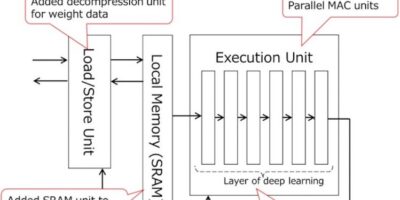
 To overcome this, it has developed a DNN accelerator that implements deep learning in hardware. It is defined by three features: parallel MAC units, reduced DRAM access and reduced SRAM access.

The ViscontiTM5 SoC has four processers, each with 256 MAC units to boost DNN processing speed. Conventional SoCs have no local memory to keep temporal data close to the DNN execution unit, they also consume a lot of power accessing local memory and when loading the weight data used for the MAC calculations. In Toshiba’s SoC, SRAM is implemented close to the DNN execution unit, and DNN processing is divided into sub-processing blocks to keep temporal data in the SRAM, reducing DRAM access. Additionally, Toshiba has added a decompression unit to the accelerator. Weight data, compressed and stored in DRAM in advance, are loaded through the decompression unit. This reduces the power consumption involved in loading weight data from DRAM, explains Toshiba.

Finally, conventional deep learning needs to access SRAM after processing each layer of DNN, which consumes too much power. The accelerator has a pipelined layer structure in the DNN execution unit of DNN, allowing a series of DNN calculations to be executed by one SRAM access.

The ViscontiTM5 SoC complies with ISO26262, the global standard for functional safety for automotive applications.

Sample shipments of Toshiba’s image-recognition processor will begin in September 2019.

 http://www.toshiba.semicon-storage.com  

> Read More

STMicroelectronics and Virscient partner for vehicle connectivity

Wireless connectivity skills from Virscient are used in STMicroelectronics’  Telemaco3P automotive application processors for connected vehicles.

Virscient offers support to ST customers in the development and delivery of advanced automotive applications based on the ST Modular Telematics Platform (MTP). MTP is a development and demonstration platform incorporating ST’s Telemaco3P telematics and connectivity microprocessor. MTP enables the rapid prototyping and development of smart driving applications, including vehicle connectivity to back-end servers, road infrastructure, and other vehicles, explains ST. Virscient brings wireless connectivity technologies and protocols for architecting connected car systems that rely on technologies such as GNSS (precise positioning), LTE/cellular modems, V2X technologies, Wi‑Fi, Bluetooth, and Bluetooth Low Energy.

The Telemaco3P incorporates dual Arm Cortex-A7 processors with an embedded hardware security module (HSM), an independent Arm Cortex-M3 subsystem, and a set of connectivity interfaces.

Telemaco3P SoC ensures a secure connection between the vehicle and the Cloud, explains ST. Its asymmetric multi-core architecture provides powerful application processors as well as an independent CAN control subsystem with optimised power management. Its ISO 26262 silicon design, its embedded Hardware Security Module, and automotive-grade qualification up to 105 degrees C ambient temperature allow for the implementation of a range of secure telematics applications supporting high-throughput wireless connectivity and over the air (OTA) firmware upgrades.

ST and Virscient will be exhibiting the Modular Telematics Platform within the ST Automotive Telematics Ecosystem at Embedded World. Visit ST in Hall 4A, stand 4A-138.

Semiconductor supplier, ST provides intelligent and energy-efficient products enabling smarter driving and smarter factories, cities and homes, along with the next generation of mobile and IoT devices.

Virscient helps the world’s leading semiconductor and product companies get to market faster with quality wireless connectivity solutions for automotive, audio, IoT, and industrial markets. With deep expertise in secure wireless and connected systems, Virscient provides engineering services and intellectual property spanning a range of technologies such as Wi‑Fi, Bluetooth, 5G, GNSS, LoRa, Sigfox and IEEE 802.15.4.

http://www.st.com

> Read More

Nvidia-based modules deliver AI to the edge

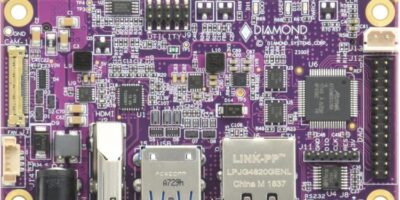
Four carrier boards and a finished system from Diamond Systems are all targeted at delivering artificial intelligence (AI) at the edge computing. The family is based on Nvidia Jetson TX2, TX2i and AGX Xavier modules and target industrial and military applications, particularly those in harsh environments such as vehicles and other outdoor applications.

The Ziggy (pictured) and Jethro carriers are designed to work with the Jetson TX2 and TX2i system on modules (SoMs). Stevie and Elton implement AGX Xavier. Elton is distinguished by a PCI/104 Express expansion socket. According to Diamond Systems, Elton bridges Ai and machine learning (ML) with the durable, rugged industrial PC/104 computing ecosystem.

Elton provides support for PCI-104, PCIe/104 type 2 (x8 lane), and PCIe/104 OneBank expansion modules (4 x1 lanes), for the rapid creation of rugged, custom-configured PCIe-based computing using off-the-shelf I/O modules from a large number of manufacturers.

Another feature of all four modules is the data acquisition circuit with analogue input, analogue output and digital I/O to interface to analogue and digital sensors and controls. There is a programming library with support for custom development and an application with graphical user interface (GUI) for real time control of the data acquisition I/O and data logging.

Ziggy is the carrier for Jetson TX2 and TX2i. It is compact, measuring just 50 x 87mm. The compact ZiggyBox computer system houses the Ziggy carrier and Jetson module and has DIN rail mounting capability, both characteristics that make it suitable for equipment racks and cabinets.

Jethro measures 76 x 107mm –  slightly larger TX2/TX2i carrier – and  offers more I/O and expansion capability, as well as a rugged connector scheme, explains Diamond Systems. It includes a PCIe MiniCard socket, an M.2 SATA flash socket, and a LTE modem socket designed to work with Nimbelink SkyWire cellular modems. Pin headers can accommodate both low-cost, traditional connector technology, or more rugged latching connectors where resistance to vibration and shock are required

Stevie is a translator board that enables the Ziggy and Jethro TX2 carriers to be used with the higher performance AGX Xavier module. It is the same size as Xavier (87 x 100mm) and adds an M.2 PCIe NVMe flash socket, two CAN ports, and an additional USB 3.0 port, as well as a socket for connecting high performance cameras.

Finally, Elton is a rugged carrier board for NVidia’s Xavier SoM. It uses a PCB that is around 50 per cent thicker than the others in the family, and has latching connectors and the rugged PCI/104-Express expansion bus for the most demanding compute-intensive harsh-environment applications. It is larger too, measuring 102 x 152mm which allows it to include all the I/O and expansion of Diamond’s other carriers, namely data acquisition, M.2 and PCIe minicard sockets, and LTE modem socket.

Visit Diamond Systems at Embedded World (Hall 2, stand 2-350) for a chance to win one of three ZiggyBox Nvidia Jetson TX2 embedded computers.

http://www.diamondsystems.com

> Read More

Software provides open source API to run on embedded computing platforms

An updated version of Xsens’ MT software suite provides enhanced support for the NMEA interface for marine electronics, which is claimed to make calibration easier for end users, and improve the developer graphical user (GUI) interface, says the company.

The open source applications programming interface (API) enables users to develop applications to run on many embedded computing platforms. The software suite is an upgraded version of the existing software package for Xsens’ MTi-series of industrial motion trackers. An updated GUI for the MT Software development kit has improved signposting of functions.

The open source API is called XDA (Xsens Device API) and is intended for use on any computing platform that runs a Windows or Linux operating system. While many developers will continue to create applications to run on a PC or laptop, increasing numbers are developing prototypes and finished products on third party embedded computing platforms such as Raspberry Pi or Beagleboard.

The XDA in MT software suite 2019 gives developers access to the code for the first time to enable them to compile it for these platforms, for other third-party boards, or for proprietary embedded computing platforms. They can also modify or extend the XDA to support the particular requirements of their development project.

The XDA is also claimed to greatly facilitate debugging and application problem-solving, as users can now see in detail the message flow between an MTi-series module and the host application.

Users can now choose from hundreds of commercial hardware development platforms that support the Windows or Linux environments, says the company. There are also enhancements to the user experience and extended message support for working with Xsens motion tracking modules.

Enhancements to the MT software suite 2019 release include extended National Marine Electronics Association (NMEA) message support, helping developers integrate an MTi module more easily with third-party equipment. There is also a uniform set of application examples across all supported programming languages, for greater consistency of user experience and an upgraded magnetic field mapping function which makes it easier for the end user to perform a calibration routine for any MTi-series module.

The MT Software Suite 2019 is now available for download from the Xsens website. It supports all current MTi-series products. Xsens is also providing updated firmware for all MTi modules, compatible with the new MT Software Suite 2019.

https://www.xsens.com

> Read More

About Smart Cities

This news story is brought to you by smartcitieselectronics.com, the specialist site dedicated to delivering information about what’s new in the Smart City Electronics industry, with daily news updates, new products and industry news. To stay up-to-date, register to receive our weekly newsletters and keep yourself informed on the latest technology news and new products from around the globe. Simply click this link to register here: Smart Cities Registration