

Multi-sensor platform progresses towards battery-less IoT

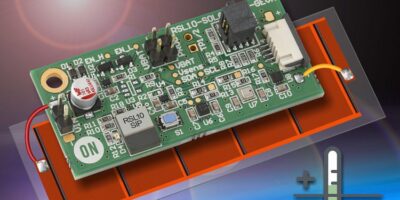
Believed to be the industry’s lowest power Bluetooth radio, the RSL10 multi-sensor platform from ON Semiconductor is powered solely with a solar cell. It is another step to enable battery-less and maintenance-free IoT, says ON Semiconductor.

The platform supports the development of IoT sensors using continuous solar energy harvesting to gather and communicate data through Bluetooth Low Energy, without the need for batteries or other forms of non-renewable energy.

The combination of low-power wireless communications, small form factor solar cell and low duty cycle sensing applications makes it possible to develop and deploy maintenance-free IoT sensor nodes. The RSL10 solar cell multi-sensor platform is enabled by the RSL10 SIP, a system-in-package (SiP) featuring the RSL10 radio, integrated antenna and all passive components.

The RSL10 SiP is combined with a solar cell and low power sensors from Bosch Sensortec, including the BME280 all-in-one environmental sensor (pressure, temperature, humidity) and the BMA400 low power, three-axis accelerometer. ON Semiconductor predicts that together, they will allow developers and manufacturers to create complete IoT nodes that are entirely powered through renewable energy or energy harvested from the sensor’s surroundings.

“After the success of the RSL10 Sensor Development Kit, we are thrilled to work with ON Semiconductor on a new cutting-edge sensor development platform that is entirely solar powered,” said Dr. Peter Weigand, vice president of marketing, Bosch Sensortec.

Commenting on the release of the RSL10 solar cell multi-sensor platform, Wiren Perera, who heads IoT at ON Semiconductor, said: “To support the growth of IoT, manufacturers are actively investigating alternative sources of energy to power their designs, helping to reduce environmental impact and lower manufacturing and maintenance costs. With this solution, established on the RSL10 Bluetooth Low Energy radio, we are proving that a battery-free and maintenance-free approach to smart sensor development is not only possible but can help manufacturers improve their designs.”

There are a growing number of IoT sensor applications where the duty cycle is low enough to support intermittent communications, allowing the energy needed to support operation to be harvested using renewable sources. The energy efficiency of the RSL10 is augmented by the highly efficient power management system and the low power sensors implemented in the platform.

Potential applications include smart home and building automation such as HVAC control, window/door sensors and air quality monitoring. Asset tracking including package open/close detection, shock monitoring, and temperature and humidity data logging are also possible applications.

The platform is supplied with all design files (Gerber, schematic and BoM) and customisable source code as part of a CMSIS software package.

http://www.onsemi.com

> Read More

Intel and Google Cloud Announce Strategic Partnership to Accelerate Hybrid Cloud

Intel and Google Cloud to Develop Anthos Reference Design to Simplify Deployment Across On-Premise Data Centers and the Cloud

Intel and Google Cloud today announced a strategic partnership aimed at helping enterprise customers seamlessly deploy applications across on-premise and cloud environments. The two companies will collaborate on Anthos, a new reference design based on the 2nd-Generation Intel® Xeon® Scalable processor and an optimised Kubernetes software stack that will deliver increased workload portability to customers who want to take advantage of hybrid cloud environments. Intel will publish the production design as an Intel Select Solution, as well as a developer platform.

While organisations are embracing multi-cloud solutions to fuel their businesses, many companies remain challenged to find the right hybrid cloud solutions that enable seamless workload migration across clouds. The new Anthos reference design will address this challenge by delivering a stack optimised for workload portability, enabling deployment of applications across on-premise data centers and public cloud provider services.

“Google and Intel enjoy a long-standing partnership focused on delivering infrastructure innovation to customers,” said Urs Hölzle, senior vice president of Technical Infrastructure at Google Cloud. “Data centre environments today are complex, and hardware and software infrastructure is not ‘one size fits all.’ Our ability to collaborate with Intel and take advantage of their technology and product innovation to deliver Anthos solutions ensures that our customers can run their applications in the way that best suits them.”

“Our collaboration with Google in delivering the infrastructure and software optimisations required to advance their hybrid and multi-cloud solution is a natural fit with Intel’s vision for data-centric computing,” said Navin Shenoy, executive vice president and general manager of the Data Centre Group at Intel Corporation. “We’re delivering an Intel technology foundation for customers to take advantage of their data, and that requires delivery of architectures that can span across various operating environments. This collaboration will give customers a choice of optimised solutions that can be utilised both in the on-prem as well as cloud environments.”

This collaboration is an extension of a technology alliance between the two companies that already spans many infrastructure optimisations, collaboration on high-growth workloads like artificial intelligence, and integration of new technologies into the Google Cloud Platform, such as the 2nd-Generation Intel Xeon Scalable processors and Intel® Optane™ DC Persistent Memory.

The new reference design will be delivered by mid-year 2019 with expected solution delivery from OEMs and solutions integrators in market later this year.

Image –  Navin Shenoy, Intel executive vice president and general manager of the Data Centre Group, displays a wafer containing Intel Xeon processors during a keynote on Tuesday, April 2, 2019. In San Francisco on April 2, Intel Corporation introduces a portfolio of data-centric tools to help its customers extract more value from their data. (Credit: Walden Kirsch/Intel Corporation)

> Read More

ULIS claims “world’s smallest thermal image sensor”

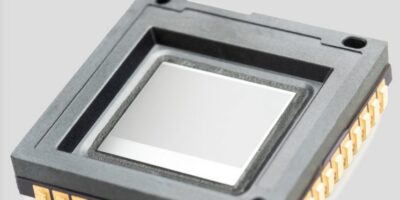
For small thermal cameras, ULIS is presenting the ATT0640 at the SPIE Defence and Commercial Sensing show in Baltimore, Maryland, USA (14 to 18 April).

It is claimed to be the world’s smallest 60Hz VGA/12 micron thermal image sensor and enables the use of smaller thermal cameras with extended battery autonomy in portable equipment for commercial and defence applications.

The sensor can be used in thermal weapon sights (TWS), surveillance and handheld thermography cameras, as well as personal vision systems (PVS), including portable monoculars and binoculars for consumer outdoor leisure, law enforcement and border control.

The PVS segment alone, is expected to see annual unit growth of 30 per cent between 2018 to 2024 (according Yole Developpement: Uncooled Infrared Imagers and Detectors 2019).

The Atto640 measures 16.5 x 16.5mm and is designed to address the size, weight and power (SWaP) reduction requirements across commercial and defence thermal image applications.

The surface mount VGA format device joins the existing QVGA Atto320 to give camera manufacturers more choice in the company’s 12 micron product range. ULIS adds that compared to 17 micron pixel pitch technology, the 12 micron pitch enables them to use smaller and lower cost optics.

Atto640 uses wager level packaging (WLP) to achieve the size advantage, describing this technology, in which the detector window is directly bonded to the wafer, as enabling a significant reduction in the overall dimension of the sensor.

The footprint of the Atto640 footprint is half the size of ULIS’ Pico640-046 (17 micron) model. The WLP enables a batch-processing technique and is suited to high-volume production.

Samples of Atto640 are currently available, with production ramp-up slated for the end of 2019. ULIS intends to further extend its 12 micron product line up with larger resolution sensors.

ULIS is a subsidiary of Sofradir. It designs and manufactures thermal image sensors for commercial, defence and security applications. Established in 2002, ULIS claims to be the world’s second largest producer of thermal image sensors (microbolometers), exporting 97 per cent of its products to camera makers across Europe, Asia and North America.

ULIS products range from low-resolution to megapixel military-grade sensors. They are used to detect threats, diagnose heat loss, avoid road obstacles, perform air-to air refuelling, locate search and rescue victims and observe nature.

http://www.ulis-ir.com

> Read More

LED driver sheds light on animation effects

Smooth animation effects in wearable electronics and appliances – where the light fades in and fades or dims in increments (known as colour chasing or deep breathing) – can be achieved using STMicroelectronics LED1202 12-channel LED driver. The programmable 12-channel RGB-LED driver is designed to enhance lighting effects and animation for smart devices around the home and wearable electronics.

The LED1202 can store eight programmable patterns and sequences and operate independently of the main controller. This enables the host system to save power while sophisticated lighting effects run continuously.  The driver’s 12-bit internal PWM dimming enables precision control of programmed sequences. The main controller can set 8-bit values for analogue dimming via the driver’s I2C interface. According to STMicroelectronics, minimal external components are required to complete the driver circuit.

The single LED1202’s 12 output channels enable it to drive four RGB LEDs at up to 20mA per channel. A synchronisation feature allows up to eight LED1202 drivers to be connected to control larger LED arrays. There is also low-current channel matching, within two per cent (typical) at 2.5mA, to enhance colour consistency. Phase shifting between channels minimises current ripple and prevents excessive peak demand, adds STMicroelectronics. There are also built-in safety features, such as open-LED detection, over-temperature protection, and a fault-flag pin.

The LED1202JR is available now in a 1.71 x 2.16mm WLCSP-20 flip-chip. The LED1202QTR is available in a 3.0 x 3.0mm VFQFPN-20.

There is also the STEVAL-LLL007V1 evaluation kit to support development of new products and lighting sequences.

http://www.st.com

> Read More

About Smart Cities

This news story is brought to you by smartcitieselectronics.com, the specialist site dedicated to delivering information about what’s new in the Smart City Electronics industry, with daily news updates, new products and industry news. To stay up-to-date, register to receive our weekly newsletters and keep yourself informed on the latest technology news and new products from around the globe. Simply click this link to register here: Smart Cities Registration