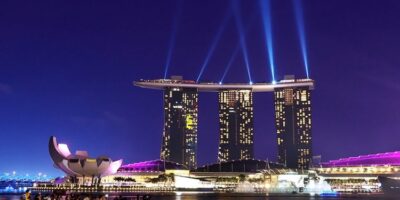
How did Singapore become one of the top smart cities in the world? Read on to find out more about the city-state’s success formula.
Singapore’s got a case of the smarts.
Medicine-dispensing robots, police patrol drones, driverless cars, and weather sensing lamp posts are now part of the daily lives of its inhabitants.
Armed with smart tech and digital infrastructure, Singapore is marching straight into the future. Recently, the country beat Dubai, Los Angeles, Paris, Beijing, Shanghai, Tokyo and Seoul to emerge first in ABI Research’s Smart Cities Competitive Assessment report of ten global cities in 2018.
Business benefits of smart cities – where technologies are used to improve performance of urban services – are absolutely tangible, affirms Mr Steffen Sorrell, Principal Analyst at Juniper Research. A smart city “creates a more liveable place for citizens, which in turn creates a more favourable environment for business competitiveness,” translating gains in productivity into bottom lines.
Mr Alex Lau, Chief Executive Officer (CEO) of Singapore-based smart city technology firm Anacle, confirms rising traction: “Governments across the region are increasing budgets for the digital transformation of cities, which encompasses a wide spectrum of technologies, from digitalising information to online platforms to smart offices and housing integrated solutions.”
With compelling benefits for adopters, more cities are looking towards a smarter future.
What it takes to be a smart city
What is behind Singapore’s smart city secret sauce? Mr Sorrell, Mr Lau and Mr Chew Men Leong, Chief Marketing Officer (CMO) of ST Engineering shares the four key ingredients in the city-state’s success formula.
1. Be smart at heart
It takes more than technology to build a smart city. Singapore’s policies and people create a tech-ready ethos across the nation.
Singapore’s Smart Nation project is one example of its embrace of tech. In 2017 alone, funding for tech amounted S$2.4 billion (US$1.7 billion), financing programmes such as a nation-wide Internet of Things (IoT) Smart Nation Sensor Platform, transforming 110,000 lamp posts into an interconnected network of wireless sensors for smarter mobility and security services through predictive analytics.
Top in Asia Pacific in the Global Talent Competitiveness Index 2019, Singapore’s IT-savvy population stands at the ready to adopt smart technologies. S$70 million (US$50 million) is being spent on deepening talent and skillsets in areas such as data analytics, tech-enabled services, and cybersecurity.
Making technology a way of life has real impact, saving each Singapore inhabitant 125 hours annually, reports Juniper Research. “Singapore is in quite a unique position,” shares Mr Sorrell. “It is the only country in the world which has a nation-wide policy for what a smart city should look like.”
2. Incubate state-of-the-art tech
Named the most innovative country outside Europe in the Global Innovation Index 2018, Singapore boasts a high density of R&D partners, including world-class universities, leading multinational corporations, and startups. The country is home to 13 innovation centres, outnumbering Silicon Valley’s ten, reports Capgemini.
The nation walks the talk in early-mover technology innovation and adoption. The world’s largest fintech hub, Lattice80 was set up here, while trials of the first self-driving taxis started as early as 2016. The country’s open approach to data encourages crowdsourced innovation, shares Mr Sorrell, pointing out how over 100 publicly available land transport authority data sets have been deployed by developers of over 40 mobile apps.
“For companies looking to drive bottom line growth, such environments open opportunities for various industry players to test technology readiness, community adoption and economic viability of smart city solutions. Singapore, being the top global performer in smart cities, is an excellent ‘living lab’ to testbed technologies”, notes Mr Chew.
3. Partner smart
The right collaboration with smart tech partners gives Singapore an advantage.
Nation-wide initiatives are executed collaboratively with industry partners to accelerate adoption and solve practical problems. Anacle, a smart estate management and energy solutions firm, spearheads the Smart Office Living Lab government initiative, which fast-tracks continuous implementation and evaluation of smart systems in operating environments, creating technology blueprints for implementation across the country.
“Few people know this, but everyone in Singapore has come into contact with Anacle solutions at some point,” shares Mr Lau. “Singapore has a comprehensive, multi-pronged digital roadmap that supports the transformation of the city, allowing new ideas to be implemented quickly.”
Anacle’s Simplicity suite of smart city management solutions are deployed in retail malls, schools, data centres, town councils, and even military camps, providing end-to-end field force automation and data analytics for maintenance, safety and supply chain operations.
4. Grow smart networks
Singapore’s smart ethos, ecosystem and partners are plugged into global networks, with prospects for synergy, scalability and export beyond its shores.
“Smart cities are really about a collaborative approach — not only in terms of the agencies within the cities themselves, but also between cities themselves — and I think that such collaboration will be one of the driving forces of future smart cities,” shares Mr Sorrell.
SEA’s networked smart cities are only getting smarter. In 2018, the ASEAN Smart Cities Network (ASCN) was launched across 26 pilot cities, creating opportunities to share data and best practices, create open-source tools, and expand business networks.
ST Engineering, a global technology, defence and engineering group headquartered in Singapore, is leveraging such networks. The firm has completed over 500 smart city projects in 70 cities, and is an invited partner in the ASCN network. ST Engineering’s integrated smart city solutions suite, CitySense, tackles mass urbanisation demands such as road congestion, physical and cybersecurity threats, energy inefficiency and utility wastage, key challenges to be solved across SEA.
“Every city has unique demographics, physical, social or economic conditions, and it would not be feasible to expect a one-size-fits-all smart city solution,” says Mr Chew. “Instead, where cities and innovation ecosystem participants can learn from one another and collaborate, we can synergise and speed up the creation of urban solutions.”
For more information – https://www.edb.gov.sg/