
Rugged 12V LDMOS power amplifiers join land mobile radio line-up

A new line of 12V laterally diffused metal oxide semiconductor (LDMOS) transistors bolsters Ampleon’s land mobile radio portfolio.

This 12V LDMOS platform is based on the 9th generation of Ampleon’s LDMOS technology and will target commercial, public safety and defence mobile radio applications, and the portfolio covers ceramic and plastic packages.

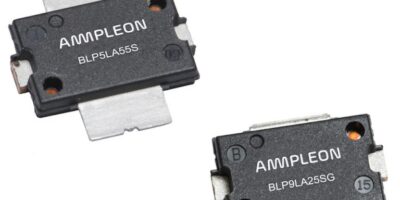
The first two products to be released are the BLP9LA25S and the BLP5LA55S. These devices are designed for 12V nominal mobile operation over the entire VHF and UHF frequency bands from 2 to 941 MHz and deliver 25 W and 55 W respectively.

They combine ease-of-use with ruggedness, enabling greater than18 dB gain and more than 65 per cent efficiency over the full operating frequency range. This results in fewer stages, improved stability, simplified cooling and thus smaller systems, says the company.

Their linearity suits them to tetra applications and their capability to handle extreme mismatch levels over 65:1 voltage standing wave ratio equated to handheld radios that can withstand harsh environments .

These broadband 12V devices are housed in compact over-molded plastic (TO270 packages for a small footprint.

Qualification samples of both the BLP5LA55S and the BLP9LA25S are available via Ampleon’s local sales channels with reference circuits available at different frequency bands.

Production for both variants is expected in the last quarter of the year.

Ampleon has more than 1,650 employees worldwide. Its portfolio offers products and solutions for a range of applications, such as mobile broadband infrastructure, radio and TV broadcasting, carbon dioxide lasers and plasma, MRI, particle accelerators, radar and air-traffic control, non-cellular communications, RF cooking and defrosting and RF heating and plasma lighting.

To stay up-to-date, register to receive our weekly newsletters and keep informed of the latest technology news and new products from around the globe. Simply click this link to register here: softei.com

http://www.ampleon.com

> Read More

Automotive smart cameras use deep learning

Following a collaboration with, StradVision, Renesas Electronics announces the joint development of a deep learning-based object recognition solution for smart cameras. StradVision’s software has been optimised to run on Renesas Electronics’ R-Car SoCs.

The deep learning-based object recognition system is for smart cameras used in next-generation advanced driver assistance system (ADAS) applications and cameras for ADAS Level 2 and above.

Next-generation ADAS implementations require high-precision object recognition capable of detecting vulnerable road users (VRUs) such as pedestrians and cyclists. These systems must also consumer very low power for mass-market mid-tier to entry-level vehicles.

According to Naoki Yoshida, vice president of Automotive Technical Customer Engagement, at Renesas, StradVision is a leader in vision processing technology, with “abundant experience developing ADAS implementations using Renesas’ R-Car SoCs”. The collaboration has produced production-ready solutions “that enable safe and accurate mobility in the future,” said Yoshida. The deep learning based camera system is expected to contribute to the widespread adoption of next-generation ADAS implementations and support the escalating vision sensor requirements expected to arrive in the next few years.

StradVision’s deep learning–based object recognition software delivers high performance in recognising vehicles, pedestrians and lane marking. The high-precision recognition software has been optimised for Renesas R-Car automotive SoCs R-Car V3H and R-Car V3M. These R-Car devices incorporate a dedicated engine for deep learning processing called CNN-IP (Convolution Neural Network Intellectual Property), enabling them to run StradVision’s SVNet automotive deep learning network at high speed with minimal power consumption. The object recognition characteristic realises deep learning–based object recognition while maintaining low power consumption, suitable in mass-produced vehicles, encouraging ADAS adoption.

StradVision’s SVNet deep learning software is an AI perception solution for the mass production of ADAS systems. It is characterised by recognition precision in low-light environments and its ability to deal with occlusion when objects are partially hidden by other objects. The basic software package for the R-Car V3H performs simultaneous vehicles, person and lane recognition, processing the image data at a rate of 25 frames per second. Developers can customise the software, adding signs, markings and other objects as recognition targets. StradVision provides support for deep learning-based object recognition covering all the steps from training through the embedding of software for mass-produced vehicles.

In addition to the CNN-IP dedicated deep learning module, the Renesas R-Car V3H and R-Car V3M feature the IMP-X5 image recognition engine. The on-chip image signal processor (ISP) is designed to convert sensor signals for image rendering and recognition processing. This makes it possible to configure a system using inexpensive cameras without built-in ISPs, reducing the overall bill-of-materials (BoM) cost, says Renesas.

The R-Car SoCs featuring the new joint deep learning solution, including software and development support from StradVision, are scheduled to be available to developers by early 2020.

http://www.renesas.com

> Read More

Low profile reflective sensor negates peripheral circuitry

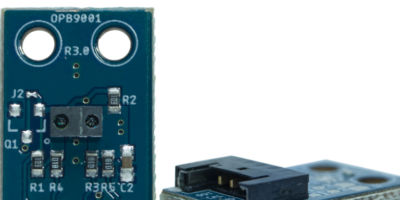
For industrial and medical applications, TT Electronics has launched a low profile reflective object sensor in PCB assembly. The OPB9001 module offers 24 to 30V input compatibility and features four-pin connectors for simple programming and operation.

The OPB9001 PCB module includes the OPB9000 reflective sensor and eliminates the need for peripheral circuitry like resistors, regulators and capacitors which are integrated into its small, robust package, explains TT Electronics.

The reflective sensor can detect objects as far away as 50mm using standard 90 per cent reflective material as well as objects as small as 2.5mm, depending on the object distance. The OPB9001 can also be programmed to recognise various distances within its reflective range.

“Industrial applications often require flexible customised solutions in order to accommodate the dynamic needs of each environment,” said Raymund Chua, product line director, Optoelectronics, TT Electronics. “The OPB9001 product family is capable of directly accepting higher input voltage and can be customised to maximise flexibility and compatibility — even in the most robust and demanding industrial use cases.”

All analogue signal conditions are incorporated into OPB9001’s integrated OPB9000 IC and PCB assembly. The OPB9001 module is equipped with an integrated connector for ease of mounting on PCBs and panels, adds TT Electronics.

TT Electronics provides engineered electronics for performance-critical applications. The company employs nearly 5,000 members of staff, operating from 29 key locations around the world. TT designs and manufactures a wide range of electronics for sensing, power management and connectivity for applications in the industrial, medical, aerospace and defence and transportation sectors.

http://www.ttelectronics.com

> Read More

M12-based Ethernet switches are for rail applications

TE Connectivity now offers EN50155 managed Ethernet switches that enable secure and reliable Gigabit-speed networks in harsh network environments on railway rolling stock.

The switches can be used even where vibration levels are extreme, says TE Connectivity.

They are equipped with hardware and firmware to provide optional Power over Ethernet (PoE), redundancy functions, easy management and advanced operation. The switches are intended for passenger information and entertainment systems, as well as surveillance systems.

The switches have built-in redundancy and can be managed remotely, saving maintenance costs. They are “highly resistant to hacking” adds the company.

According to TE’s Egbert Stellinga, “Their Gigabit performance will help our customers save on future investments, while the optional PoE capability cuts costs straight away by eliminating the need to run separate power lines.”

TE EN50155 Managed Ethernet switches can be used in networks running at speeds anywhere from 100Mbits per second to 10Gbits per second.

TE is also launching a series of complementary PoE splitters and injectors adjacent to the company’s existing portfolio consisting of unmanaged switches.

For more than 75 years, TE Connectivity has provides connectors and sensors for use in the harshest environments, enabling advances in transportation, industrial applications, medical technology, energy, data communications, and the home.

The company has 80,000 employees, including more than 8,000 engineers, working alongside customers in approximately 140 countries around the world.

http://www.te.com

> Read More

About Smart Cities

This news story is brought to you by smartcitieselectronics.com, the specialist site dedicated to delivering information about what’s new in the Smart City Electronics industry, with daily news updates, new products and industry news. To stay up-to-date, register to receive our weekly newsletters and keep yourself informed on the latest technology news and new products from around the globe. Simply click this link to register here: Smart Cities Registration