
Nordic introduces Bluetooth 5.1 SoC for multi-protocol applications

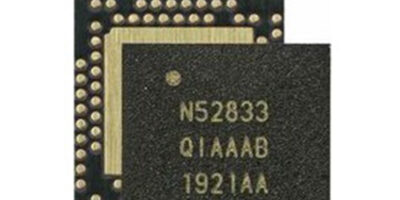
Temperature-qualified, the nRF52833 SoC joins Nordic’s nRF52 series. The multi-protocol SoC includes a Bluetooth 5.1 Direction Finding-capable radio for low power Bluetooth Low Energy, Thread, Zigbee, and 2.4GHz proprietary wireless connectivity. It is qualified for operation across a -40 to +105 degrees C temperature range.

The nRF52833 features a powerful 64MHz 32bit Arm Cortex-M4 processor with a floating-point unit (FPU) and includes 512kbyte of flash and 128kbyte of RAM, suitable for use in commercial and industrial wireless applications including professional lighting, asset tracking, smart home products, wearables, and gaming.

The SoC’s memory capacity also supports a dynamic multi-protocol capability, suitable for applications such as professional lighting where concurrent Bluetooth Low Energy and Bluetooth mesh, Thread or Zigbee support enables provisioning, commissioning, and interaction with a lighting mesh network from a smartphone using Bluetooth Low Energy. The temperature range also enables the nRF52833 to operate in professional lighting applications which typically feature elevated ambient temperatures, adds Nordic.

The nRF52833’s radio is capable of all Bluetooth 5.1 Direction Finding features and its memory can support both receiver and transmitter roles for angle-of-arrival (AoA) and angle-of-departure (AoD) applications. Direction Finding enables positioning applications that not only rely on received signal strength indication (RSSI) but also the signal direction. Applications include real-time location systems (RTLS) and indoor positioning systems (IPS).

The nRF52833 includes full-speed USB, high-speed SPI, and +8dBm output power. The increased output power together with Bluetooth 5 technology’s long-range (LoRa) feature enables the nRF52833 to be used in smart home applications.

The SoC includes up to 42 general-purpose I/Os (GPIOs) and a range of analogue and digital interfaces such as an NFC-A Tag, ADC, UART, SPI, TWI, PWM, I2S, and PDM. Additionally, a two-stage LDO voltage regulator and a DC/DC converter with a 1.7 to 5.5V input supply range allows the nRF52833 SoC to be powered by coin cells, rechargeable batteries, or the on-chip USB.

The nRF52833 is supported by the S113 or S140 SoftDevices, Nordic’s Bluetooth RF protocol stacks. The S140 is a qualified Bluetooth 5.1 stack and includes support for 2Mbits per second throughput, Bluetooth LoRa and improved coexistence through Channel Selection Algorithm #2.

The nRF5 SDK for Mesh and nRF5 SDK for Thread and Zigbee are scheduled for release in Q4 2019.

An nRF52833 development kit is for Bluetooth LE, Bluetooth mesh, 802.15.4, Thread, Zigbee, and 2.4GHz proprietary applications running on the nRF52833 SoC. It is compatible with the Arduino Uno Rev3 standard.

The SoC will be made available in three packages: a 7.0 x 7.0mm aQFN73 with 42 GPIOs, a 5.0 x 5.0mm QFN40 with 18 GPIOs and a 3.2 x 3.2mm wlCSP with 42 GPIOs.

nRF52833 engineering samples are available now with volume production due Q4, 2019.
http://www.nordicsemi.com

> Read More

Receiver antennae wirelessly transfer power for EVs

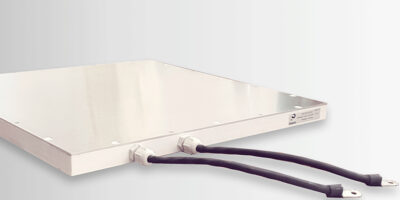
Wireless charging for electric vehicles (EVs) is possible, says Premo, as it launches the WC-RX-Series of receiver antennae (secondary coil).

The antennae provide a flexible magnetic core combining flex-ferrite blocks with PBM (soft-polymer bonding magnetic).

Initially handling 3kW to 11kW, the company announced that a 22kW version will be available soon.

Currently, the market for hybrid and electric vehicles is growing fast. These are alternative and improved solutions to common internal combustion engine vehicles to reduce global pollution, especially in terms of CO2 emissions or other NOx pollutants and other thin particles that are toxic for our health and endanger our planet.

The EV market is driving the demand for more convenient and reliable means to recharge the onboard battery. Most of the motorised EVs have a plug for direct AC or DC slow or fast charging, explains Premo.

Wireless power transfer (WPT) requires no physical contact between the vehicle and the charging station, offering convenience and avoiding the hazards caused by traditional direct-conductive methods.

The challenge is to replace the conductive charging method with WPT technology while maintaining a comparable power level and efficiency. The long-term goal is to dynamically power the moving vehicles on the road, automated guided vehicles (AGVs) on a factory floor and/or autonomous robots and forklifts in a warehouse.

This may lead to a significant size reduction in battery packs and extended driving range while also addressing the cost of batteries and range anxiety.

For the past three years, Premo has been investing in inductive components design applying both the 3DPower concept (for the magnetics involved in WPT) and the Alma concept (for long-range antennae using flex-magnetic core).

A team of scientists from Madrid’s CSIC (Superior Council of Scientific Research), researchers of UPM (Universidad Politécnica de Madrid), Andaltec (Instituto Andaluz del Plástico) and a team of materials scientists and technologists at Premo’s Innovation Center in Malaga have developed a technology aimed at inductive WPT in the range of 90kHz. This technology deals with the limits of conventional ferrite cores that are both fragile and brittle and cannot be manufactured reliably in the long, large and thick formats required by this application. The team has announced that it has realised an improvement in performance of Premo’s WC-Rx-Series (secondary coils). The magnetic core technology provides high-efficiency (above 95 per cent) power transfer due to the combination of an optimized coil (Litz wire) and a flexible core that avoids air gaps and reduces heating areas. The result is a compact secondary coil with a high Q-factor (very low losses) and high reliability, reports Premo.

Samples of the WC-RX @ 22kW) will be available by Q1 (2020).

WC-TX-Series (emitters) will be available in Q1 (2020).

http://www.grupopremo.com

> Read More

Energy storage capacitors offer long life and high moisture resistance

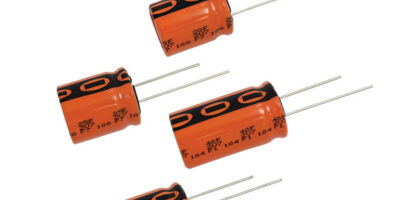
For energy harvesting and power backup applications in harsh, high humidity environments, Vishay Intertechnology offers the Vishay BCcomponents 235 EDLC-HVR ENYCAP capacitors.

The electrical double-layer energy storage capacitors are claimed to be the industry’s first high voltage devices to offer useful life of 2,000 hours at +85 degrees C. They also meet the highest class of moisture resistance, the biased 85 degrees C / 85 per cent RH 1,500-hour test.

The capacitors’ long useful life is double that of standard electrical double-layer capacitors, claims Vishay, enabling maintenance-free operation and greater design flexibility. The high humidity resistivity allows for use in industrial, renewable energy, and automotive applications, including smart meters, handheld electronics, robotics, solar panels, E-latch door systems, and emergency lighting.

The 235 EDLC-HVR ENYCAP capacitors are available in 15 small case sizes ranging from 10 x 20mm to 18 x 40mm. Capacitance values from five to 60F.

The RoHS-compliant devices feature rapid charge and discharge performance and are available in through-hole versions.

Samples and production quantities of the 235 EDLC-HVR ENYCAP capacitors are available now, with lead times of six weeks for larger quantities.

Vishay Intertechnology is one of the world’s largest manufacturers of discrete semiconductors (diodes, MOSFETs, and infrared optoelectronics) and passive electronic components (resistors, inductors, and capacitors). Components are used in virtually all types of electronic devices and equipment, in the industrial, computing, automotive, consumer, telecommunications, military, aerospace, power supplies, and medical markets.

http://www.vishay.com

> Read More

TVS diodes protect in smaller packages

The latest generation of transient voltage suppression (TVS) diodes from STMicroelectronics deliver higher protection in smaller packages, says the company.

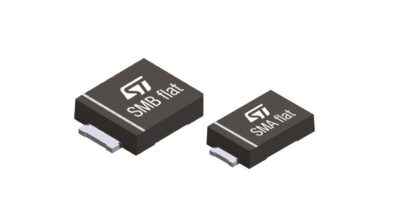
The TVS diodes are claimed to deliver market-leading power density, handling 600W and 1500W transient power in SMB Flat, and 400W and 600W in SMA Flat packages that have a low profile of just 1.0mm.

In addition to the lower profile, ST’s 1500W SMB Flat package has transient-power capability equivalent to that of conventional devices in SMC packages, in a footprint more than 50 per cent smaller. The 400W and 600W SMA Flat and SMB Flat devices are footprint-compatible with alternatives in conventional SMA and SMB packages, adds ST. Leakage current is five times lower compared with other TVS diodes on the market, to minimise the impact on system operation and power consumption.

The low-profile, high-power protection diodes cover a range of standoff voltages from 5.0V to 188V, suitable for use in applications such as telecomms equipment, e-bikes, drones, robots, automotive electronics, consumer products and power tools.

Industrial-grade and AEC-Q101 automotive-qualified parts are available.

The 400W and 600W devices are in production now, 1500W diodes are available in sample quantities and will enter production in early 2020.

All packages feature wettable flanks that facilitate automatic optical inspection (AOI) for production quality control.

http://www.st.com/tvs

> Read More

About Smart Cities

This news story is brought to you by smartcitieselectronics.com, the specialist site dedicated to delivering information about what’s new in the Smart City Electronics industry, with daily news updates, new products and industry news. To stay up-to-date, register to receive our weekly newsletters and keep yourself informed on the latest technology news and new products from around the globe. Simply click this link to register here: Smart Cities Registration