

FlightSense software makes gestures speak volumes

STMicroelectronics said it is now making gesture detection simpler and more affordable for mass-market applications with companion software for its VL53L5CX multi-zone ToF ranging sensor. The sensor, together with free engineering software, will enable touchless, gesture-based controls in simple, cost-conscious consumer and industrial applications. 

According to ST, gesture recognition with ToF sensors is a breakthrough technology that enables sophisticated interactions with a wide variety of devices instead of being confined to applications in high-end vehicles. 

Gesture-based interaction in a wide range of equipment, including kitchen appliances, thermostats, smart home and smart lighting controls, laptops, AR / VR headsets, tablets and smartphones are not only convenient, it can prevent infection from spreading through touch when using equipment such as vending and ticketing machines, elevator controls, and interactive signage.

Together, the sensor and software calculate in real-time the X / Y / Z coordinates of the hand, enabling hand tracking as well as recognition of gestures like tapping, swiping or level control.

Conventional gesture-recognition systems typically use more expensive and intrusive camera-based machine vision, but ST said its FlightSense technology and software allow designers to build systems with lower power consumption, and that work in the dark without needing external illumination, unlike vision-based systems  The lightweight gesture algorithm can run on a low power microcontroller and demands minimal system resources for it to be easily integrated in an existing application, said ST.

The STSW-IMG035 software package is specially designed for the VL53L5CX multi-zone direct time-of-flight (dToF) ranging sensor and can be used with all STM32 microcontrollers. 

The VL53L5CX is ST’s latest-generation ToF sensor, providing 64 zones with high-accuracy ranging up to 400cm with a wide, square-edged 63 degree-diagonal field of view.

The VL53L5CX sensor is in production now, in a 6.4 x 3.0 x 1.5mm 16-pin optical LGA package. The turnkey STSW-IMG035 gesture package includes resources including a GUI, example code and libraries. Associated software packages and hardware evaluation boards are available here. 
http://www.st.com

> Read More

Lynx Mosa.ic supports Google Athos for VI AI at the edge

Industrial and energy plant manager can deploy AI and other cloud-based workloads at the network edge following a partnership by Lynx Software Technologies with Google Cloud. The Lynx Mosa.ic platform supports Google Anthos Bare Metal and Google Visual Inspection (VI) AI Service for secure, video-based quality inspection, says Lynx Software.

As a result, real-time image capture can be easily caught on devices such as cameras on manufacturing plant floors. In addition, inference models built by Google Cloud Visual Inspection AI, can generate the insights while the supervisory controller  connects to the manufacturing execution system (MES) and translates insights into action. Lynx’s technology brings immutable isolation security which cannot be bypassed, claimed Lynx Software.

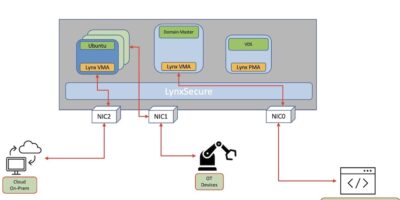
Using Google Anthos for bare metal support means that an entire Kubernetes cluster can be run locally in as little as one hardware system at the edge, with Lynx-enabled virtual air gapping providing isolation within the system. 

Addressing the security concerns for mission-critical industrial environments around merging AI and machine learning models in the cloud and deploying cloud-based workloads at the edge, Lynx has sandboxed three functions with the options of a secure one-way connection between them. The three functions are for image capture (via a camera), insight via the Google Anthos inference engine and the action with a supervisory controller.

Pavan Singh, vice president of product management at Lynx, commented: “Any containerised service can now be deployed to the mission-critical edge without compromising security or performance”.

Video-based quality systems play a role in enhancing performance and quality of output in industrial and energy applications, while mitigating security risks, said Lynx. Efficient visual inspection can reduce defects up to 10-fold. In addition to preventing the shipping of defective parts, operators can gain insights into the cause of any defects in order to optimise processes

For this set-up, the Lynx Mosa.ic runs on an Advantech MIC770, although Mosa.ic is also able to run on various Intel and Arm processors, facilitating local or on-premises management with the benefits of using the cloud for workloads.

Lynx Software Technologies enables safe, secure and high-performance environments for customers in aerospace and automotive, enterprise and industrial markets. Since 1988 it has supplied real-time operating systems (RTOS), virtualisation and system certification to protect data.

http://www.lynx.com

> Read More

Fast charging ICs offer highest charging efficiencies, says Halo Microelectronics 

Two fast charging ICs released by Halo Microelectronics use a dual-phase switched capacitor architecture for single cell battery applications.

The HL7138 and HL7139, fast charging ICs are claimed to offer the industry’s highest charging efficiencies, which enable faster and cooler battery charging operations in a PCB solution size that is up to 30 per cent smaller than the nearest competitor. The small form factor allows for more system level design flexibility, added Halo Microelectronics.

In addition to saving consumers time by fast charging, the ICs deliver cooler charging which means less energy is wasted, making the charging process environmentally friendly. The small size also provides designers more leeway to choose between thinner and lighter form factors or larger batteries for longer battery life, and whether to include more features or lower bill of material (BoM) costs.

Fast charging is one of the features which can differentiate a smartphone design in a saturated market. It is also one that consumers can relate to and understand the benefits, commented David Nam, CEO of Halo Microelectronics. “Halo Microelectronics has seen switched capacitor-based fast-charging architectures quickly extend from high-end to mid-level smartphones,” he said.

Halo Microelectronics develops analogue and power management ICs (PMICs) enabling energy-efficient smart systems. Its customers develop mobile, IoT and automotive systems.

https://halomicro.com

> Read More

Handheld terminal has Denso’s strongest decode engine

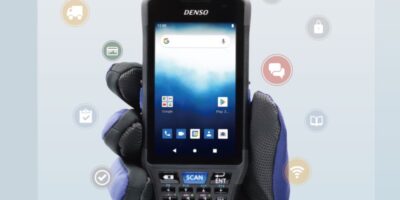
An Android mobile computer, the BHT-M70 by Denso has its strongest decode engine and scans up to 30 tags per second. 

It is for logistics to keep track of same-day delivery, real-time locating of goods and high-speed tracking along the supply chain. In retail, for example, Denso said that inventory times can be reduced significantly, and in logistics and warehouse management can be accelerated, using the BHT-M70 to scan goods from a distance of up to 1.5 metres. 

The mobile computer has been added to Denso’s BHT series and is equipped with a large four-inch touch screen and physical keys to accelerate processes by scanning a wide range of different codes, such as barcodes and QR codes. The BHT-M70’s decode engine and high-resolution CPU enable scanning that is three times faster than with regular devices for mobile data collection, said Denso. 

The handheld terminal can easily scan through plastic or glass and read dirty or damaged codes. Optical character recognition (OCR) automates the manual entry of expiry dates and slip numbers, reducing visual work for employees, while ensuring the accurate checking of goods. 

The BHT-M70 features a diverse mix of Android-based software using 4G, Wi-Fi communication and GPS to realise a modern work style with digitalised processes. 

Employees can optimise internal communication apps such as chats and phone calls using the BHT-M70. While the handheld terminal is intuitive to use, Denso pointed out that a quick video call can help with training or troubleshooting. Furthermore, the BHT-M70 uses GPS to manage the location of goods.

Denso Wave provides auto-ID solutions helping businesses in retail, logistics, and healthcare to improve stock management, have full data transparency and accelerate processes along the supply chain. QR Code is a registered trademark of Denso Wave. 

Denso Wave hardware and software solutions are tested extensively before being available at the market. Products range from premium RFID readers, handheld terminals / mobile computers and barcode scanners to complex and cloud based IoT data management systems. 

Denso is a member of the Toyota Group and is exclusively represented in Europe by Denso Wave Europe. 

http://www.denso-wave.eu

> Read More

About Smart Cities

This news story is brought to you by smartcitieselectronics.com, the specialist site dedicated to delivering information about what’s new in the Smart City Electronics industry, with daily news updates, new products and industry news. To stay up-to-date, register to receive our weekly newsletters and keep yourself informed on the latest technology news and new products from around the globe. Simply click this link to register here: Smart Cities Registration