

Synaptics launches the next generation of Astra multimodal GenAI processors

Synaptics has announced the new Astra SL2600 Series of multimodal Edge AI processors designed for power and performance. The Astra SL2600 series enables a new generation of cost-effective intelligent devices that make the cognitive Internet of Things (IoT) possible.

The SL2600 Series will launch with the SL2610 product line, featuring five processor families tailored for diverse Edge AI applications. These processors are purpose-built for the next wave of smart appliances, home and factory automation equipment, charging infrastructure, healthcare devices, retail point of sale terminals and scanners, autonomous robotic systems, UAVs, casual gaming devices, and more.

The Astra SL2610 processors are powered by the new Synaptics Torq Edge AI platform, combining future-ready NPU architectures with open-source compilers, to set a new standard in IoT AI application development. Torq delivers the first production deployment of Google’s RISC-V-based Coral NPU with dynamic operator support, future-proofing Edge AI designs. Leveraging an open-source IREE/MLIR compiler and runtime, it embodies a developer-first approach. The SL2610 product line integrates Arm Cortex-A55, Cortex®-M52 with Helium, and Mali GPU technologies, and these processors take a comprehensive, multi-layered approach to building security directly into the silicon, enabling immutable root of trust, threat detection, and an application crypto coprocessor to manage intensive AI workloads.

The SL2610 product line encompasses five pin-to-pin compatible families: SL2611, SL2613, SL2615, SL2617, and SL2619, built for a wide range of solutions from battery-powered and passively cooled devices to high-performance industrial vision systems. These processors deliver hallmark power efficiency and seamless integration with Synaptics Veros Connectivity—across Wi-Fi 6/6E/7, BT/BLE, Thread, and UWB—providing a unified developer experience that accelerates time-to-market.

The Synaptics Astra SL2610 product line is sampling to customers now with general availability planned for calendar Q2 2026.


www.synaptics.com

> Read More

SkyWire technology from Microchip aligns and compares clocks within nanoseconds

Microchip has announced its new SkyWire technology, a time measurement tool embedded in the BlueSky Firewall 2200, that is designed to measure, align and verify time to within nanoseconds even when clocks are long distances apart.

With the BlueSky GNSS Firewall 2200 and SkyWire technology, geographically dispersed timing systems can be compared to each other and compared to the time scale systems deployed at metrology labs within nanoseconds. Measurement of clock alignment and traceability to this level has typically only been done between metrology labs and scientific institutes. With Microchip’s solution, critical timing networks for air traffic control, transportation, public utilities and financial services can achieve alignment within nanoseconds between its clocks to protect their infrastructure no matter where the clocks are located.

“To ensure timing systems are delivering to stringent accuracy requirements, it’s important to measure and verify in an independent manner relative to UTC as managed by national laboratories and traceable to the Bureau International Poids et Mesures (BIPM),” said Randy Brudzinski, corporate vice president of Microchip’s frequency and timing systems business unit. “With the new SkyWire technology solution, we’re making UTC more widely accessible so that large deployments of clocks can be independently measured and verified against each other across long distances.”

The concept originated as an extension to the National Institute of Standards and Technology’s (NIST’s) pre-existing service called Time Measurement and Analysis Service (TMAS), which is utilised by entities that are required to maintain an accurate local time standard.

The BlueSky GNSS Firewall 2200 with SkyWire technology provides a Commercial Off-The-Shelf (COTS) product to enable critical infrastructure operators to connect with the NIST TMAS Data Service for large-volume clock deployments.

“At NIST, our goal is to enable the most accurate time to support our country’s infrastructure,” said, Andrew Novick, engineer at NIST. “Our TMAS Data Service in conjunction with commercial hardware, provides a scalable solution for anyone who needs traceable and accurate timing.”

Nations around the globe can replicate this solution using Microchip’s SkyWire technology capabilities within its TimePictra software suite, which delivers similar features and functionality as that provided by the NIST TMAS Data Service. Metrology labs, government agencies and enterprises worldwide can deploy TimePictra software suite and the BlueSky GNSS Firewall 2200 with SkyWire technology and have their own end-to-end solution for traceable time measurement, alignment and verification.

Development Tools
The TimePictra software suite provides customers with support to deploy BlueSky GNSS Firewalls at scale.

www.microchip.com

> Read More

Analog Devices launches ADI Power Studio and new web-based tools

Analog Devices has announced the launch of ADI Power Studio, a family of products that offers advanced modelling, component recommendations and efficiency analysis with simulation. In addition, ADI is introducing early versions of two new web-based tools with a modernised user experience under the Power Studio umbrella: ADI Power Studio Planner and ADI Power Studio Designer. These new tools, together with the full ADI Power Studio portfolio, including LTspice, SIMPLIS, LTpowerCAD, LTpowerPlanner, EE-Sim, LTpowerPlay and LTpowerAnalyzer, streamline the entire power system design process. The Power Studio tools support engineers from initial concept through measurement and evaluation.

Today’s electronic systems require more power density than ever, with dozens or even hundreds of power rails and interdependent voltage domains. That complexity creates bottlenecks and requires rework during architecture decisions, component selection and validation. Power Studio addresses these challenges by providing a unified, intuitive workflow that helps engineering teams make better decisions earlier by simulating real-world performance with accurate models and automating key outputs, such as bill of materials and report generation. Together, the family of tools can facilitate shorter development cycles, reduce rework and increase speed at which engineers bring power-dense systems to market.

• ADI Power Studio Planner: The next-generation, web-based tool for system-level power tree planning, Power Studio Planner gives engineers an interactive view of their system architecture, providing clarity to model power distribution, calculate power loss, and analyse system efficiency with ease. With intelligent parametric search and tradeoff comparisons, teams can make faster, better architecture decisions from the start.

• ADI Power Studio Designer: A web-based tool for IC-level power supply design, Power Studio Designer provides optimised component recommendations, performance estimates, and tailored efficiency analysis. Built on the ADI power design architecture, Power Studio Designer offers guided workflows so engineers can set key parameters and move confidently toward simulation, configuration and evaluation. By guiding users through these steps, engineers can build accurate models to simulate real-world performance with support for both LTspice and SIMPLIS schematics before moving to hardware.

Power Studio Planner and Power Studio Designer are available now as part of the ADI Power Studio. These tools represent the first phase of ADI’s vision to deliver a fully connected power design workflow for customers, with ongoing updates and product announcements planned in the months ahead.

www.analog.com

> Read More

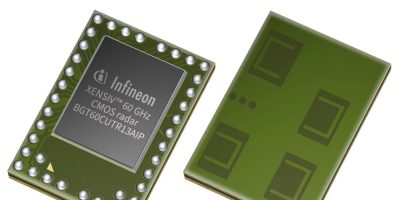
Infineon launches next-generation XENSIV 60 GHz CMOS radar for low-power IoT solutions

Infineon has launched its next-generation, highly integrated 60 GHz CMOS radar sensor. Targeting ultra-low power IoT solutions, the Infineon XENSIV BGT60CUTR13AIP aims to become a key sensor for Physical AI to increase the intelligence of smart home and IoT devices. The new radar sensor is fully supported by Infineon hardware and software, third-party modules, and transferable FCC certification to aid fast-time-to-market.

The new XENSIV 60 GHz CMOS radar family includes on-chip processing powered by a hardware accelerator providing customers the flexibility to access either raw or pre-processed data. By handling radar processing on-chip Infineon’s solution offloads the host processor and supports a more efficient system architecture enabling smaller form factors and cost-efficiency. Thanks to an integrated bootloader, the XENSIV BGT60CUTR13AIP is able to run fully autonomous ultra-low power presence detection to wake-up the host, only if required.

With up to 7 GHz bandwidth and 11 dBm output power, Infineon’s XENSIV BGT60CUTR13AIP detects both moving and static targets at an extended range with up to 20 m. The cost- and footprint-optimised antenna in package (AIP) design features one transmit (Tx) and three receive (Rx) channels to enable up to 150° field of view covering both dimensions azimuth and elevation. Thus, the new XENSIV 60 GHz CMOS radar sensor enables Physical AI applications to become more intelligent and allow for more natural and intuitive interactions with users, targeting applications such as security cameras, smart thermostats, smart TVs, and HVAC systems.

Together with the integrated on-chip processing and improved radar performance, the XENSIV BGT60CUTR13AIP increases energy efficiency and extends the battery life in smart IoT devices by enabling robust, ultra-low power presence detection. This makes it well-suited for battery-powered smart home and smart building applications which interact with the user upon presence detection like video doorbells, smart displays, and smart speakers. Dedicated software stacks support advanced features including people tracking, gesture sensing, activity monitoring, and vital signs sensing so smart IoT devices can respond more naturally to their surroundings while protecting user privacy.

www.infineon.com

> Read More

About Smart Cities

This news story is brought to you by smartcitieselectronics.com, the specialist site dedicated to delivering information about what’s new in the Smart City Electronics industry, with daily news updates, new products and industry news. To stay up-to-date, register to receive our weekly newsletters and keep yourself informed on the latest technology news and new products from around the globe. Simply click this link to register here: Smart Cities Registration