

Microchip’s TimeProvider 4500 v3 grandmaster clock enables terrestrial alternative to GNSS

Microchip has announced the release of the TimeProvider 4500 v3 grandmaster clock (TP4500) designed to deliver sub-nanosecond accuracy for time distribution across 800 km long-haul optical transmission.

Most current deployments require GNSS at grandmaster sites, but the TP4500 enables highly resilient synchronisation without relying on GNSS. The TP4500 supports time reference provided by UTC(k) UTC time provided by national labs, and is the first grandmaster to offer a premium capability that delivers High Accuracy Time Transfer (HA-TT) as defined by ITU-T G.8271.1/Y.1366.1 (01/2024) to meet 5 nanoseconds (ns) time delay over 800 km (equating to 500 picoseconds (ps) average per node, assuming 10 nodes).

The TP4500 system can be configured with multiple operation modes to form an end-to-end architecture known as virtual PRTC (vPRTC), capable of delivering PRTC accuracy over a long-distance optical network. vPRTC is a carrier-grade architecture for terrestrial distribution of HA-TT, which has been widely deployed in operator networks throughout the world. HA-TT is a proven and cost-effective approach, as opposed to other alternative PNT solutions that have no wide adoption into critical infrastructure networks to date, have low Technology Readiness Levels (TRL) and are still dependent on GNSS as the ultimate source of time.

TimeProvider 4500 v3 is a steppingstone towards support of the ITU-T G.8272.2 standard, which defines a coherent network reference time clock (cnPRTC) in amendment 2 (2024). An cnPRTC architecture ensures highly accurate, resilient, and robust timekeeping throughout a telecom network. This allows stable, network-wide ePRTC time accuracy, even during periods of regional or network-wide GNSS unavailability or other failures and interruptions.

microchip.com

> Read More

Rohm launches diode combining low VF and IR for advanced image sensor protection

Rohm has developed an innovative Schottky barrier diode that overcomes the traditional VF/IR trade-off. This way, it delivers high reliability protection for a wide range of high-resolution image sensor applications, including ADAS cameras.

Modern ADAS cameras and similar systems require higher pixel counts to meet the demand for greater precision. This has created a growing concern – the risk of damage caused by photovoltaic voltage generated under light exposure during power OFF. While low-VF SBDs are effective countermeasures, low IR is also essential during operation to prevent thermal runaway. However, simultaneously achieving both low VF and IR has been a longstanding technical challenge. Rohm has developing an SBD that combines low VF with low IR which is ideal for protection applications.

By adopting a proprietary architecture, Rohm has achieved low IR that is typically difficult to realize with low VF designs. As a result the device meets market requirements by delivering VF of less than 300mV (at IF=7.5mA even at Ta=-40°C), and an IR of less than 20mA (at VR=3V even at Ta=125°C). These characteristics not only prevent circuit damage caused by high photovoltaic voltage generated when powered OFF, but also reduce the risk of thermal runaway and malfunction during operation.

The diode is housed in a compact flat-lead SOD-323HE package (2.5mm × 1.4mm) that offers both space efficiency and mountability. This enables support for space-constrained applications such as automotive cameras, industrial equipment, and security systems. The RBE01VYM6AFH is also AEC-Q101 qualified, ensuring suitability as a protection device for next-generation automotive electronics requiring high reliability and long-term stability.

www.rohm.com

> Read More

Renesas adds new MCU groups to RA8 series with 1GHz performance and embedded MRAM

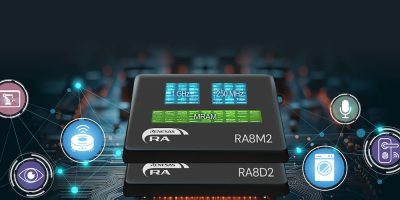
Renesas has introduced the RA8M2 and RA8D2 microcontroller (MCU) groups. Based on a 1 GHz Arm Cortex-M85 processor with an optional 250 MHz Arm Cortex-M33 processor, the new MCUs are the latest Renesas offerings to deliver an unmatched 7300 Coremarks of raw compute performance, the industry benchmark for MCUs. The optional Cortex-M33 processor enables efficient system partitioning and task segregation.

Both RA8D2 and RA8M2 devices are ultra-high performance MCUs as part of the second generation of the RA8 Series – the RA8M2 are general-purpose devices, and the RA8D2 MCUs are packed with a variety of high-end graphics peripherals. They are built on the same high-speed, low-power 22-nm ULL process used for the RA8P1 and RA8T2 devices introduced earlier this year. The devices include single and dual core options, and a specialised feature set to address the needs of a broad base of compute intensive applications. They take advantage of the high performance of the Arm Cortex-M85 processor and Arm’s Helium technology to offer a significant performance boost for digital signal processor (DSP) and machine learning (ML) implementations.

The RA8M2 and RA8D2 devices offer embedded MRAM that has several advantages over Flash technology – high endurance & data retention, faster writes, no erase needed, and byte addressable with lower leakage and manufacturing costs. SIP options with 4 or 8 MB of external flash in a single package are also available for more demanding applications. Both the RA8M2 and RA8D2 MCUs include Gigabit Ethernet interfaces and a 2-port TSN switch to address industrial networking use cases.

Both of the MCU Groups provide a combination of the performance of the Cortex-M85 core, together with large memory and a rich peripheral set, making them particularly suitable for a wide range of IoT and industrial use cases. The lower power CM33 core can act as a housekeeping MCU, executing system tasks while the high performance CM85 core stays in sleep mode, to be woken up only as needed for high compute tasks, thus lowering the system power consumption.

The new RA8M2 and RA8D2 Group MCUs are supported by Renesas’ Flexible Software Package (FSP). The FSP enables faster application development by providing all the infrastructure software needed, including multiple RTOS, BSP, peripheral drivers, middleware, connectivity, networking, and security stacks as well as reference software to build complex AI, motor control and cloud solutions. It allows customers to integrate their own legacy code and choice of RTOS (FreeRTOS and Azure RTOS) with FSP, thus providing full flexibility in application development. In addition, Zephyr support is now included. Using the FSP will ease migration of existing designs to the new RA8 Series devices.

www.renesas.com/RA8M2

www.renesas.com/RA8D2

> Read More

Microchip adds single-chip wireless platform designed for advanced connectivity

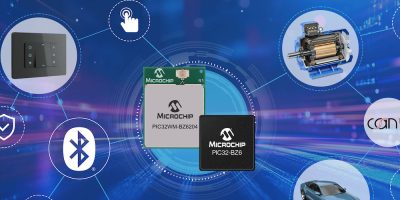
Microchip has released the highly integrated PIC32-BZ6 MCU that serves as a common, single-chip platform to reduce development cost, complexity and time-to-market for multi-protocol products featuring advanced connectivity and scalability.

RF design for smart devices has become increasingly complex, and wireless solutions typically require multiple chips to add new features or frequent redesigns to support evolving industry standards. The PIC32-BZ6 MCU replaces these multi-chip solutions and reduces the redesign burden with a single, highly integrated chip that removes the complexity of multi-protocol wired and wireless connectivity. The MCU also includes analog peripherals to simplify motor control development, along with touch and graphics capabilities for advanced user interfaces and enhanced memory to support complex applications, heavy workloads and Over the Air (OTA) firmware updates.

The PIC32-BZ6 MCU platform streamlines development of products in the smart home and for automotive connectivity, industrial automation and wireless motor control use cases. Key features include:

• High memory and scalable package choices to support demanding applications and OTA updates: The high-performance MCU includes 2 MB Flash memory and 512 KB RAM and is available in 132-pin ICs and modules with additional pin and package variants planned.
• Multi-protocol wireless networking: Qualified against Bluetooth Core Specification 6.0, the device also supports 802.15.4-based protocols such as Thread and Matter plus proprietary smart-home mesh networking protocols.
• Design flexibility that extends product options and scaling opportunities: Versatile and comprehensive selection of on-chip peripherals goes beyond wireless connectivity and OTA updates to support:
o Wired connectivity: Multiple interfaces include two CAN-FD ports for automotive and industrial communication, a 10/100 Mbps Ethernet MAC for high-speed wired connectivity and a USB 2.0 full-speed transceiver for seamless data transfer and PC integration.
o Touch and graphics: Incorporates peripherals that enable advanced user interfaces including Capacitive Voltage Divider (CVD)-based touch capabilities with up to 18 channels.
o Motor control: Simplifies system development through advanced analog peripherals such as 12-bit ADCs, 7-bit DAC, analog comparators, PWMs and QEI for precise motor position and speed control.
• Security by design to protect applications and IP: Includes immutable secure boot in ROM and an advanced on-board hardware-based security engine supporting AES, SHA, ECC and TRNG encryption.
• Reliability in harsh environments: The device is qualified to AEC-Q100 Grade 1 (125 °C) specifications for automotive and industrial environments.

Development Tools
Microchip simplifies development and product certification for the PIC32-BZ6 MCU by offering proven chip-down reference designs and wireless design check services, helping to minimise design risk. To further ease regulatory compliance, pre-certified modules are available in multiple regions worldwide. The PIC32-BZ6 MCU family is supported by the PIC32-BZ6 Curiosity Board that enables testing of all MCU I/Os, connectivity and peripheral features. Developers also benefit from a comprehensive development environment through Microchip’s MPLAB® Integrated Development Environment (IDE) and the Zephyr® Real Time Operating System (RTOS).

microchip.com

> Read More

About Smart Cities

This news story is brought to you by smartcitieselectronics.com, the specialist site dedicated to delivering information about what’s new in the Smart City Electronics industry, with daily news updates, new products and industry news. To stay up-to-date, register to receive our weekly newsletters and keep yourself informed on the latest technology news and new products from around the globe. Simply click this link to register here: Smart Cities Registration