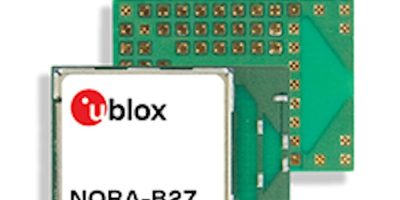
u-blox introduces the NORA-B27 Bluetooth LE module

u-blox has introduced the NORA-B27, the latest addition to their NORA-B2 family of Bluetooth Low Energy modules. Designed with u-connectXpress for scalability and ease of integration, the NORA-B27 provides a cost-optimised solution ideal for battery-powered, high-volume IoT applications such as sensor hubs, beacons, cable-replacement links, and mobile device companions.

Built on Nordic Semiconductor’s nRF54L05 chipset and pre-flashed with u-blox u-connectXpress software, the NORA-B27 streamlines wireless integration through a familiar AT-command interface—minimising the need for deep Bluetooth expertise. This enables faster prototyping and time-to-market while maintaining performance, security, and low power consumption.

Qualified against Bluetooth Core 6.0 and for industrial temperature ranges from −40 °C to +85 °C, the NORA-B27 delivers stable and secure connectivity in demanding environments across diverse markets, including industrial automation, smart buildings, healthcare, and asset tracking.

u-blox.com

> Read More

NXP improves battery health monitoring with EIS capable battery management chipset

NXP Semiconductors has announced its industry-first Electrochemical Impedance Spectroscopy (EIS) battery management chipset with hardware-based nanosecond-level synchronisation of all devices. The new system solution is designed to enhance safety, longevity, and performance in electric vehicles and energy storage systems. It integrates EIS measurement directly into three battery management system (BMS) chipset units, enabling carmakers to gain deeper insights into battery health and behaviour.

OEMs today face increasing pressure to deliver safe and faster charging, longer battery life, and safer battery energy storage systems – all while keeping costs and design complexity in check. Traditional, software-based battery monitoring methods often struggle to precisely detect dynamic, millisecond level events that serve as early indicators of failure. To ensure safe and fast charging, these systems frequently require additional sensors and software.

NXP’s new chipset tackles these challenges by embedding EIS directly into the hardware, consisting of three BMS units: the BMA7418 cell sensing device, the BMA6402 gateway, and the BMA8420 battery junction box controller. It enables real-time, high-frequency monitoring without the need for extra components or costly redesigns. The hardware-based solution operates in highly precise synchronisation to deliver highly accurate impedance measurements with directly in-chip integrated discrete Fourier transformation, helping OEMs better manage safe and fast charging, detect early signs of battery failure, and reduce system complexity.

“The EIS solution brings a powerful lab-grade diagnostic tool into the vehicle. It simplifies system design by reducing the need for additional temperature sensors and supports the shift toward faster, safer and more reliable charging without compromising battery health”, said Naomi Smit, VP and GM, Drivers and Energy System at NXP. “The chipset also offers a low-barrier upgrade path, with pin-to-pin compatible packages that can be directly upgraded to on cell module and battery junction box control units.”

The technology of Electrochemical Impedance Spectroscopy is based on sending controlled electrical excitation signals through the entire battery. NXP’s system solution includes an electrical excitation signal generator, which both pre-charges the high-voltage circuit and produces the excitation signal. This setup allows the DC link capacitors to act as a secondary energy storage—alongside the battery—making the excitation process more energy efficient.

By measuring how the cells respond across different frequencies to the current excitation, the responses reveal subtle changes in the cell’s internal condition, such as temperature gradients, ageing effects, or micro short circuits. Unlike traditional time-based measurements, EIS provides a fast and reliable way to assess the impedance of each cell and distinguish from capacity fade, to estimate battery health even during dynamic conditions like charging or load shifts.

https://www.nxp.com

> Read More

POLYN Technology announces first silicon-implemented NASP chip

POLYN Technology has announced the successful manufacturing and testing of the world’s first silicon-proven implementation of its unique NASP (Neuromorphic Analog Signal Processing) technology.

The NASP platform employs trained neural networks in the analog domain to perform AI inference with much lower power consumption than conventional digital neural processors.

NASP chips with AI cores process sensor signals in their native analog form in microseconds, using microwatt-level power and eliminating all overhead associated with digital operations. This is ideal for always-on edge devices. Application-specific NASP chips can be designed for a diverse range of edge AI applications, including audio, vibration, wearable, robotics, industrial, and automotive sensing.

NASP technology and POLYN’ design tools automatically convert trained digital neural network models into ultra-low-power analog neuromorphic cores ready for manufacturing in standard CMOS processes. The testing confirmed the chip’s parameters strictly match its model.

This first chip contains a VAD core for real-time voice activity detection. It marks the first step toward a new level of voice processing offered by POLYN. It will be followed by other cores POLYN is developing for speaker recognition and voice extraction, enhancing home appliances, critical communications headsets, and other voice-controlled devices.

Customers developing products with ultra-low power voice control can apply online for the NASP VAD chip evaluation kit.

POLYN’s NASP technology and design tools give semiconductor and AI developers a new way to quickly implement neural networks directly in analog silicon. It offers process-agnostic design across 40–90 nm CMOS nodes and automatic conversion from digital ML models.

POLYN is preparing evaluation kits for early adopters and extending the implementation of its NASP product families for automotive, critical communication, and wearable applications.

polyn.ai

> Read More

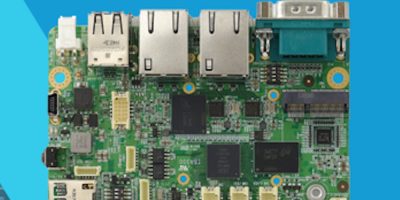
Compact IBR300 2.5″ SBC Powered by NXP i.MX 93 from IBASE

IBASE Technology has announced the release of the IBR300, a 2.5-inch RISC-based single board computer (SBC) powered by the NXP i.MX 93 processor with dual-core ARM Cortex-A55 (up to 1.7 GHz) and a Cortex-M33 MCU. Designed for embedded and industrial edge deployments, the IBR300 delivers powerful processing and real-time control in a compact, low-power form factor optimised for space-constrained systems.

Featuring 2 GB LPDDR4 memory, 32 GB eMMC storage, and an SD socket for easy expansion, the IBR300 provides a complete embedded solution for space-constrained applications. A comprehensive set of industrial-grade I/O interfaces, including an M.2 E-Key (2230) slot for WiFi/Bluetooth modules, ensures flexible connectivity for factory automation, smart retail, machine control, and IoT gateway deployments. Most notably, the IBR300 supports a wide operating temperature range from -40 °C to +85 °C, delivering stable and reliable performance in harsh or fanless environments while minimising maintenance and integration complexity.

www.ibase.com.tw

> Read More

About Smart Cities

This news story is brought to you by smartcitieselectronics.com, the specialist site dedicated to delivering information about what’s new in the Smart City Electronics industry, with daily news updates, new products and industry news. To stay up-to-date, register to receive our weekly newsletters and keep yourself informed on the latest technology news and new products from around the globe. Simply click this link to register here: Smart Cities Registration