

ST launches three-in-one motion sensor for industrial IoT applications

ST has revealed the ISM6HG256X, a tiny three-in-one motion sensor for data-hungry industrial IoT applications, serving as an additional catalyst for edge AI advancement. This smart IMU sensor uniquely combines simultaneous detection of low-g (±16g) and high-g (±256g) accelerations with a high performance and stable gyroscope within a single compact package, ensuring no critical event—from subtle motion or vibrations to severe shocks—is ever missed.

The ISM6HG256X addresses the growing demand for reliable, high-performance sensors in industrial IoT applications such as asset tracking, worker safety wearables, condition monitoring, robotics, factory automation, and black box event recording. By integrating accelerometer with dual full-scale ranges, it eliminates the need for multiple sensors, simplifying system design and reducing overall complexity. Its embedded edge processing and self-configurability support real-time event detection and context-adaptive sensing, which are essential for long lasting asset tracking sensor nodes, wearable safety devices, continuous industrial equipment monitoring, and automated factory systems.

Edge AI is a crucial driver for ST’s MEMS activity as it boosts performance and efficiency by enabling real-time data processing on the device, reducing latency and energy use. It enhances privacy and security through local data handling, limits reliance on external processing, and provides scalability and flexibility for various applications. Additionally, edge AI supports innovative uses like advanced sensing and IoT integration, aligning with growing demand for smart, connected devices.

The ISM6HG256X contains the unique machine-learning core (MLC) and finite state machine (FSM), together with adaptive self-configuration (ASC) and sensor fusion low power (SFLP). These features bring edge AI directly into the sensor to autonomously classify detected events, ensuring real-time, low-latency performance and ultra-low system power consumption. This embedded technology can reconstruct signal dynamics to provide high-fidelity motion tracking. Thanks to the embedded SFLP algorithm, also 3D orientation tracking is possible with just few µA of current consumption.

ST’s new X-NUCLEO-IKS5A1 industrial expansion board with MEMS Studio design environment and software libraries, X-CUBE-MEMS1, are available to assist developers, helping implement functions including high-g and low-g fusion, sensor fusion, context awareness, asset tracking, and calibration.

www.st.com

> Read More

Microchip unveils MCP server to power AI-driven product data access

Microchip has announced the launch of its Model Context Protocol (MCP) Server. An AI interface, the MCP Server connects directly with compatible AI tools and large language models (LLMs) to provide the context these systems need to answer questions. Through simple conversational queries, the MCP Server enables users to retrieve verified, up to date Microchip public data, including product specifications, datasheets, inventory, pricing and lead times.

Built on MCP streamable HTTP standards, the server delivers context-aware and JSON-encoded responses optimised for AI clients such as Copilots, AI chatbots, LLM-based IDEs and enterprise AI agents. The platform supports a wide range of applications and integrates Microchip public data directly into development environments and intelligent assistants.

“The launch of our MCP Server is another example of how Microchip is leaning into AI and providing AI-based tools that help make life easier for our customers,” said Rich Simoncic, chief operating officer for Microchip Technology. “We’re dedicated to harnessing the power of AI to boost productivity and drive innovation. By enabling instant access to verified product information within the AI platforms developers already rely on, we’re removing barriers and making it easier to design with Microchip solutions.”

By combining reliable technical and sourcing information, the MCP Server can enhance design productivity, streamline automation and empower engineers to develop faster and make more informed decisions.

microchip.com

> Read More

Next-Generation of optical ethernet PHY transceivers from Microchip

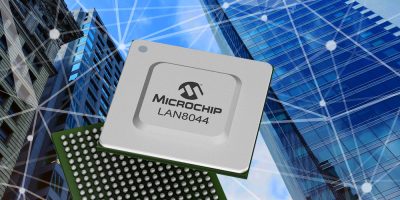
The rise of smart factories, remote monitoring and connected infrastructure are increasing the demand for advanced networking systems that can operate over long distances and in challenging environments. To address the need for reliable and secure connectivity solutions, Microchip has announced its new portfolio of Optical Ethernet PHY transceivers, available in 25 Gbps and 10 Gbps versions, featuring IEEE 1588 Precision Time Protocol (PTP) and Media Access Control Security (MACsec) encryption.

Microchip’s optical Ethernet PHY transceivers provide a secure, deterministic and scalable alternative to traditional copper-based Ethernet solutions. They support link lengths of up to 10 kilometres over single-mode fibre for seamless deployments over dispersed infrastructure such as company and college campuses or warehouses. The integration of PTP time stamping delivers sub-nanosecond (<1ns) synchronisation accuracy across distributed nodes. This level of timing precision is essential for time-sensitive applications such as industrial automation, telecommunications and robotics.

“Design engineers are looking for solutions that simplify complex networking systems, adding PTP or MACsec could mean a complete overhaul of an existing design, our solution helps preserve our customers’ core-processing investment,” said Charlie Forni, corporate vice president of Microchip’s networking and connectivity solutions business. “We’ve integrated these capabilities into our transceivers, enabling bolt-on functionality to help engineers build smarter, more secure and scalable networks.”

The new variants support Ethernet speeds ranging from 1 Gbps to 25 Gbps, enabling higher bandwidth for data-intensive applications such as data centers, campus area networks, and robotic / industrial automation. Designers can easily scale their networks by selecting the appropriate data rate and media (Optical or DAC – Direct Attach Copper) to match their application requirements.

To help safeguard sensitive data in connected environments, security is integrated at the silicon level with support for MACsec (IEEE 802.1AE) encryption. This hardware-based implementation protects against network data breaches by encrypting traffic between Ethernet devices. MACsec is designed to thwart common cyberattacks including man-in-the-middle attacks, denial-of-service (DoS), eavesdropping and spoofing, to ensure data integrity across the network.

microchip.com

> Read More

Rutronik expands its wireless portfolio with Wi-Fi 7 solutions from Intel

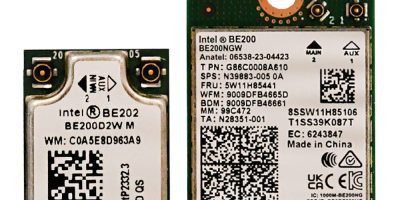
Rutronik is offering two solutions for modern, high-speed wireless communications with the Intel Wi-Fi 7 modules BE200 and BE202. Thanks to their support for the latest IEEE 802.11be standard (Wi-Fi 7), they enable data rates of up to 5.8 Gbit / s, particularly low latencies and stable connections – even when multiple frequency bands are used in parallel. The modules are ideal for networked applications in industry, medicine, transportation and consumer electronics.

The Intel BE200 and BE202 modules mark the next step in the evolution of wireless data transmission. Based on the Wi-Fi 7 standard (IEEE 802.11be), they offer extremely high bandwidths and deterministic latency, making them the ideal choice for all applications where speed and reliability are critical.

The BE200 module achieves transfer rates of up to 5.8 Gbit / s, while the BE202 module is designed for data rates of up to 2.4 Mbit / s. Both modules feature a channel bandwidth of 320 MHz, 4K QAM modulation and multi-link operation (MLO) capability, allowing two frequency bands to be used simultaneously, which can improve connection quality.

With frequency bands of 2.4 GHz, 5 GHz and 6 GHz, 2 x 2 TX/RX streams and integrated Bluetooth 5.4, the BE200 and BE202 series combine high performance with flexible integration. They are available as both a pluggable M.2 2230 version and a solderable M.2 1216 variant and support Windows 10, Windows 11 and Linux.

Maximum security is ensured by WPA3 encryption, which also guarantees a high level of protection in critical industrial or medical applications. Combined with their energy efficiency and compatibility with existing platforms, the modules offer an ideal solution for current and future IIoT, transport and smart device designs

rutronik.com

> Read More

About Smart Cities

This news story is brought to you by smartcitieselectronics.com, the specialist site dedicated to delivering information about what’s new in the Smart City Electronics industry, with daily news updates, new products and industry news. To stay up-to-date, register to receive our weekly newsletters and keep yourself informed on the latest technology news and new products from around the globe. Simply click this link to register here: Smart Cities Registration